

ECN vs STP vs Market Maker Broker: Full Difference Explained
ECN vs STP vs market maker brokers compared, with real broker examples and a trader-style decision guide.
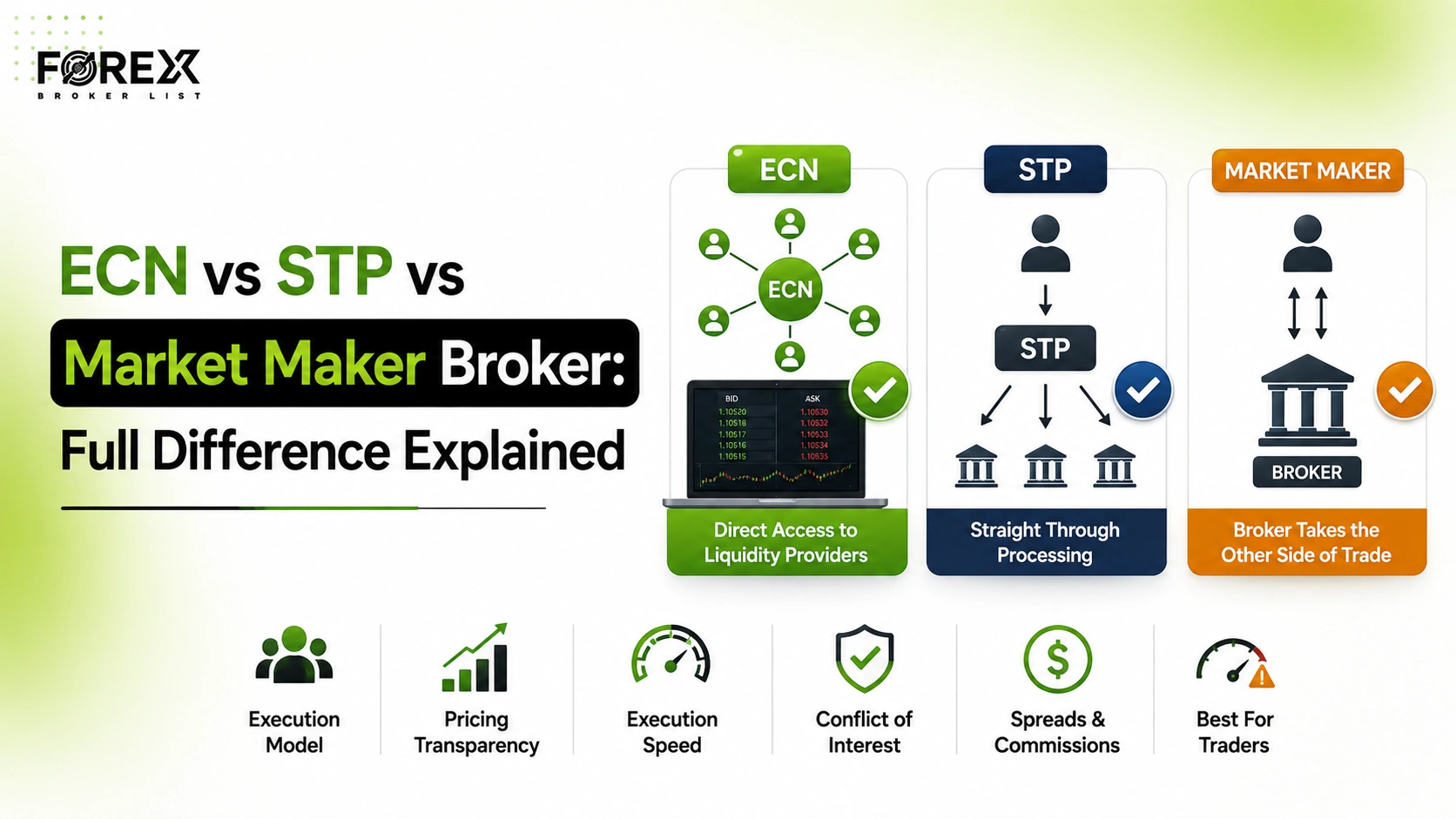
ECN, STP, and market maker are the three main forex broker execution models. ECN brokers match orders directly with other market participants for a commission. STP brokers route orders to external liquidity providers, often with a spread markup. Market maker brokers create an internal market and can take the opposite side of your trade.
Key Takeaways
-
ECN brokers offer the most transparent pricing but usually charge a separate commission per trade
-
STP brokers route orders externally without a dealing desk, sitting between ECN and market maker models
-
Market maker brokers can take the opposite side of your trade, creating a structural conflict of interest, though regulation limits how this can be exploited
-
Execution speed generally ranks ECN fastest, STP close behind, market maker slowest
-
Your broker's real execution model is usually disclosed in its order execution policy, not just its marketing page
What Is an ECN Broker?
ECN stands for Electronic Communication Network. A true ECN broker connects your order directly to a network of liquidity providers, including banks, hedge funds, and other traders, and matches it at the best available price in that pool. There is no dealing desk standing between you and the market, and the broker earns through a flat commission per lot rather than by marking up the spread.
Because pricing comes straight from the liquidity pool, ECN spreads can compress to near-zero during active market hours, particularly on major pairs like EUR/USD. This is what the term true ECN broker refers to, as opposed to brokers that use ECN in their marketing while actually running a hybrid or STP-style setup behind the scenes. You can browse providers specifically built around this model in our ECN broker category.
What Is an STP Broker?
STP stands for Straight Through Processing. An STP broker also has no dealing desk, meaning it does not manually intervene in your trade or take the opposite side, but it routes your order through its own liquidity provider relationships rather than an open network. The broker may apply a small markup to the raw spread it receives, which becomes its main source of revenue instead of a separate commission line.
STP broker meaning in practice sits between ECN and market maker models: you get external, automated execution without the conflict of interest a dealing desk creates, but pricing transparency depends on how many liquidity providers the broker connects to and how much markup it applies. You can compare providers built on this model in our STP broker category.
What Is a Market Maker Broker?
A market maker forex broker creates its own internal market instead of routing orders externally. It continuously quotes both a buy and sell price and can fill your order directly, sometimes taking the opposite side of your trade itself. This is also called a dealing desk model, and it is the origin of the broader dealing desk vs no dealing desk distinction used across the industry.
Market makers typically offer fixed spreads and near-instant execution, since they are not waiting on external liquidity confirmation. The tradeoff is the conflict-of-interest structure: because the broker can profit when a client loses, regulators require clear disclosure of this model and impose rules around fair execution. You can see providers using this structure in our market maker broker category.
Execution Speed and Slippage Compared
Execution speed generally follows a consistent order across all three models. ECN execution is typically fastest, since orders are matched automatically within a deep liquidity network with no manual step. STP execution is close behind, still automated but passing through the broker's own routing layer first. Market maker execution can be marginally slower in practice, particularly during high volatility, since the broker's internal pricing engine has to process the quote itself.
Slippage, the difference between your requested price and your actual fill price, occurs across all three models but shows up differently. ECN and STP brokers experience slippage as a natural function of market movement between order placement and execution, and it can be positive or negative. Market maker brokers are more associated with requotes, where the broker rejects your requested price and offers a new one, though modern regulation has reduced how often this happens at well-regulated firms.
Cost Structure: Commission vs Spread Markup
The three models earn money in structurally different ways, and understanding this changes how you evaluate a broker's true cost.
ECN brokers typically charge a flat commission, commonly in the $3 to $7 range per standard lot round turn, on top of a raw spread that can be close to 0.0 pips during liquid hours. Your total cost is transparent because the commission is stated separately from the price.
STP brokers usually fold their cost into the spread itself, quoting something like 1.0 to 1.5 pips on EUR/USD with no separate commission line. The all-in cost can end up similar to an ECN account, but it is less visible since it is baked into the price rather than itemized.
Market maker brokers almost always use a spread-only model too, often with fixed spreads that do not widen during news events the way ECN and STP spreads can. This predictability is genuinely useful for some traders, but it usually comes at the cost of a wider baseline spread than a raw ECN feed offers.
Which Model Has the Least Conflict of Interest?
ECN and STP models are both considered no dealing desk (NDD) execution, meaning the broker is not taking the other side of your trade and profits the same way regardless of whether you win or lose. This structurally removes the most direct conflict of interest.
Market maker models carry the conflict by design, since the broker can be your direct counterparty. This does not mean every market maker is acting against its clients. Regulated market makers are legally required to provide fair execution and are supervised specifically because of this conflict, and many operate honestly within that framework for years. But the structural incentive is real, which is why traders who prioritize this specific concern tend to favor ECN or STP providers.
Real Broker Execution Model Comparison (Table)
| Broker | Execution Model | Spread Type | Commission |
|---|---|---|---|
| IC Markets (Raw Spread) | ECN/STP hybrid, true ECN pricing | Raw, from 0.0-0.1 pips | $3.50/lot/side |
| Pepperstone (Razor) | ECN-style, no dealing desk | Raw, from 0.0 pips | From $3.50/lot/side |
| XTB | STP, agency model | Spread-only, 0.5-0.9 pips | None |
| AvaTrade | Market maker, dealing desk | Fixed, from 0.9 pips | None |
Data sourced from IC Markets, Pepperstone, XTB, and AvaTrade official trading account pages. Confirm current terms directly with the broker before opening an account, as pricing structures can change.
How to Verify Your Broker's Real Execution Model (Checklist)
Marketing pages sometimes use terms loosely, so verifying the actual model takes a few concrete checks.
-
Read the order execution policy: Regulated brokers are required to publish this document, and it states explicitly whether the firm acts as principal (market maker) or agent (ECN/STP) on your trades.
-
Check whether spreads are fixed or variable: Fixed spreads that stay identical regardless of market volatility usually indicate a market maker model. Spreads that widen and narrow with liquidity usually indicate ECN or STP.
-
Look for a stated commission: A separate, itemized commission per lot is a strong signal of a true ECN account rather than a spread-only STP or market maker account.
-
Ask about requote frequency and policy: No dealing desk models rarely requote; if a broker's terms mention requotes as a normal occurrence, that leans toward a dealing desk setup.
-
Check the account type name. Brokers offering multiple account tiers often label them clearly, such as "Raw," "ECN," "Zero," "Standard," or "Fixed Spread," which map roughly to the models above.
Which Model Fits Your Trading Style? (Decision Table)
| Trader Profile | Best-Fit Model | Why |
|---|---|---|
| Scalper / high-frequency trader | ECN | Tightest raw spreads and fastest execution matter most when trading dozens of times a day |
| Day trader | ECN or STP | Both offer fast, transparent execution without dealing-desk conflict |
| Swing trader (days to weeks) | STP or market maker | Execution speed matters less; predictable, fixed costs can simplify planning |
| Beginner testing strategies | STP or market maker | Simpler cost structure (spread-only, no separate commission) is easier to track while learning |
| News/event trader | ECN | Spreads on market maker accounts often widen or restrict trading around high-impact news |
Conclusion
ECN, STP, and market maker models differ in exactly one core way: how your order gets from your screen to the market, and who is on the other side of it. ECN offers the most transparent, direct route at the cost of a separate commission. STP sits in the middle, routing externally without a dealing desk but folding cost into the spread. Market maker brokers create their own internal market, offering predictable fixed pricing alongside a structural conflict of interest that regulation exists specifically to manage. The right model depends less on which is universally "best" and more on your trading frequency, strategy, and how much you weigh execution transparency against pricing simplicity.
Disclaimer: This article is for informational and educational purposes only. It does not constitute financial or investment advice. Forex and CFD trading involves significant risk of loss and is not suitable for all investors. Always verify a broker's execution model and regulatory status directly through its official order execution policy before depositing funds.
Frequently Asked Questions
Dipak Dangodra | Financial Writer at Forex Broker List
I am Dipak Dangodra, a financial writer at Forex Broker List. I have published 200+ articles on forex broker reviews, trading platforms, spreads and commissions, and regulatory analysis using data from FCA, ASIC, and CySEC.
Related Blogs

Best Liquidity Providers for Forex Brokers (2026 Comparison)

 Your brand here