How to Choose the Best Forex Broker in 2026

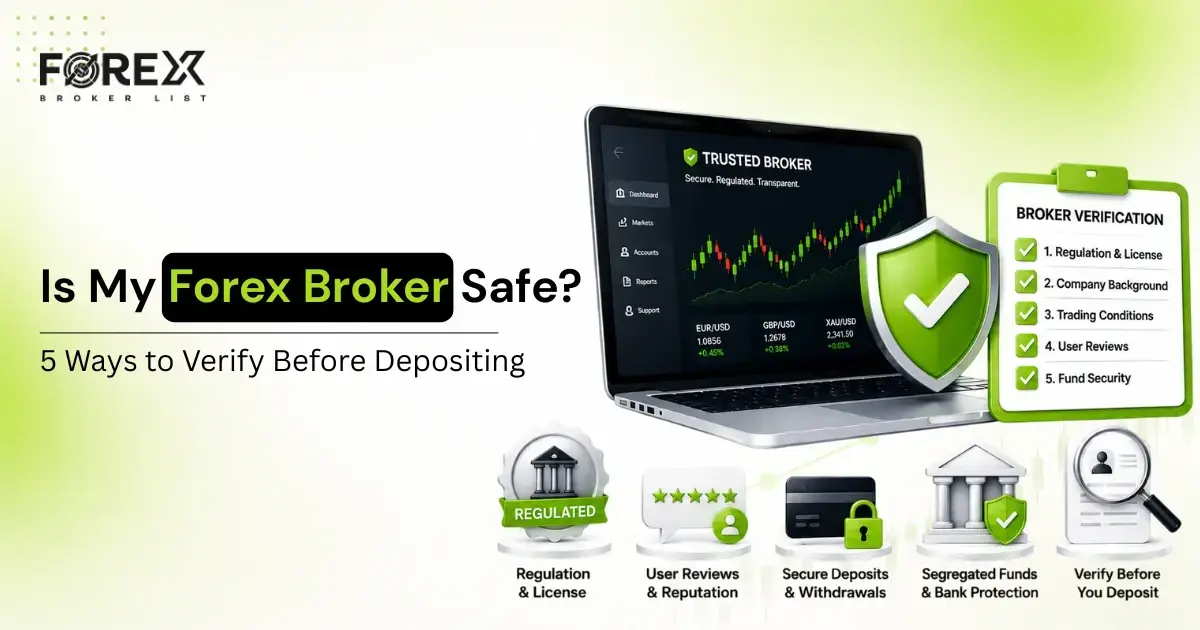
To choose a forex broker, verify regulation first (FCA, ASIC, or CySEC), then compare total trading costs including spread, commission, and overnight swap fees. Check the platform on a demo account before depositing. Prioritise brokers with segregated client funds, negative balance protection, and a clean regulatory record.

 How to Choose the Best Forex Broker in 2026

Quick Summary

  • Regulation is non-negotiable; only trade with brokers licensed by FCA, ASIC, CySEC, or NFA.
  • Total trading cost = spread + commission + swap fees combined, not just the headline spread
  • MT4, MT5, and cTrader are the three most widely supported platforms in 2026
  • Always open a demo account and test a small withdrawal before committing real capital.
  • Red flags include offshore-only licenses, withdrawal delays, and no named legal entity on the broker's website.
  • Use our forex broker directory to compare 750+ verified, regulated brokers by regulation, platform, and account type.

Step 1: Check Regulation Before Anything Else

Regulation is the single most important factor when choosing a forex broker. A regulated broker is legally required to segregate client funds from company operating capital, provide negative balance protection (under FCA, ASIC, and CySEC), submit to regular audits, and participate in compensation schemes where mandated.

A broker can be unregulated and still offer tight spreads and a polished platform. The difference only becomes clear when something goes wrong, a withdrawal is frozen, a broker faces insolvency, or client funds go missing. Without regulatory oversight, traders have no legal recourse and no compensation scheme to fall back on.

The four regulators that offer retail traders the strongest protection in 2026:

Regulator Jurisdiction Client Fund Protection Compensation Scheme
FCA United Kingdom Segregated accounts + negative balance protection FSCS up to £85,000
ASIC Australia Segregated accounts + negative balance protection None
CySEC Cyprus / EU Segregated accounts + negative balance protection ICF up to €20,000
NFA / CFTC United States Segregated accounts None

*Sources: FCA (fca.org.uk), ASIC (asic.gov.au), CySEC (cysec.gov.cy), NFA (nfa.futures.org). Last updated: June 2026. *

##How to Verify a Broker's Regulatory Status

Do not rely on the broker's own website to confirm regulation. Always check the official regulator register directly.

FCA (UK): Go to register.fca.org.uk. Search by firm name or Firm Reference Number (FRN). Confirm that the firm's status shows "Authorised" and that the permissions include "dealing in investments as principal" or "arranging deals in investments." The FRN listed on the broker's website must match the register exactly.

ASIC (Australia): Go to moneysmart.gov.au/check. Search the company name and confirm the Australian Financial Services (AFS) licence number. Cross-reference with the ASIC Registers at connectonline.asic.gov.au.

CySEC (Cyprus/EU): Go to cysec.gov.cy/en-GB/entities/investment-firms/cypriot/. The licensed CIFs list is publicly available. Confirm the Cyprus Investment Firm (CIF) licence number matches what the broker discloses.

Any broker that cannot be found on one of these registers, or that only holds a licence from an obscure offshore jurisdiction (Vanuatu, St. Vincent and the Grenadines, Belize), should be avoided before any funds are deposited.

Step 2: Understand the True Cost of Trading

Most beginner traders focus on the advertised spread. The spread is only one part of the total cost of trading, and for some account types, it is not even the largest part.

The three cost components every trader must understand:

Spread: The difference between the buy (ask) and sell (bid) price. On a standard EUR/USD trade, a 1.1 pip spread costs $11 per standard lot (100,000 units).

Commission: Charged on raw or ECN account types instead of a wider spread. A typical rate is $3.00–$7.00 per round lot (both sides combined). On a raw account with a 0.1 pip spread and a $7.00 commission, the total all-in cost per standard lot is $8.00 cheaper than a 1.1 pip standard account at $11.00.

Swap fees: Charged when a leveraged position is held overnight. A trader holding one standard lot of EUR/USD short for three nights at -$5.00 per night pays an additional $15.00 in swap costs. Swing traders and position traders should check swap rates before opening accounts, as these can quietly become the largest trading cost over time.

How to Calculate Your Real All-In Trading Cost

Use this formula to compare brokers accurately:

All-in cost per standard lot = (Spread in pips x $10) + Commission per round lot

Account Type Broker Example Spread (EUR/USD) Commission All-In Cost per Lot
Standard (spread-only) Pepperstone Standard 1.1 pips $0 $11.00
Raw / ECN (cTrader) IC Markets Raw cTrader 0.02 pips $6.00 $6.20
Raw / ECN (MT4/MT5) IC Markets Raw MT4 0.02 pips $7.00 $7.20
Razor (commission-based) Pepperstone Razor 0.10 pips $7.00 $8.00

Sources: ForexBrokers.com comparison, ICMarkets.com, Pepperstone.com. Last updated: June 2026.

For a trader placing 20 standard lots per month, the difference between an $11.00 all-in cost and a $6.20 all-in cost is $96 per month, $1,152 per year. Cost selection matters.

Step 3: Choose the Right Trading Platform

The trading platform is where every decision gets executed. A slow or unreliable platform during a high-volatility event, such as a central bank rate decision or a non-farm payrolls release, can turn a profitable setup into a losing trade through slippage or delayed order fills.

The four most widely used platforms across regulated brokers in 2026:

Platform Best For EA / Algo Support Mobile App Depth of Market
MetaTrader 4 (MT4) Forex-focused, EA traders Yes (Expert Advisors) Yes No
MetaTrader 5 (MT5) Multi-asset, more order types Yes Yes Yes
cTrader ECN traders, scalpers Yes (cBots) Yes Yes
TradingView Chart-first traders Limited Yes (browser) No

Data sourced from the broker's official platforms. Last updated: June 2026.

MT4 remains the industry standard for retail forex. Its Expert Advisor (EA) ecosystem is the largest of any platform, and almost every regulated broker supports it. For traders who run automated strategies, MT4 is still the most compatible choice.

MT5 adds more timeframes (21 vs. 9), more pending order types, and support for stocks and futures alongside forex. It is the better long-term choice for traders who plan to expand beyond currency pairs.

cTrader is preferred by ECN traders for its Level 2 depth-of-market display, transparent order execution, and clean interface. IC Markets and Pepperstone both offer cTrader alongside MT4/MT5.

TradingView integration has become a meaningful differentiator in 2026. Traders who have already built their analysis in TradingView can now execute directly through brokers that support the connection, without switching applications.

Choose the platform your strategy requires, not simply the one the broker promotes most heavily.

Step 4: Compare Account Types and Minimum Deposits

Account type determines your cost structure. The platform determines your execution environment. These two decisions shape more of your trading experience than any other factor after regulation.

Standard accounts bundle the broker's margin into the spread. No commission is charged per trade. Suitable for beginners and lower-frequency traders who prefer simpler cost tracking.

Raw or ECN accounts charge a per-lot commission and provide access to tighter, near-interbank spreads. Better for scalpers, day traders, and anyone trading more than 10 lots per month.

Islamic (swap-free) accounts replace overnight swap fees with an administrative fee structure for traders who require Sharia-compliant trading conditions. Available at Pepperstone, IC Markets, and AvaTrade. Here is how three regulated brokers compare across the key account and cost metrics:

Broker Min Deposit EUR/USD (Standard) EUR/USD All-In (Raw/ECN) Platforms Key Regulation
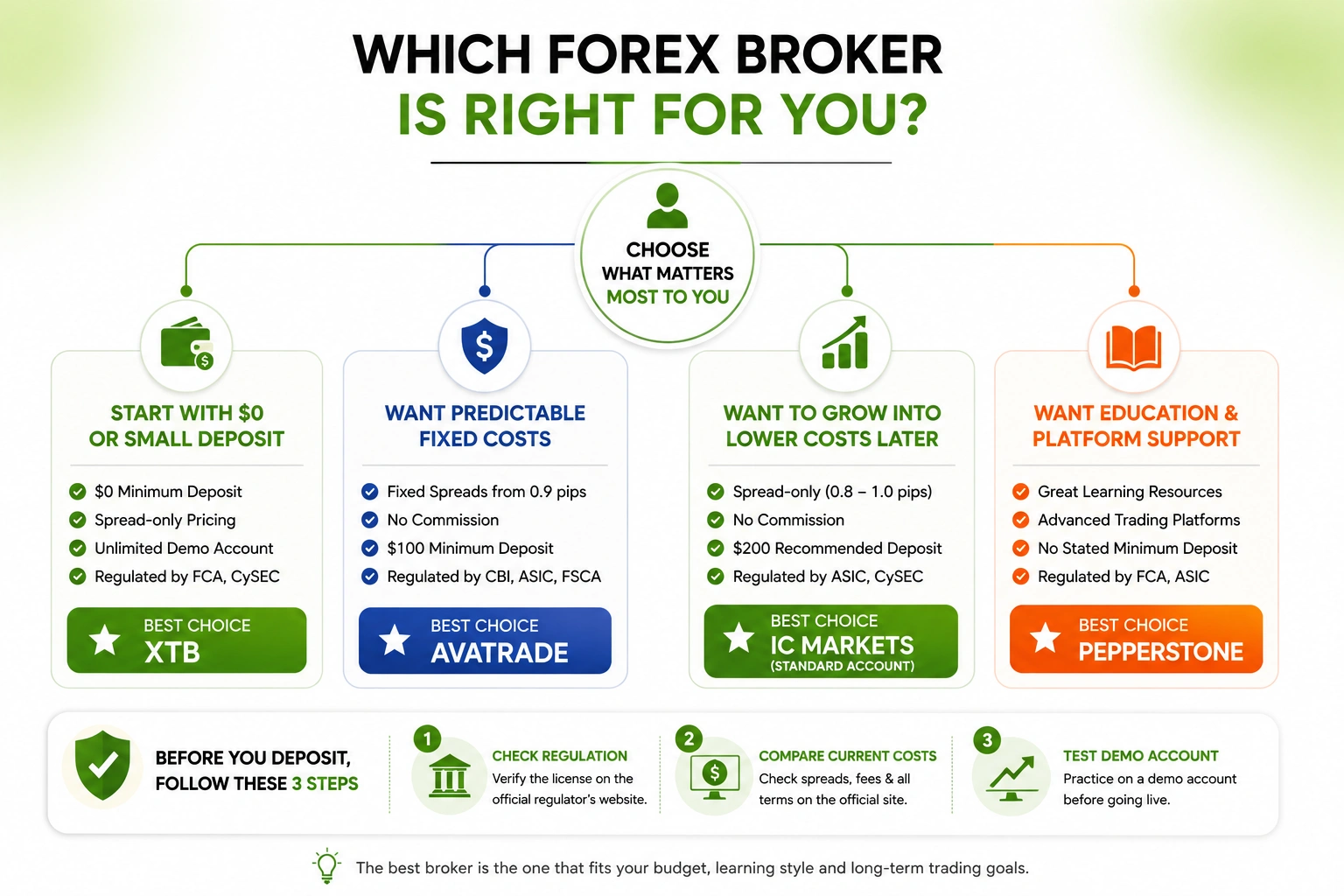
Pepperstone None 1.1 pips ~0.80 pips all-in (Razor) MT4, MT5, cTrader, TradingView FCA, ASIC, CySEC, BaFin
IC Markets $200 1.0 pip ~0.62 pips all-in (cTrader Raw) MT4, MT5, cTrader ASIC, CySEC
AvaTrade $100 0.9 pips N/A (no raw account) MT4, MT5, AvaTradeGO ASIC, CySEC, FSCA, others

Sources: Pepperstone.com, ICMarkets.com, AvaTrade.com, ForexBrokers.com. Last updated: June 2026.

Pepperstone requires no minimum deposit on any account type, making it accessible for traders starting with smaller capital (Source: Pepperstone.com, June 2026). IC Markets has a $200 minimum but offers the lowest all-in EUR/USD cost on its Raw cTrader account among widely used retail brokers (Source: ForexBrokers.com, 2026). See the full AvaTrade review for a detailed breakdown of its account structure and multi-jurisdiction regulation.

Step 5: Test the Broker Before Depositing Real Money

Opening a demo account costs nothing. Skipping this step costs traders real money every year.

A demo account lets you verify spread behaviour, order execution speed, and platform stability before any capital is at risk. The important test is not whether the platform works during quiet market hours, but whether execution holds up during volatility.

Test 1: Spread widening during a news event. Open a demo account and note the EUR/USD spread five minutes before a major release (NFP, CPI, FOMC). A quality-regulated broker widens spreads temporarily but returns to normal levels within seconds. A poor-quality broker widens spreads by 5–10x and holds them wide for minutes, preventing entries or inflating costs on existing positions.

Test 2 Small live withdrawal Deposit the minimum amount allowed and request a withdrawal immediately. A reliable broker processes it within 1–2 business days with no unexplained delays, fees beyond those disclosed, or requests for excessive documentation for a small amount. Withdrawal reliability is where brokers reveal their actual quality, not their marketing.

Test 3 Customer support Send a live chat message during active trading hours. Time the response. A broker worth using responds within 5 minutes with a substantive answer, not a scripted holding reply.

5-Point Broker Testing Checklist

  1. Demo account available with no time limit and realistic spreads
  2. Spreads on the demo account match the published live account averages
  3. Small withdrawal processed within 48 hours with no unexpected conditions
  4. Live chat support responds within 5 minutes during the London or New York session
  5. Regulatory status confirmed on FCA, ASIC, or CySEC register before any deposit is made

Complete all five before committing meaningful capital to any broker.

Step 6: Watch for Red Flags

A well-designed website and a competitive spread table do not make a broker safe. These are the warning signs that should stop any trader from depositing funds.

Offshore-only regulation: A broker regulated exclusively by the Seychelles FSA, Vanuatu VFSC, or Belize IFSC offers no meaningful client protection. These jurisdictions impose minimal capital requirements, no compensation schemes, and limited enforcement. Many legitimate brokers hold an offshore entity alongside a primary regulated entity;; the distinction is whether the regulated entity is the one actually holding your funds.

**No named legal entity: **Every regulated broker discloses its full legal entity name, registered address, and regulatory reference number at the bottom of its website. If this information is absent or vague, the broker should not be trusted with deposits.

Withdrawal delays or conditions: Legitimate brokers process withdrawals without requiring traders to reach a trading volume threshold, provide justification, or wait weeks. Any broker imposing such conditions on withdrawals is a red flag regardless of its claimed regulation.

Spreads that look too good to be true: A broker advertising 0.0 pip EUR/USD on a standard account with no commission is either subsidising acquisition costs or planning to widen spreads significantly during live conditions. Check independent spread data from sites like Myfxbook, which publishes live spread data from real broker accounts.

The Alpari UK lesson: In January 2015, Alpari UK, an FCA-regulated broker, went insolvent following the Swiss National Bank's removal of the EUR/CHF floor. Despite being regulated, client funds were temporarily inaccessible during administration proceedings. The FSCS compensation scheme covered eligible UK clients up to £50,000 at the time (now £85,000). Traders using unregulated offshore brokers in the same event had no compensation route whatsoever (Source: FCA, January 2015 statement). Regulation does not eliminate all risk, but it provides the only legal safety net available when a broker fails.

ESMA data from 2019 found that 74–89% of retail CFD trader accounts lose money (Source: ESMA, Retail Investor Protection, 2019). A broker that adds cost, slippage, or execution problems on top of normal market risk makes an already difficult environment worse.

Conclusion

Choosing a forex broker in 2026 comes down to four non-negotiable steps: verify regulation on the official register, calculate the true all-in cost of trading for your style, test the platform on a demo account through a live news event, and complete a small withdrawal before committing real capital.

The broker that looks best on a comparison table is not always the one that serves you best in live trading. Regulation keeps your funds protected. Low all-in costs preserve your edge. A reliable platform ensures your orders are executed as intended. And a tested withdrawal process confirms the broker operates honestly when money needs to move.

Browse our verified directory to filter forex brokers by regulation type, platform, and account category, and shortlist brokers that match your trading style and jurisdiction.

This article is for informational and educational purposes only. It does not constitute financial or investment advice. Forex and CFD trading involve significant risk of loss and are not suitable for all investors. Always verify a broker's regulatory status through official authorities such as FCA, ASIC, or CySEC before depositing funds.

About the Author

Dipak is a forex content analyst at ForexBrokerList.io, where he covers broker comparisons, trading platforms, regulation, and forex market education. He has researched and reviewed 150+ forex brokers using data from FCA, ASIC, CySEC, and official broker disclosures.

Frequently Asked Questions

Share: