

Minimum Deposit in Forex Trading: Broker-wise Comparison
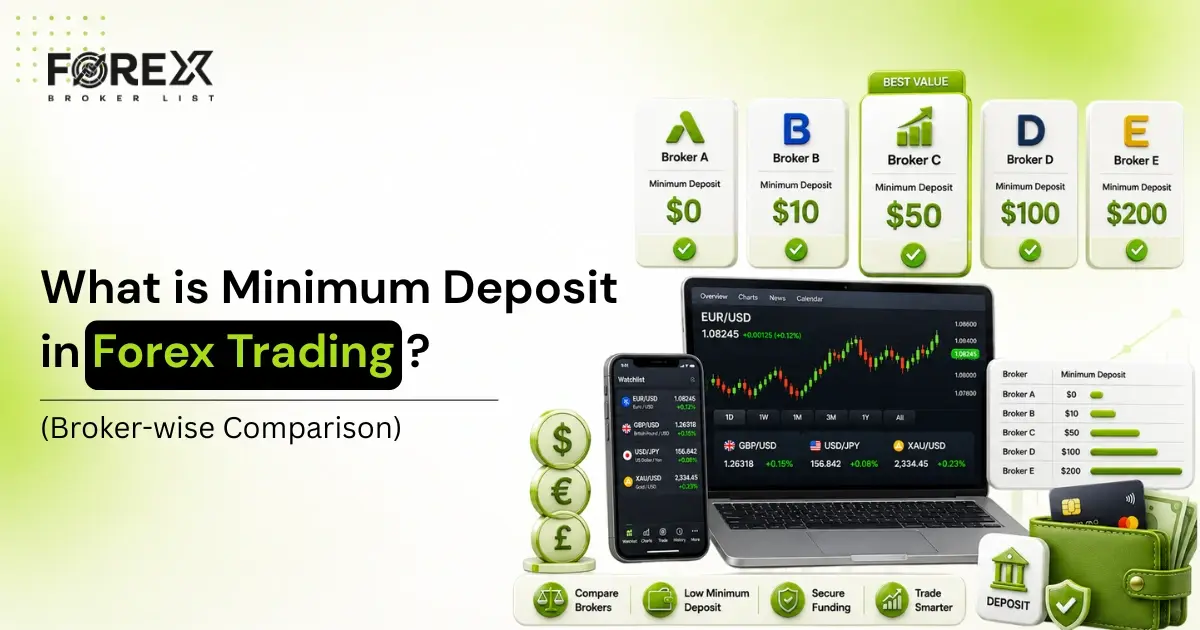
The minimum deposit in forex trading is the smallest amount a broker requires to open a live trading account. It ranges from $0 to $500 depending on the broker and account type. Most regulated brokers set minimums between $50 and $200. The minimum deposit is not the same as the recommended starting capital.
Quick Summary
- Forex broker minimum deposits range from $0 to $500, depending on the broker and account type.
- Cent and micro accounts typically require $1 to $10, making them suited for complete beginners.
- FCA- and ASIC-regulated brokers generally require higher minimums than offshore brokers.
- Depositing the bare minimum ($10 to $50) exposes you to margin calls and fast account blow-outs.
- Most experienced traders recommend starting with at least $200 to $500 for meaningful practice.
- Always check spreads, regulations, and platform quality, not just the deposit number.
Most beginner traders ask the same question before opening their first account: how much do I actually need to deposit? The answer depends on the broker, the account type, and most importantly, how much you need to trade without blowing your account in the first week. This guide breaks down minimum deposit requirements across top brokers in our forex broker directory, explains what different account types cost to open, and tells you what the minimum deposit figure does not tell you.
What Is Minimum Deposit in Forex Trading?
The minimum deposit in forex trading is the lowest amount of money a broker will accept to activate a live trading account. Below this threshold, the broker will not process your deposit or allow you to place trades.
Brokers set minimum deposits based on several factors: the account type offered, their operating costs, regulatory requirements, and the target client profile. A broker targeting institutional traders may set a $10,000 minimum. A broker targeting beginners may set $0 or $10.
The minimum deposit figure tells you the entry barrier. Nothing more. It does not tell you how much you need to trade profitably, how long your account will survive, or whether the broker is trustworthy.
Minimum Deposit vs Recommended Starting Capital
This distinction matters more than most beginners realise. A broker advertising a $10 minimum deposit means you can open an account with $10. It does not mean $10 is enough to trade forex without serious risk of losing everything immediately.
Here is a real example. With a $10 account and 1:100 leverage, your maximum position size on EUR/USD is 0.01 lots (a micro lot). A single pip movement on a micro lot is worth $0.10. A 50-pip loss (a normal daily range on EUR/USD) wipes out $5, or 50% of your account. Two such moves and your account is gone.
Most professional traders and risk management guidelines suggest starting with at least $200 to $500 to trade micro lots with a reasonable stop-loss buffer. Some traders recommend $1,000 for a Standard account. The $10 minimum exists because it is technically possible to place a trade, not because it is financially sensible.
Forex Broker Minimum Deposit Comparison (2026)
The table below shows minimum deposit requirements across major regulated brokers. All data sourced directly from brokers' official websites.
| Broker | Min Deposit | Account Type | Regulation | Platform |
|---|---|---|---|---|
| Exness | $10 | Standard | CySEC, FCA | MT4, MT5 |
| XM | $5 | Micro | CySEC, ASIC, IFSC | MT4, MT5 |
| Pepperstone | $0 | Razor / Standard | FCA, ASIC | MT4, MT5, cTrader |
| IC Markets | $200 | Raw Spread | ASIC, CySEC, SCB | MT4, MT5, cTrader |
| AvaTrade | $100 | Standard | ASIC, CySEC, FSCA | MT4, MT5 |
| Blueberry Markets | $100 | Standard | ASIC | MT4, MT5 |
| FXDD | $100 | Standard | MFSA | MT4, MT5 |
| Newera365 | $100 | Standard | Regulated | MT4, MT5 |
Data sourced from brokers' official websites. Last updated: June 2026.
A $0 minimum deposit (Pepperstone) means there is no stated barrier, but Pepperstone's internal systems typically process deposits from $1 upward, and their spreads on the Standard account are wider than the Razor account, which suits traders with larger capital. Browse the full 750+ broker listings to filter by minimum deposit, regulation, and platform.
Types of Forex Accounts and Their Minimum Deposits
Minimum deposit requirements vary significantly by account type. The same broker often offers multiple account tiers with different deposit thresholds, spreads, and commission structures.
Standard Account: The most common account type for retail traders. Minimum deposits typically range from $50 to $200. Spreads are wider (1.0 to 2.0 pips on EUR/USD), but there is no per-trade commission. Suited for beginners who want simplicity.
ECN / Raw Spread Account Direct market access with spreads from 0.0 pips but a commission per lot (typically $3 to $7 per lot per side). Minimum deposits are higher, usually $200 to $500. IC Markets Raw Spread account requires $200 (Source: IC Markets, June 2026). Suited for active traders who trade high volume.
Islamic / Swap-Free Account Available at most major brokers with no extra minimum deposit. Replaces overnight swap charges with an administration fee. Suited for traders who cannot earn or pay interest under Sharia law.
Demo Account: No deposit required. Virtual funds only. Most brokers offer unlimited demo access. Use it before committing real money.
Cent and Micro Accounts: Best for Small Deposits
Cent accounts are the lowest-barrier entry point in forex trading. XM offers a Micro account from $5 (Source: XM, June 2026). Exness offers cent account access from $10 (Source: Exness, June 2026).
On a cent account, your balance is denominated in cents rather than dollars. A $10 deposit becomes 1,000 cents. Position sizes are 100 times smaller than a Standard account. A 50-pip loss on a cent micro lot costs $0.05 rather than $5.
Cent accounts are useful for one specific purpose: getting used to placing real trades with real money without catastrophic loss risk. They are not useful for building meaningful profit because the position sizes are too small. Once you understand how to manage trades, positions, and emotions, move to a Standard account with proper capital.
Does Regulation Affect Minimum Deposit?
Yes, regulation has a direct impact on minimum deposit requirements, and understanding why it helps you evaluate brokers more accurately.
Brokers regulated by top-tier authorities, including FCA (UK), ASIC (Australia), and CySEC (Cyprus/EU), operate under strict client fund protection rules. These include client money segregation (your funds are held separately from the broker's operating funds), negative balance protection (you cannot lose more than your deposit), and compensation scheme membership. In the UK, the Financial Services Compensation Scheme (FSCS) protects client funds up to £85,000 per person if an FCA-regulated broker becomes insolvent (Source: FCA, June 2026).
Meeting these regulatory requirements costs money. Compliance teams, audits, reporting systems, and compensation scheme contributions all add to a regulated broker's operating costs. Some of those costs are reflected in higher minimum deposits.
Offshore brokers regulated in jurisdictions like SVG (St Vincent and the Grenadines), Vanuatu, or Belize face far lower compliance costs. This is partly why many offshorebrokers advertise $1 or $0 minimum deposits. The lower barrier is real. The lower protection is also real.
This does not mean every offshore broker is a scam. It means the protections you rely on if something goes wrong are significantly weaker. For beginners putting real money into a first account, regulation quality matters more than deposit size.
How Much Money Do You Actually Need to Start Forex Trading?
The minimum deposit and the recommended starting capital are two different numbers. Most beginners conflate them, and it costs them their first account.
Here is a practical framework based on account type:
Cent / Micro Account ($10 to $50) Suitable only for learning trade mechanics. Expect no meaningful profit. The maximum value is building emotional discipline around real money. Treat this as an extended demo.
Standard Account: Beginner Level ($200 to $500). With $200 and micro lot trading (0.01 lots), you have enough buffer to absorb 20 to 30 losing trades of 10 pips each before your account is at risk. This is the realistic minimum for learning with a real safety buffer.
Standard Account: Intermediate Level ($500 to $1,000) gives you room to follow proper position sizing (risk 1% to 2% per trade), use reasonable stop-losses of 20 to 50 pips, and survive a normal losing streak without margin pressure.
A common mistake in 2015, when the Swiss National Bank removed the CHF cap, and EUR/CHF dropped 1,800 pips in minutes, was that traders with under-capitalised accounts were wiped out and pushed into negative balances before stops could execute. Many brokers subsequently absorbed those losses, but not all. Proper capitalisation and negative balance protection from a regulated broker are the two defences against events like this.
For more guidance on managing risk as a beginner, visit the forex trading blog for practical guides on position sizing and account management.
Which Forex Broker Has the Lowest Minimum Deposit?
Several brokers offer very low or zero minimum deposits. The key ones as of June 2026:
-Pepperstone: $0 stated minimum (Standard and Razor accounts). FCA and ASIC regulated.
-XM: $5 minimum on a Micro account. CySEC and ASIC regulated.
-Exness: $10 minimum on Standard account. FCA and CySEC regulated.
These three brokers combine low entry barriers with credible top-tier regulation, a combination that is less common than it appears. Most brokers with $0 to $5 minimums are offshore-regulated, which increases counterparty risk.
One practical note: Pepperstone's $0 minimum does not mean you can trade with $0. Their minimum transaction size and margin requirements still apply. In practice, you need at least $50 to $100 to place a single micro lot trade with a reasonable stop-loss on a Pepperstone Standard account.
What to Look for Beyond the Minimum Deposit
The minimum deposit amount is one of the least important factors when choosing a forex broker. Here is what actually matters:
Regulation: Always verify a broker's regulatory status through the official FCA register (register.fca.org.uk), ASIC register (asic.gov.au), or CySEC register (cysec.gov.cy) before depositing. A broker claiming FCA regulation is not the same as a broker appearing on the FCA register.
Spreads and Commission: A $0 minimum deposit means nothing if spreads are 3.0 pips on EUR/USD. At 3.0 pips, you pay $30 per standard lot just to enter a trade. IC Markets Raw Spread account averages 0.1 pips on EUR/USD with a $3.50 commission per lot per side (Source: IC Markets, June 2026), a total entry cost of $4.50 vs $30 at a wide-spread broker.
Platforms MT4 and MT5 are the industry standard. cTrader is preferred by ECN traders. Avoid brokers with proprietary-only platforms unless you have researched them thoroughly.
Leverage FCA-regulated brokers cap retail leverage at 1:30 on major pairs (Source: FCA, June 2026). Higher leverage is available from offshore brokers, but higher leverage amplifies losses as much as gains.
Withdrawal Speed and Method: Check withdrawal processing times and fees before depositing. A broker that takes 5 to 10 business days to process withdrawals or charges a $25 wire fee on small accounts is a practical problem regardless of their minimum deposit.
Conclusion
The minimum deposit in forex trading ranges from $0 to $500 across major brokers. Cent and micro accounts let you start with as little as $5 to $10, but depositing the bare minimum exposes you to fast losses through margin pressure and over-leveraged positions. A realistic starting capital for a Standard account is $200 to $500. Regulation quality, spreads, and platform reliability matter more than the deposit barrier when selecting a broker.
Risk Disclaimer: This article is for informational and educational purposes only. It does not constitute financial or investment advice. Forex and CFD trading involve significant risk of loss and are not suitable for all investors. Always verify a broker's regulatory status through official authorities such as FCA, ASIC, or CySEC before depositing funds.
About the Author [Author Name] is a forex content analyst at ForexBrokerList.io, where he covers broker comparisons, trading platforms, regulation, and forex market education. He has researched and reviewed 150+ forex brokers using data from FCA, ASIC, CySEC, and official broker disclosures.
Frequently Asked Questions
Dipak Dangodra | Financial Writer at Forex Broker List
I am Dipak Dangodra, a financial writer at Forex Broker List. I have published 200+ articles on forex broker reviews, trading platforms, spreads and commissions, and regulatory analysis using data from FCA, ASIC, and CySEC.
Related Blogs

Best Liquidity Providers for Forex Brokers (2026 Comparison)

 Your brand here