

What Is Leverage in Forex? How It Works + Real Examples
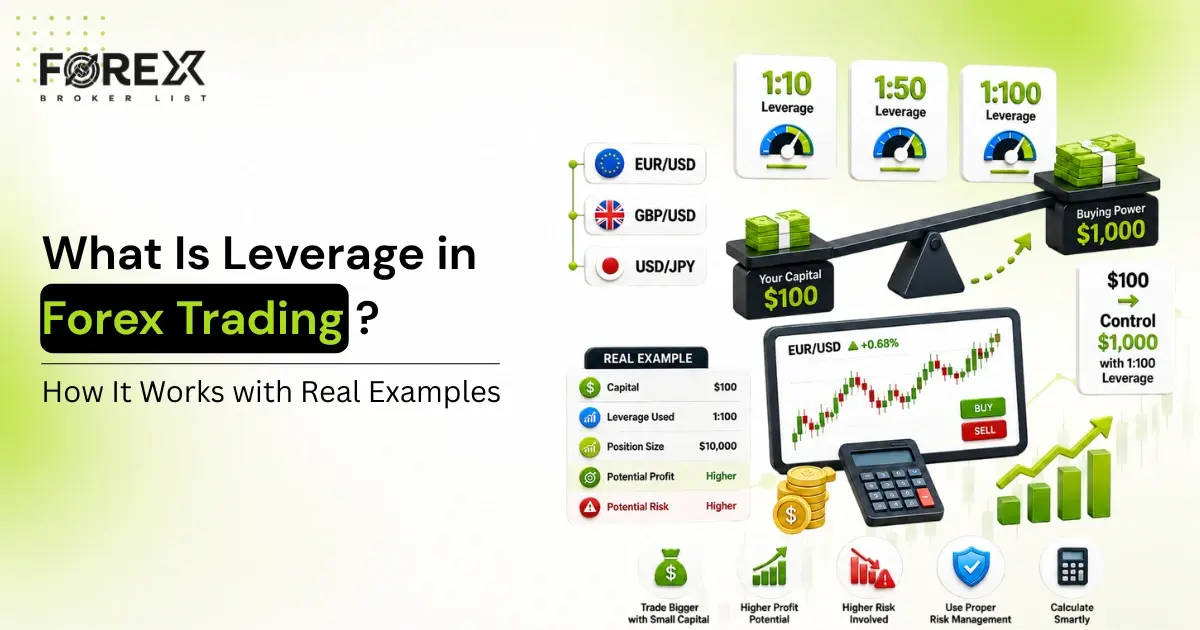
Leverage in forex trading lets you control a large position with a small deposit. A 30:1 leverage ratio means $1,000 of your money controls a $30,000 trade. Profits and losses are both calculated on the full position, not just your deposit. Regulated brokers in the UK, EU, and Australia cap retail leverage at 30:1.
Quick Summary
- Leverage lets you control a position larger than your account balance using a margin deposit.
- A 30:1 ratio means $1,000 controls $30,000, and profits and losses are amplified equally.
- FCA, ASIC, and CySEC cap retail leverage at 30:1 for major currency pairs
- Beginners should use 10:1 or less until they trade consistently
- Always verify a broker's regulation before depositing funds. Use our forex broker to compare verified, regulated brokers.
What Is Leverage in Forex Trading?
Leverage in forex is a tool that lets you open a position worth more than the cash in your account. Your broker covers the difference between your deposit and the full trade value you pay for that exposure through spreads, commissions, and overnight swap fees.
The key number is the leverage ratio. A 30:1 ratio means every $1 of your own money controls $30 of market exposure. A 100:1 ratio means $1 controls $100. The higher the ratio, the less margin you need and the more your account balance moves with each pip.
How the Leverage Ratio Works
The leverage ratio is calculated by dividingthe total position size by the margin required:
Leverage Ratio = Total Position Value / Margin Required
Example: You want to buy one standard lot of EUR/USD. One standard lot = $100,000 notional value. At 30:1 leverage, your required margin is:
$100,000 / 30 = $3,333
At 100:1 leverage, the same position requires only $1,000 in margin.
The position size stays at $100,000 either way. What changes is how much of your own capital you commit to hold it open.
Leverage vs. Margin: What's the Difference?
Margin is the deposit you put up to open a trade. Leverage is the multiplier that determines how large a position a deposit controls. They are two sides of the same calculation.
| Margin Rate | Leverage Ratio | $100,000 Position Requires |
|---|---|---|
| 10% | 10:1 | $10,000 |
| 3.33% | 30:1 | $3,333 |
| 2% | 50:1 | $2,000 |
| 1% | 100:1 | $1,000 |
| 0.5% | 200:1 | $500 |
| 0.2% | 500:1 | $200 |
Data sourced from broker official disclosures and regulatory guidance. Last updated: June 2026.
A lower margin rate means higher leverage. The two figures always move in opposite directions.
How Leverage Works in Practice: Real Trade Examples
The fastest way to understand leverage is through two scenarios using the same trade setup.
Setup: $1,000 margin, 30:1 leverage, one mini lot of EUR/USD (10,000 units). Position value = $30,000. Each pip = approximately $1.
Scenario A: Trade moves in your favour
EUR/USD rises 50 pips. Profit = 50 pips x $1 = $50. Return on your $1,000 margin = 5%.
Without leverage, a $50 profit on a $30,000 position would require you to commit the full $30,000 for a return of just 0.17%.
Scenario B: Trade moves against you. EUR/USD falls 100 pips. Loss = 100 pips x $1 = $100. That is 10% of your $1,000 margin, wiped out in a single trade with no stop-loss in place.
Now scale that to a standard lot (100,000 units) at 100:1 leverage witha $1,000 margin. Each pip = $10. A 100-pip adverse move = $1,000 loss, your entire margin, gone. The position is liquidated automatically.
Leverage does not change the market's percentage move. It changes the financial impact of that move on your account. At 100:1, a 1% adverse move wipes your margin entirely. At 30:1, a 3.33% move does the same. The math is exact and unforgiving.
Leverage Limits by Regulator: What You Can Actually Use
Retail leverage is not the same worldwide. Where your broker is regulated determines the maximum leverage available on your account. Below are the current limits set by the four major regulators as of June 2026.
| Regulator | Jurisdiction | Max Leverage (Major Pairs) | Negative Balance Protection | Compensation Scheme |
|---|---|---|---|---|
| FCA | United Kingdom | 30:1 | Yes (mandatory) | FSCS up to £85,000 |
| ASIC | Australia | 30:1 | Yes (mandatory) | None |
| CySEC | Cyprus / EU | 30:1 | Yes (mandatory) | ICF up to €20,000 |
| NFA / CFTC | United States | 50:1 | Not mandated | None |
| Offshore (e.g. SCB Bahamas) | Various | Up to 500:1 | Varies | None |
Sources: FCA register (register.fca.org.uk), ASIC (asic.gov.au), CySEC (cysec.gov.cy), NFA (nfa.futures.org). Last updated: June 2026.
The FCA, ASIC, and CySEC all introduced their 30:1 cap following ESMA's 2018 product intervention measures, which were triggered by data showing the majority of retail traders lose money on leveraged products.
Retail traders in the UK can apply to be classified as an "Elective Professional" client to access higher leverage. To qualify, they must meet at least two of three FCA criteria: 40 significant trades in the past 12 months, a portfolio exceeding €500,000, or relevant professional experience (Source: FCA, PS19/18).
Before opening any account, browse verified forex brokers filtered by regulation to confirm your broker's status.
Broker Leverage Comparison: Pepperstone, IC Markets & AvaTrade
Three of the most widely used brokers by retail forex traders illustrate how leverage varies by entity, account type, and regulation
| Broker | Max Retail Leverage (Regulated) | Max Leverage (Offshore Entity) | Key Regulators | Min Deposit | Platforms |
|---|---|---|---|---|---|
| Pepperstone | 30:1 (FCA / ASIC / CySEC) | 200:1 | FCA, ASIC, CySEC, BaFin | None | MT4, MT5, cTrader |
| IC Markets | 30:1 (ASIC / CySEC) | 500:1 | ASIC, CySEC | $200 | MT4, MT5, cTrader |
| AvaTrade | 30:1 (ASIC / CySEC) | 400:1 | ASIC, CySEC, FSCA, others | $100 | MT4, MT5, AvaTradeGO |
Sources: Pepperstone.com, ICMarkets.com, AvaTrade.com. Last updated: June 2026.
A few important distinctions:
Pepperstone operates under FCA, ASIC, and CySEC regulation for most retail clients, all capped at 30:1 for major pairs. Its offshore Bahamas entity (SCB-regulated) offers up to 200:1, but traders lose FCA/ASIC client protections at that entity (Source: Pepperstone.com, June 2026). See the full Pepperstone review.
IC Markets offers the lowest spreads on its Raw Spread account, with an average EUR/USD spread of 0.02 pips and a commission of $3.00 per lot on cTrader (Source: ForexBrokers.com comparison, 2026). Leverage under ASIC is capped at 30:1 for retail clients. Its Seychelles entity extends leverage up to 500:1. See the full IC Markets review.
AvaTrade holds regulation across multiple jurisdictions, including ASIC, CySEC, FSCA, and the Central Bank of Ireland, making it one of the more broadly regulated brokers for traders across different regions.
The Real Risks of High Leverage: What Traders Get Wrong
High leverage does not increase your chance of a winning trade. It increases the speed at which a losing trade erases your margin.
Margin calls and stop-outs
When your floating losses reduce your account equity to the broker's stop-out level, typically 50% of used margin at most regulated brokers, open positions are automatically closed. You do not get a warning. The liquidation happens at the prevailing market price, which can be worse than expected in fast-moving conditions.
Negative balance protection
All FCA-, ASIC-, and CySEC-regulated brokers are required to offer negative balance protection for retail clients. This means you cannot lose more than the funds in your trading account, even if the market gaps through your stop-loss. Traders using offshore-regulated entities do not always have this protection.
The 2015 CHF flash crash a real-world lesson
On 15 January 2015, the Swiss National Bank unexpectedly removed the EUR/CHF floor at 1.20. EUR/CHF fell approximately 30% in minutes. Traders long EUR/CHF with 100:1 leverage saw positions wiped out in seconds, with accounts going into negative balance before negative balance protection rules existed. Alpari UK, an FCA-regulated broker at the time, went insolvent as a result. The event became one of the primary drivers behind regulatory leverage caps in Europe and Australia (Source: FCA, January 2015 statement). Traders using unregulated offshore brokers faced no compensation and no recourse.
The most common beginner mistake
Using the maximum available leverage without a stop-loss order. At 100:1 leverage with no stop-loss, a 1% adverse move on a standard lot costs $1,000, a full account wipeout for most beginners. Position sizing is the first line of risk management, not leverage selection alone.
What Leverage Should a Beginner Use in Forex?
The maximum leverage your broker offers and the leverage you should actually use are two very different numbers.
A practical rule: beginners should use 10:1 or less until they achieve three consecutive months of consistent results on a demo or small live account.
Why 10:1 for beginners? At 10:1 leverage, a 100-pip adverse move on a mini lot (10,000 units) costs $10, a manageable loss from a $500 account. The same move at 100:1 costs $100, taking a $500 account down 20% in a single trade. ** Position sizing example $500 account, 1% risk rule**
- Account balance: $500
- Maximum risk per trade: 1% = $5
- Currency pair: EUR/USD, stop-loss distance: 20 pips
- Pip value for micro lot (1,000 units): $0.10
- Maximum position size: $5 / (20 pips x $0.10) = 2.5 micro lots
This keeps the trade within the 1% risk rule regardless of the leverage ratio in use.
| Experience Level | Suggested Max Leverage | Why |
|---|---|---|
| Beginner (0–6 months) | 5:1 to 10:1 | Limits damage per trade; builds discipline |
| Intermediate (6–24 months) | 10:1 to 30:1 | Matches regulated retail cap; suits tested strategies |
| Advanced / Professional | 30:1+ | Requires strict position sizing and risk systems |
##Conclusion
Leverage is not a profit-multiplier; it is a position-sizing tool that cuts both ways. Used with a defined stop-loss and a 1–2% risk-per-trade rule, 10:1 to 30:1 leverage gives retail traders meaningful market exposure without gambling their account on a single move.
Three takeaways to remember:
- The leverage ratio determines how much of the market you control per dollar of margin, not your odds of winning
- FCA, ASIC, and CySEC cap retail leverage at 30:1 for major pairs for good reason
- Never use the maximum available leverage without a stop-loss and a clear position size calculated before entry
When choosing a broker, verify regulation first. A broker offering 500:1 leverage with no negative balance protection is not offering you an advantage; it is transferring risk onto you.
This article is for informational and educational purposes only. It does not constitute financial or investment advice. Forex and CFD trading involve significant risk of loss and are not suitable for all investors. Always verify a broker's regulatory status through official authorities such as FCA, ASIC, or CySEC before depositing funds.
About the Author
Dipak is a forex ontent analyst at ForexBrokerList.io, where he covers broker comparisons, trading platforms, regulation, and forex market education. He has researched and reviewed 150+ forex brokers using data from FCA, ASIC, CySEC, and official broker disclosures.
Frequently Asked Questions
Dipak Dangodra | Financial Writer at Forex Broker List
I am Dipak Dangodra, a financial writer at Forex Broker List. I have published 200+ articles on forex broker reviews, trading platforms, spreads and commissions, and regulatory analysis using data from FCA, ASIC, and CySEC.
Related Blogs

Best Liquidity Providers for Forex Brokers (2026 Comparison)

 Your brand here