

Algo Trading for Beginners: EAs, Bots, and Copy Trading Explained
Algo trading for beginners: EAs, bots, and copy trading compared, with a verification checklist.
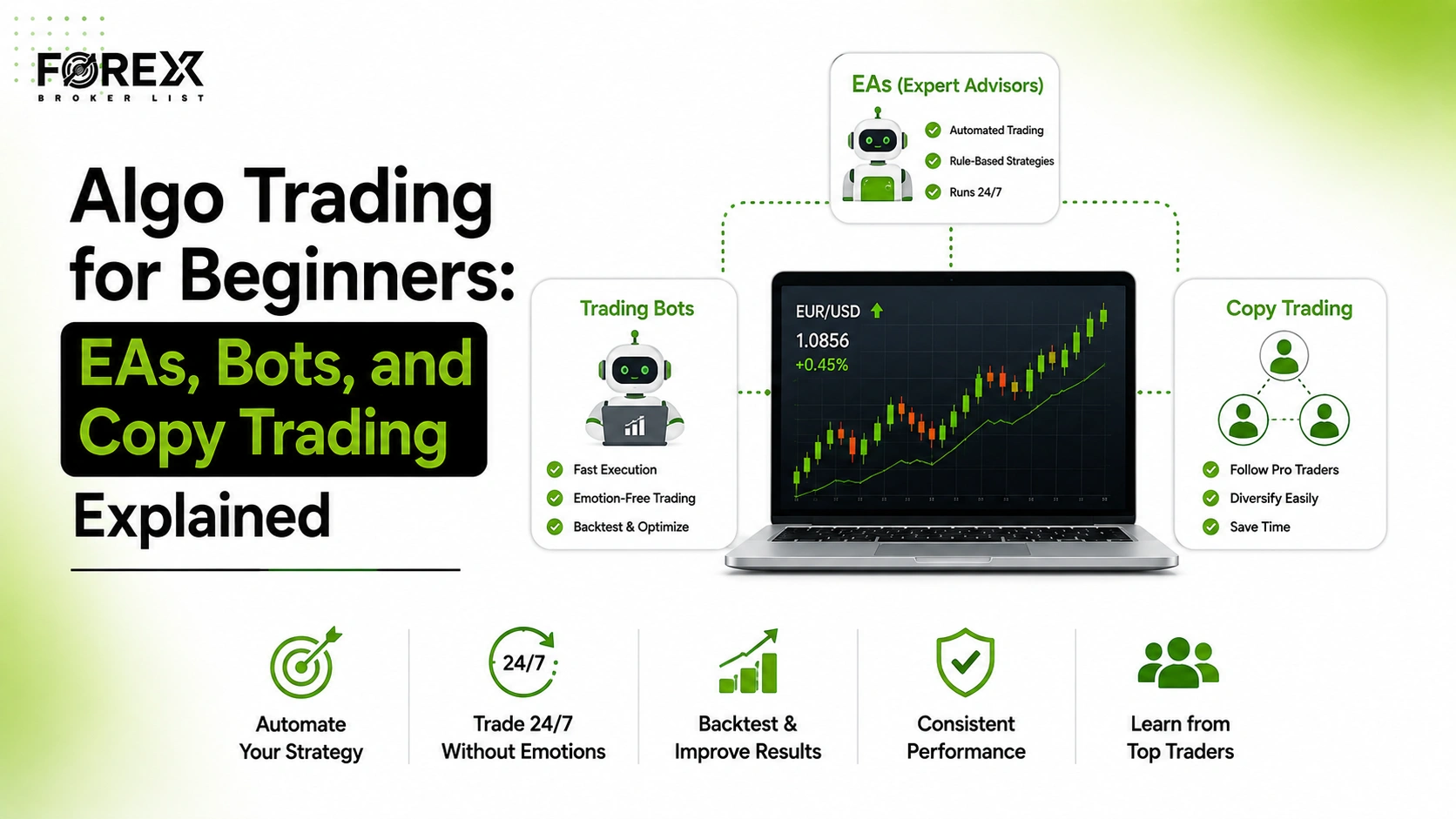
Algo trading in forex covers three main approaches for beginners: Expert Advisors (EAs), which run coded strategies automatically on platforms like MT4 and MT5; trading bots, which range from no-code builders to fully automated systems; and copy trading, which mirrors a human trader's positions directly into your account. Each removes manual execution but carries different risks and levels of control.
Key Takeaways
-
Expert Advisors run pre-coded rules on your own platform; bots range from simple no-code tools to advanced custom systems; copy trading mirrors another person's live trades directly
-
No single approach is inherently safer than the others, since each still carries full market risk regardless of who or what is making the decisions
-
Verified, forward-tested track records matter far more than backtest results alone when evaluating any EA or signal provider
-
Prop firms increasingly allow automated and copied trading, but every deployment needs checking against that specific firm's rules first
-
Algo trading shifts your role from executing trades to designing, testing, and monitoring a system
What Is Algo Trading in Forex?
Algo trading replaces manual, in-the-moment decision-making with a system that executes trades based on predefined rules. Instead of watching charts and clicking buy or sell yourself, you build, buy, or subscribe to something that does it for you.
For beginners, this generally comes down to three distinct paths. Each removes manual execution, but each hands control to a different source.
-
Expert Advisors (EAs), coded strategies that run on your own trading platform
-
Trading bots, ranging from no-code builders to fully custom automated systems
-
Copy trading, where you mirror a real person's live trades into your own account
Expert Advisors (EAs) Explained
An Expert Advisor is a program that runs directly inside MetaTrader 4 or MetaTrader 5, executing trades automatically based on rules you or a developer coded into it. A typical EA might watch for a specific indicator condition, like a moving average crossover or a Fibonacci retracement level, and place a buy or sell order the moment that condition triggers.
EAs are written in MQL4 or MQL5, MetaTrader's proprietary programming languages. You can build one yourself, hire a developer, or buy a pre-built EA from a marketplace, though quality and transparency vary enormously across vendors.
You can compare which brokers actually support EA deployment and platform access on your account type in our full forex platform directory.
Trading Bots: No-Code vs Custom-Built
"Trading bot" is a broader term than EA and isn't limited to MetaTrader. It covers everything from simple no-code builders to sophisticated custom systems connecting directly to a broker's API.
No-code bot builders let you assemble a strategy from preset rules and conditions without writing any code. These lower the entry barrier significantly but limit you to the logic the platform's builder actually supports.
Custom-built bots, most commonly written in Python, offer far more flexibility. Building one requires real programming knowledge, but 2026 tooling, including AI coding assistants, has meaningfully lowered that barrier for traders willing to learn the basics.
Some advanced setups now connect custom dashboards directly to liquidity providers through REST or WebSocket APIs, bypassing a traditional retail platform entirely. This remains firmly advanced-trader territory, not a beginner starting point.
Copy Trading Explained: How It Actually Works
Copy trading connects your account to a trader you choose to follow. When they open or close a position, your account mirrors that same action automatically, scaled to your allocated capital.
The mechanics follow a consistent pattern across most platforms:
-
Choose a broker or platform with built-in copy trading functionality
-
Select a trader to follow, reviewing their verified performance history, drawdown, and risk level
-
Allocate capital, which determines your proportional exposure to every trade they place
-
Trades replicate automatically in real time, scaled to your account
-
Monitor and adjust regularly, since copy trading is not a fully passive, set-and-forget approach
If a trader you're following risks 2% per trade and you've allocated $1,000, your account risks roughly $20 on that same trade. You can find brokers offering built-in copy trading functionality in our full forex broker directory.
EA vs Bot vs Copy Trading: Which Path Fits You?
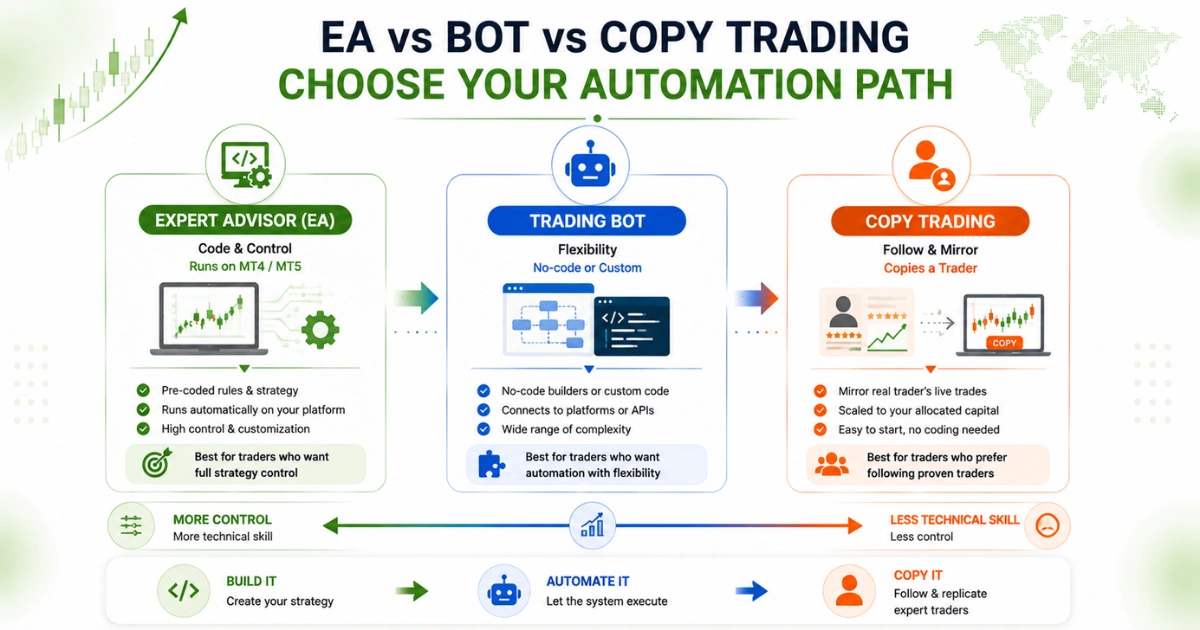
| Approach | Control Level | Technical Skill Needed | Best For |
|---|---|---|---|
| Expert Advisor (EA) | High, if self-built | Moderate to high (MQL4/MQL5) | Traders who want a specific, testable strategy running on their own platform |
| No-code bot | Moderate | Low | Beginners who want automation without learning to code |
| Custom-built bot | Very high | High (typically Python) | Traders with programming background wanting full flexibility |
| Copy trading | Low | None | Beginners who want market exposure without building or coding anything |
How to Verify an EA or Signal Provider Before Trusting It
This step separates a reasonable automated trading decision from a costly one, and it applies whether you're buying an EA or choosing a trader to copy.
-
Check for forward-tested or live-verified results, not just a backtest, since backtests are far easier to optimize into looking better than they'll perform live
-
Look for third-party verification through services like Myfxbook or FX Blue, which display real account statistics rather than vendor-reported numbers
-
Review maximum drawdown, not just returns, since a strategy showing high returns alongside high drawdown carries meaningfully more risk than the headline number suggests
-
Confirm the broker itself is properly regulated, since even a genuinely good strategy means little if your funds sit with an unverified broker; our guide on what " regulated broker" actually means covers exactly how to check this
-
Watch for unrealistic promises, since most genuinely profitable EAs target modest monthly gains, commonly cited around 2 to 8%, not the dramatic returns some vendors advertise
Algo Trading and Prop Firm Rules
Automated and copied trading are increasingly common on funded prop firm accounts, but rules vary meaningfully between firms and change frequently.
Before deploying any EA, bot, or copy trading setup on a prop firm account, confirm the firm's specific policy on:
-
Automated trading and third-party EAs specifically
-
Copy trading across multiple funded accounts
-
News trading restrictions during high-impact releases
-
Weekend position holding
-
Lot size scaling and daily drawdown limits
A strategy that performs well but violates a firm's specific rules can result in a breached account regardless of its actual profitability.
Risks of Automated and Copy Trading
Automation and copy trading remove manual execution, but they do not remove market risk. This needs to be stated plainly rather than softened.
-
Losses transfer directly, whether from your own EA's coded logic or a copied trader's losing streak
-
Software bugs and overfitted strategies can fail in live markets even after a strong-looking backtest
-
Slippage increases in less liquid conditions, which affects copy trading execution quality particularly around major news events
-
Over-reliance on statistics is common; many traders trust performance numbers without understanding the underlying strategy or why a provider's approach might shift over time
None of this makes algo or copy trading inherently unsuitable for beginners. It means the responsibility for risk management stays with you regardless of who or what is placing the trade.
Conclusion
Algo trading for beginners comes down to choosing between three real paths: coding or buying an Expert Advisor for MetaTrader, using a no-code or custom-built bot, or copy trading a verified human trader. Each removes manual execution, but none removes the responsibility of verifying track records, understanding drawdown, and monitoring performance over time. Before committing capital to any of these approaches, confirm your broker's regulatory status, check any prop firm rules that apply, and treat performance claims with the same scrutiny you'd apply to a manual strategy. You can explore automated and algo-friendly trading options across our full algo trading directory.
Disclaimer: This article is for informational and educational purposes only. It does not constitute financial or investment advice. Forex and CFD trading involves significant risk of loss and is not suitable for all investors. Automated and copy trading do not eliminate market risk. Always verify a broker's regulatory status and any performance claims before committing funds.
Frequently Asked Questions
Dipak Dangodra | Financial Writer at Forex Broker List
I am Dipak Dangodra, a financial writer at Forex Broker List. I have published 200+ articles on forex broker reviews, trading platforms, spreads and commissions, and regulatory analysis using data from FCA, ASIC, and CySEC.
Related Blogs

Best Liquidity Providers for Forex Brokers (2026 Comparison)

 Your brand here