

What Does "Regulated Broker" Mean? (FCA, ASIC, CySEC)
What "regulated broker" really means, how to verify a license, and Tier 1 vs offshore compared.
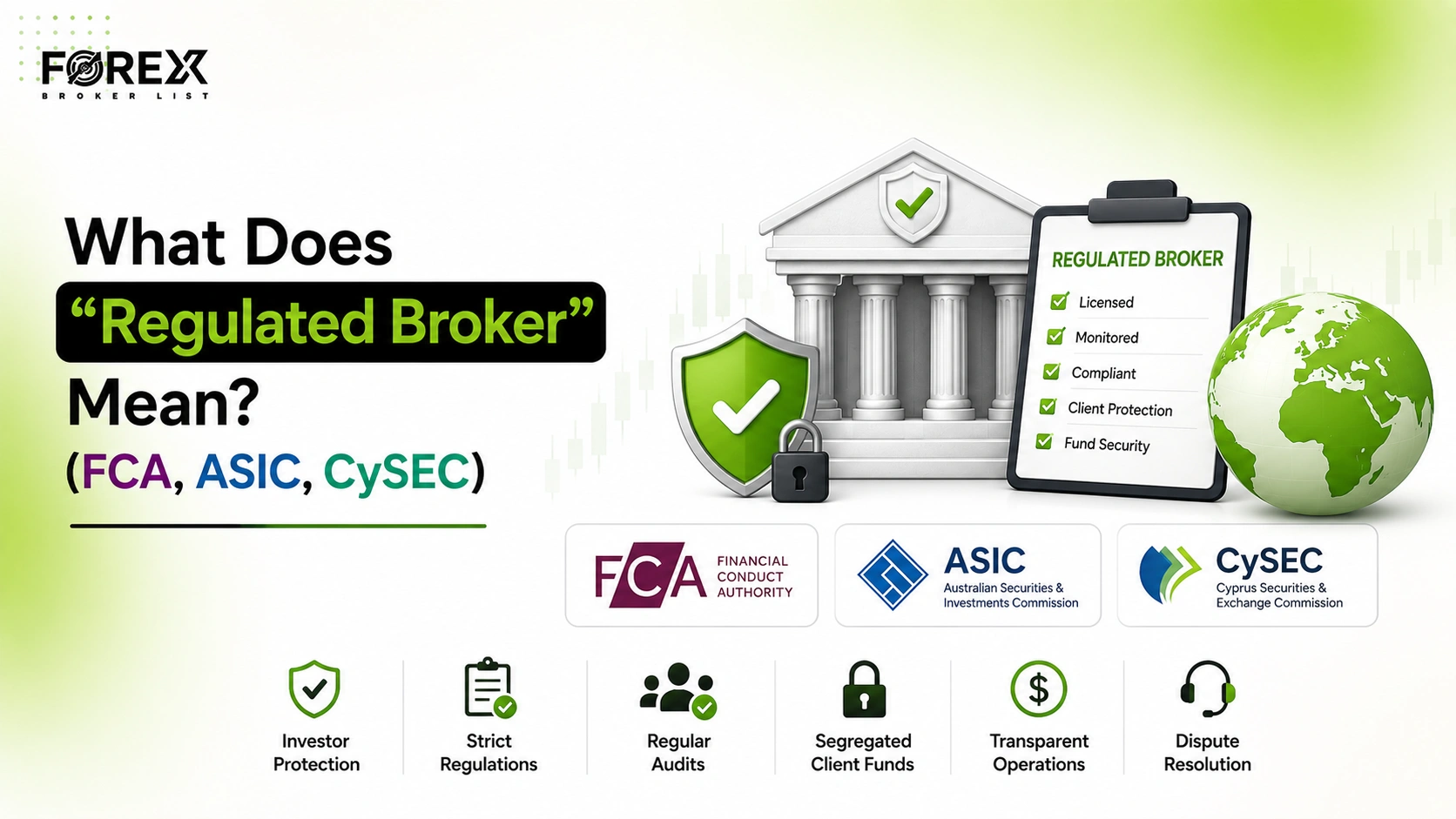
A regulated forex broker is licensed and supervised by a financial authority such as the FCA, ASIC, or CySEC, which requires it to keep client funds in segregated accounts, meet minimum capital requirements, and participate in investor compensation schemes. Regulation does not guarantee profits or perfect execution, but it gives you legal recourse if something goes wrong.
Key Takeaways
- Regulation requires segregated client funds, minimum capital, regular audits, and a formal complaints process
- A broker's marketing brand can differ from the specific legal entity that actually holds your account, and only that entity's protections apply to you
- Tier 1 regulators (FCA, ASIC, CySEC) offer the strongest protection; offshore regulators (Seychelles, Vanuatu, Belize) offer minimal oversight
- Regulation does not guarantee profitable trading, perfect execution, or protection from ordinary market losses
- Always verify a broker's license directly on the regulator's official register using the exact legal entity name, not the brand name
What Does "Regulated Broker" Actually Mean?
When people ask is my forex broker regulated, they are really asking whether a government financial authority has reviewed and approved that firm to handle client money under specific rules. A regulated status means the broker meets minimum capital requirements, undergoes regular independent audits, keeps client funds in bank accounts separate from its own operating capital, and is required to resolve disputes through a formal, government-backed process.
What does FCA regulated mean specifically? Under the UK's Financial Conduct Authority, it means the firm is authorized under the Financial Services and Markets Act, subject to the Conduct of Business Sourcebook rules, and its retail clients are covered by the Financial Services Compensation Scheme up to £85,000 if the firm fails. CySEC regulated broker meaning follows a similar structure under Cyprus and EU MiFID II rules, with the Investor Compensation Fund covering up to €20,000. ASIC regulated broker meaning, under Australia's framework, includes mandatory AFCA dispute resolution membership and product intervention rules such as leverage caps and negative balance protection.
Why the Legal Entity Matters More Than the Brand Name
A single broker brand often operates through several separate legal entities, each licensed in a different jurisdiction, and each offering different protections. A trader in the UK might open an account under the firm's FCA-regulated entity, while a trader in a country without local licensing requirements might be onboarded under the same brand's offshore entity in Seychelles or Belize instead, with none of the FCA protections applying.
This is the single most misunderstood part of forex broker license verification. Seeing "FCA regulated" on a homepage does not confirm that the specific account you are opening falls under that FCA entity. The account opening terms, not the homepage badge, state which legal entity you are actually contracting with.
Tier 1 vs Tier 2 vs Offshore Regulation (Comparison Table)
Regulatory strictness varies enormously by jurisdiction, and this directly affects how protected your funds are.
| Tier | Regulators | Compensation Scheme | Leverage Cap (Retail) | Audit Requirement |
|---|---|---|---|---|
| Tier 1 | FCA, ASIC, CySEC, BaFin, FINMA, MAS | FSCS up to £85,000 (FCA); ICF up to €20,000 (CySEC) | 1:30 | Mandatory independent annual audit |
| Tier 2 | DFSA, FSCA, CMA (Kenya) | Limited or none | Varies, often up to 1:500 | Regular reporting, less stringent than Tier 1 |
| Offshore | FSA Seychelles, VFSC Vanuatu, IFSC Belize | None | Up to 1:2000 or unlimited | Minimal or self-reported |
Sources: FCA, CySEC/ESMA, ASIC published regulatory frameworks.
An unregulated forex broker risks section is worth stating plainly here: a broker with no license from any of these tiers has no external audit requirement, no fund segregation obligation enforced by law, and no compensation scheme if it becomes insolvent or refuses withdrawals. You can browse providers licensed under the strictest tier in our Tier 1 regulated brokers category.
Real Broker Entity Comparison (Table)
| Broker | Regulated Entities | License Numbers |
|---|---|---|
| Pepperstone | FCA, ASIC | FCA 684312, ASIC 414530 |
| AvaTrade | Central Bank of Ireland, ASIC, and 7 others | Multiple, entity-dependent |
| XM Group | CySEC, ASIC, DFSA, FSC Belize | CySEC 120/10, ASIC 443670, DFSA F003484 |
| Tickmill | CySEC, FCA | CySEC 278/15, FCA 717270 |
Data sourced from broker official regulatory disclosure pages. Always confirm the exact entity named in your own account agreement, since brokers with multiple licenses may onboard clients from different countries under different entities. You can see full license details on the Pepperstone broker profile as one example.
How to Verify a Broker's License (Step-by-Step)
Checking a broker license number takes a few minutes and should happen before any deposit.
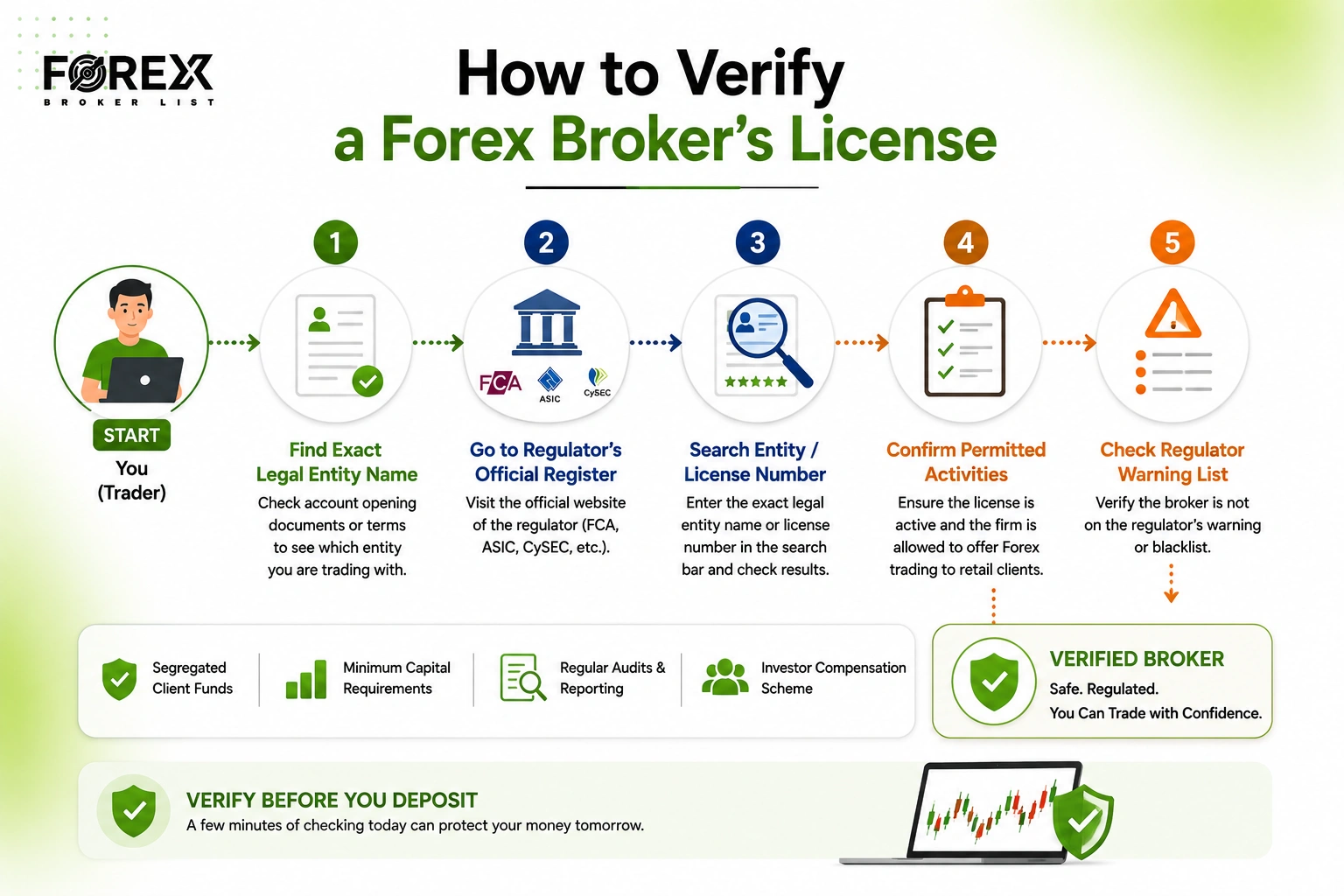
- Find the exact legal entity name. This is usually in the broker's terms and conditions or account opening agreement, not the marketing homepage.
- Go to the regulator's official register. Use the FCA Financial Services Register for UK entities, CySEC's public register for Cyprus/EU entities, or ASIC's Professional Registers for Australian entities.
- Search by entity name or license number, not by brand name alone, since brand names can be reused or imitated.
- Confirm the permitted activities match what the broker is offering you, since some licenses cover limited activities rather than full retail forex dealing.
- Check for regulator warnings. Most regulators publish a public warning list of firms falsely claiming authorization or operating without one.
What Regulation Does NOT Protect You From
Regulation is frequently misunderstood as a guarantee of trading success, and it is not. A licensed, regulated broker can still offer wide spreads, slow customer support, or a platform you personally dislike. Regulation does not compensate for losses that come from normal market movement, does not guarantee a specific execution speed or fill price, and does not mean the broker's trading conditions are the best available in the market.
What regulation does provide is narrower but genuinely important: confirmation that client funds are held separately from company funds, a legal framework for resolving disputes, and a compensation scheme that activates specifically if the firm itself becomes insolvent or acts fraudulently, not if your trades simply lose money.
Red Flags of a Fake or Unregulated Broker
- Vague claims like "internationally regulated" or "globally licensed" without naming a specific regulator, entity, and license number
- Guaranteed returns or fixed-profit promises, which no genuinely regulated broker is permitted to offer
- A license number that does not match any entity on the stated regulator's official register
- Pressure to deposit quickly or bonus offers tied to larger, harder-to-withdraw deposits
- No verifiable physical business address or a support team unwilling to confirm the exact regulated entity
You can start comparing verified, regulated providers directly in our full forex broker directory rather than relying on a broker's own claims about its regulatory status.
Conclusion
Understanding what a regulated broker actually means changes how you evaluate every other claim a broker makes. A license from a Tier 1 regulator like the FCA, ASIC, or CySEC confirms segregated funds, audit requirements, and a real compensation scheme if the firm fails, but it never guarantees profitable trading or perfect execution. Before opening any account, confirm the exact legal entity you are contracting with, verify its license number directly on the regulator's own register, and treat vague or unverifiable regulation claims as a serious warning sign.
Disclaimer: This article is for informational and educational purposes only. It does not constitute financial or investment advice. Forex and CFD trading involves significant risk of loss and is not suitable for all investors. Always verify a broker's regulatory status through official authorities such as FCA, ASIC, or CySEC before depositing funds.
Frequently Asked Questions
Dipak Dangodra | Financial Writer at Forex Broker List
I am Dipak Dangodra, a financial writer at Forex Broker List. I have published 200+ articles on forex broker reviews, trading platforms, spreads and commissions, and regulatory analysis using data from FCA, ASIC, and CySEC.
Related Blogs

Best Liquidity Providers for Forex Brokers (2026 Comparison)

 Your brand here