

Best ECN Brokers With Lowest Spreads 2026
True ECN brokers compared on spread, commission, and regulation, with a breakeven volume guide.
The best ECN brokers for lowest spreads in 2026 combine raw spreads near 0.0 pips with a transparent per-lot commission and strong regulation. Based on verified account terms, IC Markets and Pepperstone offer the most established true ECN pricing, while Fusion Markets offers the lowest commission for high-frequency traders willing to accept lighter regulatory coverage.
Key Takeaways
- A "0.0 pip" headline spread means little without checking the commission charged alongside it
- ECN accounts typically only beat standard/spread-only accounts once you're trading roughly 3-5 lots per day
- Regulatory depth varies sharply between ECN brokers; some hold only one license, others hold three or more
- Ultra-tight, unregulated broker pricing is often achievable specifically because the firm skips compliance costs
- True ECN pricing requires checking the specific account type, since the same broker often has both ECN and standard tiers
What Makes a Broker Genuinely "ECN"
A genuine ECN broker routes your order directly into a network of liquidity providers and other market participants, matching it at the best available price with no dealing desk in between. The broker earns through a flat commission per lot rather than a spread markup, which is what keeps the quoted spread itself close to raw market pricing, sometimes near 0.0 pips during active hours.
The word "ECN" gets used loosely in marketing, sometimes describing accounts that are actually hybrid STP setups. The two reliable signals of a true ECN account are a separately stated commission, rather than cost folded into the spread, and direct market depth or order book access on the platform, rather than a single quoted price.
Best ECN Brokers Compared (Verified Data Table)
| Broker | Raw Spread (EUR/USD) | Commission | Min. Deposit | Founded | Regulation |
|---|---|---|---|---|---|
| IC Markets | From 0.0-0.1 pips | $3.50/lot/side ($7 round-turn) | $200 (recommended) | 2007 | ASIC, CySEC |
| Pepperstone | From 0.0 pips | From $3.50/lot/side ($7 round-turn) | No stated minimum | 2010 | FCA, ASIC |
| Tickmill | From 0.0 pips, avg 0.10 pips | $3.00/lot/side ($6 round-turn) | $100 | 2014 | FCA, CySEC |
| Fusion Markets | From 0.14 pips | $2.25/lot/side ($4.50 round turn) | No stated minimum | 2017 | ASIC only |
| FP Markets | From 0.0 pips | From $3.00/lot/side | Varies by region | 2005 | ASIC, CySEC |
| XM (Zero Account) | From 0.0-0.1 pips | $3.50/lot/side ($7 round-turn) | $5 | 2009 | CySEC, ASIC |
| Vantage (Raw ECN) | From 0.0-0.08 pips | $3.00/lot/side ($6 round-turn) | $200 | 2009 | ASIC, FCA |
| FxPro (Raw+) | Near 0.0 pips | ~$3.50/lot/side ($7 round-turn) | $100 | 2006 | FCA, CySEC |
| FXTM (ECN) | Slightly wider than peers | ~$2.00/lot/side ($4 round-turn) | $200 | 2011 | FCA, CySEC |
| Exness (Raw Spread) | From 0.0 pips | From $3.50/lot/side | $0-$10 (entity-dependent) | 2008 | FCA, CySEC (regulated entities) |
Data sourced from IC Markets, Pepperstone, and Tickmill official pages; FX-Brokers.eu and TradingPedia (Tickmill); CompareForexBrokers.com and TopBrokers360.com (Fusion Markets, FP Markets, XM); ForexBrokers.com, BestBrokers.com, and TakeProfitApp (Vantage); and industry broker comparison data for FxPro, FXTM, and Exness, August 2026. Commission and spread figures change periodically; confirm current terms directly with each broker, and note that Exness offshore entities offer materially higher leverage and different terms than its FCA/CySEC-regulated entities.
Platforms and Instrument Range Compared
| Broker | Platforms | Approx. Instruments |
|---|---|---|
| IC Markets | MT4, MT5, cTrader | 2,250+ across forex, indices, commodities, shares |
| Pepperstone | MT4, MT5, cTrader, TradingView | 1,200+ |
| Tickmill | MT4, MT5 | 620+ |
| Fusion Markets | MT4, MT5, cTrader, TradingView | 250+ |
| FP Markets | MT4, MT5, cTrader, Iress | 10,000+ (widest range, includes extensive share CFDs) |
| XM | MT4, MT5 | 1,000+ |
| Vantage | MT4, MT5, ProTrader, TradingView | 1,000+ |
| FxPro | MT4, MT5, cTrader, FxPro Edge | 2,100+ |
| FXTM | MT4, MT5 | 750+ |
| Exness | MT4, MT5, Exness Terminal | 200+ (forex/CFD focused, narrower than multi-asset brokers) |
A wider instrument range matters less if you only trade major forex pairs, but it becomes relevant if you plan to diversify into indices, commodities, or share CFDs under the same account later.
1. Execution Speed and Latency Compared
Execution speed differences between top ECN brokers are usually measured in single-digit milliseconds and matter most to algorithmic traders and scalpers running high-frequency strategies. Tickmill's servers average 7 to 12 milliseconds latency, while comparable ECN-focused competitors typically sit in a similar 9 to 15 millisecond range. For manual discretionary trading, this difference is generally imperceptible. For automated strategies placing dozens of orders per hour, even a few milliseconds can affect whether an order fills at the intended price or experiences minor slippage, which is why high-frequency traders often pair their ECN account with a VPS located near the broker's data center to minimize latency further.
2. IC Markets: Benchmark for True ECN Pricing
IC Markets is widely treated as the reference point for true ECN pricing among retail brokers, offering raw spreads from 0.0 to 0.1 pips on its Raw Spread account alongside a $3.50 per lot per side commission. It holds ASIC and CySEC regulation and supports MT4, MT5, and cTrader, giving traders flexibility in platform choice without switching brokers. Its established track record and deep liquidity access make it a common default pick for scalpers and high-frequency traders comparing ECN options.
3. Pepperstone: Most Versatile ECN Broker
Pepperstone's Razor account matches IC Markets closely on raw spread and commission structure, with the added strength of FCA regulation alongside ASIC, giving UK-based traders a Tier 1-regulated ECN option specifically. Its broader platform support, including cTrader alongside MT4 and MT5, and its structured educational content make it a versatile pick for traders who want tight ECN pricing without sacrificing platform choice or regulatory coverage.
4. Fusion Markets: Lowest Commission, Lighter Regulation
Fusion Markets undercuts both IC Markets and Pepperstone on commission, charging $2.25 per lot per side ($4.50 round turn), which makes a meaningful difference for traders placing a high volume of trades monthly. The tradeoff is regulatory depth: Fusion Markets holds ASIC regulation but lacks the FCA or CySEC licensing that IC Markets and Pepperstone carry. For traders whose account falls under the ASIC-regulated entity specifically, protection is comparable to the other picks; traders should confirm which entity their account is opened under before assuming full ASIC coverage applies.
5. Tickmill: Best Balance of Low Commission and Tier 1 Regulation
Tickmill, founded in 2014 and headquartered in London, holds both FCA and CySEC licensing, giving it dual Tier 1 coverage alongside a $100 minimum deposit that undercuts IC Markets and matches or beats most competitors on this list. Its Raw account charges $3.00 per lot per side, slightly below IC Markets and Pepperstone, with average EUR/USD spreads around 0.10 pips during liquid sessions. Tickmill also offers a Pro account tier for higher-volume traders, where commissions scale down to as low as $1.50 per side once monthly volume exceeds 50 standard lots, making it particularly competitive for consistently active traders who can meet that threshold. The narrower instrument range compared to multi-asset brokers like FP Markets is the main tradeoff, so it suits traders focused primarily on forex and major CFD instruments rather than broad share CFD access.
6. FP Markets: Widest Instrument Range for Multi-Asset ECN Trading
FP Markets, founded in 2005, is one of the longer-established brokers on this list and pairs ASIC and CySEC regulation with the widest instrument range of the group, including extensive share CFD access alongside standard forex ECN pricing. Its raw spreads start from 0.0 pips with commission from $3.00 per lot per side, placing it competitively close to Tickmill on cost while offering meaningfully more instruments to diversify into if your trading extends beyond forex pairs.
Five More ECN Brokers Worth Comparing
XM, founded in 2009, offers a Zero Account with spreads from 0.0 to 0.1 pips and a $3.50 per lot per side commission, alongside one of the lowest entry points on this list at a $5 minimum deposit. It holds CySEC and ASIC regulation and is well suited to traders who want ECN-style pricing without a large upfront deposit.
Vantage, also founded in 2009, runs a Raw ECN account with spreads averaging around 0.08 to 0.12 pips and a $3.00 per side commission, with a Pro ECN tier available for high-volume traders that drops commission to $1.50-$2.00 per side once eligibility thresholds around 100+ lots per month or higher deposits are met. It holds ASIC and FCA regulation.
FxPro, founded in 2006, offers a Raw+ account with near-zero spreads and an all-in round-turn cost close to $7 per standard lot, comparable to IC Markets and Pepperstone. It holds FCA and CySEC regulation and has one of the longer operating histories among ECN-focused brokers on this list.
FXTM, founded in 2011, runs an ECN account with a lower round-turn commission around $4 per standard lot, though its raw spreads tend to run marginally wider than the tightest brokers on this list. It holds FCA and CySEC regulation.
Exness, founded in 2008, offers Raw Spread and Zero account options with spreads from 0.0 pips and commission from $3.50 per side. Exness operates multiple regulated entities, including FCA and CySEC licensed ones, alongside offshore entities offering materially different leverage and terms, so confirming which specific entity your account falls under matters more here than with most other brokers on this list.
When Does an ECN Account Actually Save You Money?
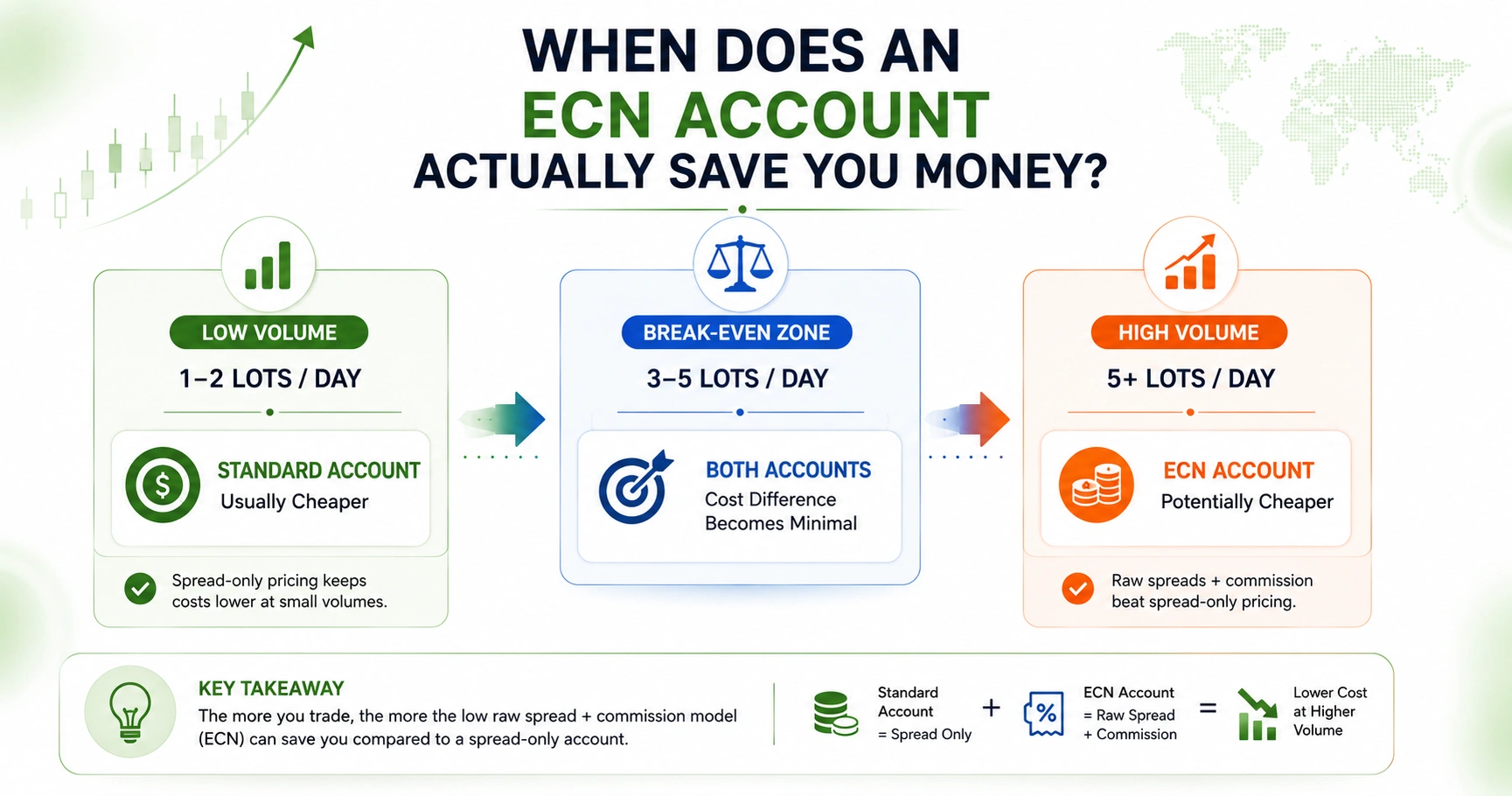
An ECN account is not automatically cheaper than a spread-only standard account. The commission is a real, separate cost, and at low trading volumes it can outweigh the spread savings entirely.
| Monthly Volume | Standard Account (Spread-Only) | ECN Account (Raw + Commission) | Cheaper Option |
|---|---|---|---|
| 5 lots/month | Spread cost only, no commission | Spread savings small relative to $17.50-$35 total commission | Standard account |
| 30 lots/month | Moderate spread cost | Commission scales, spread savings start to offset it | Close to breakeven |
| 100+ lots/month | High cumulative spread cost | $225-$700 in commission, but spread savings compound | ECN account |
As a rough guide, the breakeven point for most traders sits around 3 to 5 round-turn lots per day of active trading. Below that volume, a standard spread-only account is often the simpler and cheaper choice; above it, the tighter raw spread on an ECN account starts to outweigh the commission cost.
Why Some Unregulated Brokers Advertise Tighter Spreads
It is worth addressing directly: some unregulated or lightly regulated brokers advertise even tighter spreads or larger bonuses than any broker listed here. This is not a coincidence. Operating without strict licensing means skipping the compliance costs, audits, and capital requirements that regulated brokers must absorb, which frees up margin to offer more aggressive headline pricing.
That pricing comes without the protections a regulated broker provides, including segregated client funds and a compensation scheme if the firm fails. Before choosing a broker based on the tightest advertised spread alone, verify its regulatory status directly on the regulator's official register. Our full guide on what "regulated broker" actually means covers exactly how to do this and what protection regulation does and does not provide.
Which ECN Broker Fits Your Trading Volume?
- Low-frequency trader (under 5 lots/month): A standard spread-only account, not an ECN account, is likely cheaper overall
- Very small starting deposit: XM ($5 minimum) is the lowest entry point among Tier 1-adjacent options on this list
- Moderate-frequency trader (5-30 lots/month): IC Markets, Pepperstone, Tickmill, or FxPro offer a reliable balance of tight pricing and strong regulation
- High-frequency trader (100+ lots/month): Fusion Markets' lower commission compounds meaningfully at volume; Tickmill's Pro tier and Vantage's Pro ECN tier are also worth checking once you cross their respective volume thresholds
- UK-based trader wanting Tier 1 protection specifically: Pepperstone, Tickmill, Vantage, FxPro, or FXTM all hold FCA regulation alongside a second Tier 1 license
- Multi-asset trader wanting forex plus broad share CFD access: FP Markets or FxPro, for their wider instrument ranges under one ECN account
- Traders comparing a globally recognized brand: Exness and XM are among the most widely used names on this list, though Exness requires extra care confirming which specific regulated entity applies to your account
Conclusion
The lowest-spread headline number is only half the picture with ECN brokers. IC Markets, Pepperstone, Tickmill, and FxPro remain among the most established, well-regulated true ECN options, Fusion Markets and FXTM offer the lowest commissions for cost-focused traders, Vantage and XM stand out for accessible entry points and volume-based commission tiers, FP Markets pairs competitive pricing with the widest instrument range, and Exness brings global brand recognition alongside a more complex multi-entity structure worth verifying carefully. Before choosing based on spread alone, calculate your actual monthly trading volume against the breakeven point, and always verify a broker's regulatory status directly rather than relying on advertised pricing alone. You can compare additional regulated ECN and STP providers in our full forex broker directory.
Disclaimer This article is for informational and educational purposes only. It does not constitute financial or investment advice. Forex and CFD trading involves significant risk of loss and is not suitable for all investors. Always verify a broker's current spreads, commissions, and regulatory status directly before depositing funds.
Frequently Asked Questions
Dipak Dangodra | Financial Writer at Forex Broker List
I am Dipak Dangodra, a financial writer at Forex Broker List. I have published 200+ articles on forex broker reviews, trading platforms, spreads and commissions, and regulatory analysis using data from FCA, ASIC, and CySEC.
Related Blogs

Best Liquidity Providers for Forex Brokers (2026 Comparison)

 Your brand here