

Forex Leverage Limits by Country (Guide)
Compare forex leverage limits by country and regulator in 2026.
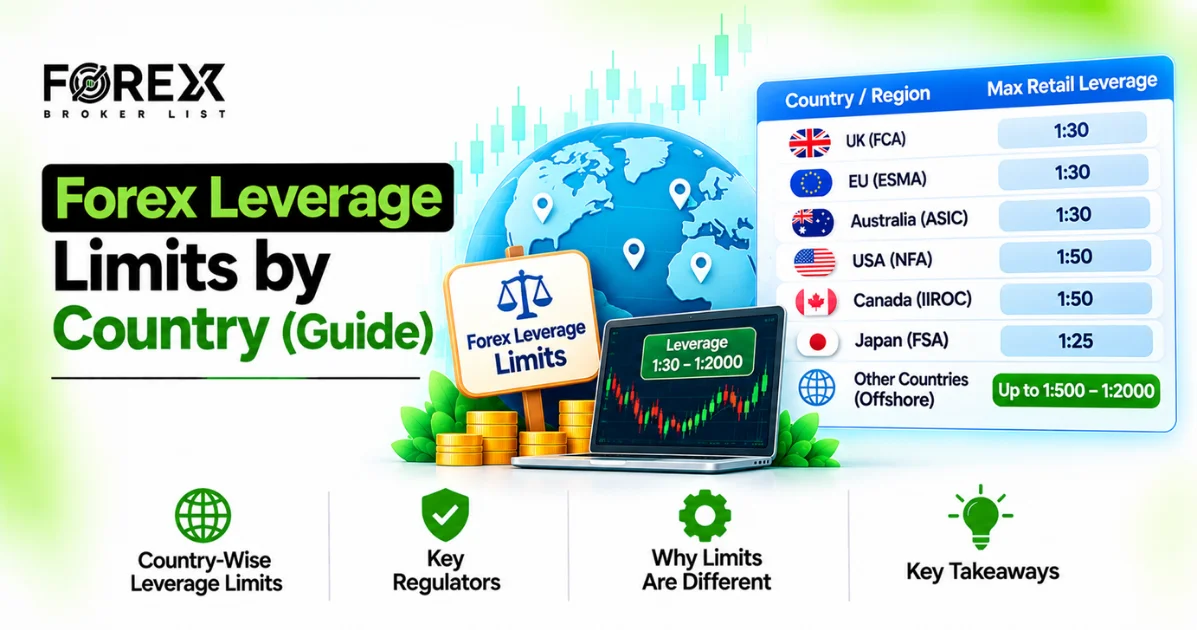
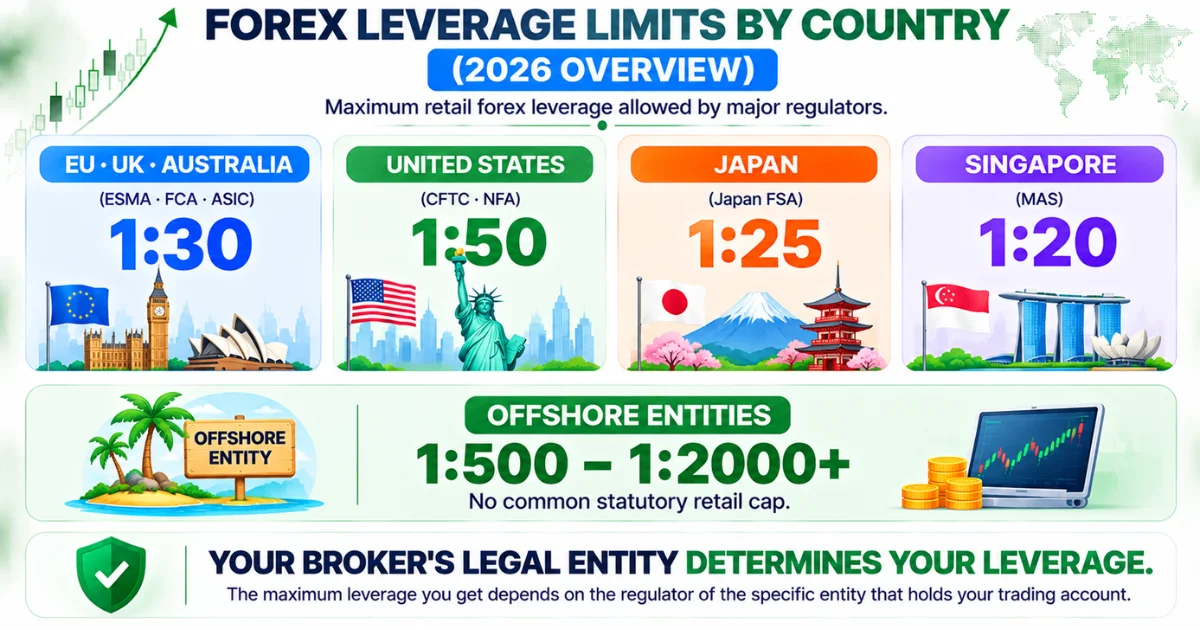
How to check forex leverage limits by country: Retail forex leverage limits are set by the regulator of the broker’s legal entity, not by your home country. Major regulators cap retail major-pair leverage at 30:1 (ESMA/CySEC/FCA/ASIC), 50:1 (US NFA), or 25:1 (Japan FSA). Offshore entities of the same brands often allow 500:1 or higher. Always confirm the specific entity on your client agreement.
Forex leverage limits by country create large differences in the position size a trader can open with the same deposit. A retail client of an FCA- or ASIC-regulated entity can open a standard lot of EUR/USD with roughly 3.3% margin. The same trader using an offshore entity of the same brand may need only 0.2% margin. These caps exist because most retail CFD accounts lose money. ESMA’s 2018 product-intervention measures, later made permanent by national regulators, cited broker loss-rate disclosures as the main reason for the 30:1 major-pair ceiling.
The limit follows the broker entity that holds your account, not your passport. A trader living in India who is onboarded by a CySEC entity receives the same 30:1 cap as a trader in Cyprus. The same trader onboarded by that broker’s Seychelles or Mauritius entity can receive 500:1 or more. This distinction appears on the client agreement and the legal name shown in the account confirmation email.
Forex Leverage Limits by Major Regulator
| Regulator | Region | Max Retail Leverage (Major FX) | Other Key Caps | Negative Balance Protection | Compensation Scheme |
|---|---|---|---|---|---|
| ESMA / CySEC | EU | 30:1 | 20:1 non-major/gold/major indices; 10:1 commodities; 5:1 equities; 2:1 crypto | Yes | ICF up to €20,000 |
| FCA | UK | 30:1 | Same tiers as ESMA | Yes | FSCS up to £85,000 |
| ASIC | Australia | 30:1 | 20:1 minors/gold/major indices | Yes | AFCA (no fixed cap) |
| CFTC / NFA | United States | 50:1 | 20:1 other pairs | Effectively via segregation | None (segregation only) |
| JFSA (FSA) | Japan | 25:1 | Applies across pairs | Yes | Full segregation |
| MAS | Singapore | 20:1 | Similar on most instruments | Yes | Segregation |
| Offshore (FSA Seychelles, VFSC, FSC Mauritius) | Various | No statutory cap (often 500:1–2000:1) | Broker sets limits | Optional | None |
Data sourced from ESMA product-intervention measures (made permanent by national NCAs), FCA Handbook, ASIC Product Intervention Order, NFA Financial Requirements Section 12, JFSA rules, and MAS guidelines. Last updated: October 2026.
These numbers apply to retail clients. Professional or wholesale clients can receive higher leverage after meeting experience, volume, and portfolio tests.
ESMA and CySEC Leverage Rules in the EU
ESMA introduced temporary product-intervention measures on 1 August 2018. National competent authorities, including CySEC, later made the measures permanent. Retail clients of any EU-authorised firm face:
- 30:1 on major currency pairs (pairs formed from USD, EUR, JPY, GBP, CAD, CHF)
- 20:1 on non-major pairs, gold, and major indices
- 10:1 on other commodities and minor indices
- 5:1 on individual equities
- 2:1 on crypto CFDs
The same package requires a 50% margin close-out rule and negative balance protection. CySEC applies these rules to its Cyprus Investment Firms. A 2025 CySEC directive further tightened non-major CFD leverage in some cases. ESMA’s five-year review published in 2026 reaffirmed the existing caps through at least 2031.
A standard lot (100,000 units) of EUR/USD at 1.0850 has a notional value of $108,500. At 30:1 the required margin is approximately $3,617. The same position at 500:1 requires only about $217.
ASIC Leverage Limits in Australia
ASIC’s Product Intervention Order, effective March 2021 and extended through 2027–2031, aligned Australian retail CFD leverage with the ESMA framework. Major pairs are capped at 30:1 and minor pairs/gold/major indices at 20:1. Negative balance protection is mandatory. Before 2021 many ASIC-regulated brokers offered 500:1 to retail clients. That era ended.
ASIC data for the 2023–24 financial year showed 68% of retail CFD accounts made a net loss, with aggregate losses of AUD $458 million. The intervention order was designed to slow the speed at which accounts can be emptied.
FCA Leverage Limits in the United Kingdom
The FCA adopted permanent CFD rules that mirror ESMA’s tiers. Retail major-pair leverage remains 30:1. Negative balance protection is mandatory and eligible clients are covered by the Financial Services Compensation Scheme up to £85,000 if the firm fails. Post-Brexit the UK rules operate independently of ESMA, yet the numerical caps stayed the same.
Japan FSA, Singapore MAS, and Other Asian Limits
Japan’s Financial Services Agency (JFSA/FSA) has capped retail forex leverage at 25:1 since 2011. The rule applies across pairs and requires a minimum 4% margin deposit. Singapore’s Monetary Authority of Singapore (MAS) limits retail major-pair leverage to 20:1 for Capital Markets Services licence holders. Hong Kong’s Securities and Futures Commission applies a 20:1 retail cap for Type 3 licensed firms.
These tighter Asian caps pre-date the European measures and reflect local concerns about retail speculative losses after earlier market events.
United States CFTC and NFA Limits
US retail forex is limited to 50:1 on major pairs and 20:1 on other pairs under NFA Financial Requirements Section 12 (minimum security deposits of 2% and 5% respectively). Only firms registered as Retail Foreign Exchange Dealers or Futures Commission Merchants may solicit US residents. The capital and segregation rules effectively close the market to most offshore brokers. CFDs are not offered to US retail clients.
Offshore Entities and Higher Leverage
Offshore jurisdictions such as Seychelles (FSA), Mauritius (FSC), Vanuatu (VFSC), and Belize (FSC) do not impose statutory retail leverage caps. Brokers can therefore offer 500:1, 1000:1, or higher through these entities. The same brand that offers 30:1 under its FCA, ASIC, or CySEC entity commonly offers far higher leverage under its offshore licence.
Examples drawn from public disclosures and broker terms (as of October 2026):
- Exness (FSA Seychelles entity): unlimited leverage available below certain equity thresholds, scaling down as equity rises.
- HFM and FXTM (offshore entities): up to 1:2000 on selected accounts.
- IC Markets (Seychelles entity): up to 1:500.
Higher leverage increases the speed of potential losses. A 0.2% adverse move wipes margin at 500:1; the same move leaves most of the margin intact at 30:1. During the 15 January 2015 Swiss franc flash crash, many high-leverage accounts were wiped out or went negative before brokers could close positions. Negative balance protection, mandatory under ESMA/FCA/ASIC, limited losses to the deposit for retail clients of those entities. Offshore accounts frequently lacked the same protection.
You can compare current high-leverage offerings on our highest leverage forex brokers page and review entity differences in our guide to what regulated broker means.
How Country of Residence Affects Available Leverage
Your residence often determines which entity a broker assigns you, but the legal cap is still set by that entity’s regulator. Many multi-entity brokers present different signup paths or ask for country of residence early in the form. Some allow an explicit choice of entity. The client agreement and the legal name on statements show which rules apply.
Traders who want the higher leverage of an offshore entity must accept the corresponding reduction in compensation-scheme access and, in many cases, the absence of mandatory negative balance protection. For a structured checklist before depositing, see how to choose the best forex broker in 2026.
Professional Client Status for Higher Leverage
EU, UK, and Australian brokers may offer higher leverage (commonly up to 500:1 on major pairs) to clients classified as elective professional or wholesale. Eligibility usually requires meeting at least two of three tests: significant trading volume in the previous year, a portfolio of a stated size, and relevant work experience in the financial sector. Professional status removes some retail protections, including the leverage cap and, in some cases, negative balance protection. The decision should be based on genuine eligibility rather than a desire for higher leverage alone.
Practical Margin Examples
Assume EUR/USD at 1.0850 and a standard lot:
- 30:1 (ESMA/FCA/ASIC retail): margin ≈ $3,617
- 50:1 (US NFA): margin ≈ $2,170
- 25:1 (Japan FSA): margin ≈ $4,340
- 500:1 (typical offshore): margin ≈ $217
A 50-pip adverse move on a standard lot costs $500. At 30:1 that represents roughly 14% of the required margin. At 500:1 it exceeds the entire margin several times over. Position sizing based on a fixed percentage of account equity (for example 0.5–1% risk per trade) keeps exposure consistent regardless of the maximum leverage the broker advertises.
This article is for informational and educational purposes only. It does not constitute financial or investment advice. Forex and CFD trading involves significant risk of loss and is not suitable for all investors. Always verify a broker's regulatory status through official authorities such as FCA, ASIC, or CySEC before depositing funds.
Conclusion
Forex leverage limits by country are determined by the regulator of the broker entity, not by the trader’s nationality. Tier-1 regulators (ESMA, CySEC, FCA, ASIC) keep retail major-pair leverage at 30:1, the US NFA allows 50:1, and Japan’s FSA sets 25:1. Offshore entities commonly permit 500:1 or more. The higher figure increases the speed of potential losses and usually comes with weaker client-fund protections. Confirm the exact entity on your client agreement, size positions by risk rather than available margin, and verify current rules on the regulator’s official register before depositing.
Frequently Asked Questions
Dipak Dangodra | Financial Writer at Forex Broker List
I am Dipak Dangodra, a financial writer at Forex Broker List. I have published 200+ articles on forex broker reviews, trading platforms, spreads and commissions, and regulatory analysis using data from FCA, ASIC, and CySEC.
Related Blogs
Brokers Offering MT5 (and MT4): Who Still Supports Them
 Your brand here