

Forex Slippage Explained: Causes, Examples and How Brokers Handle It
Forex slippage explained: real causes, a historical example, and how ECN, STP and market maker brokers handle execution differently.
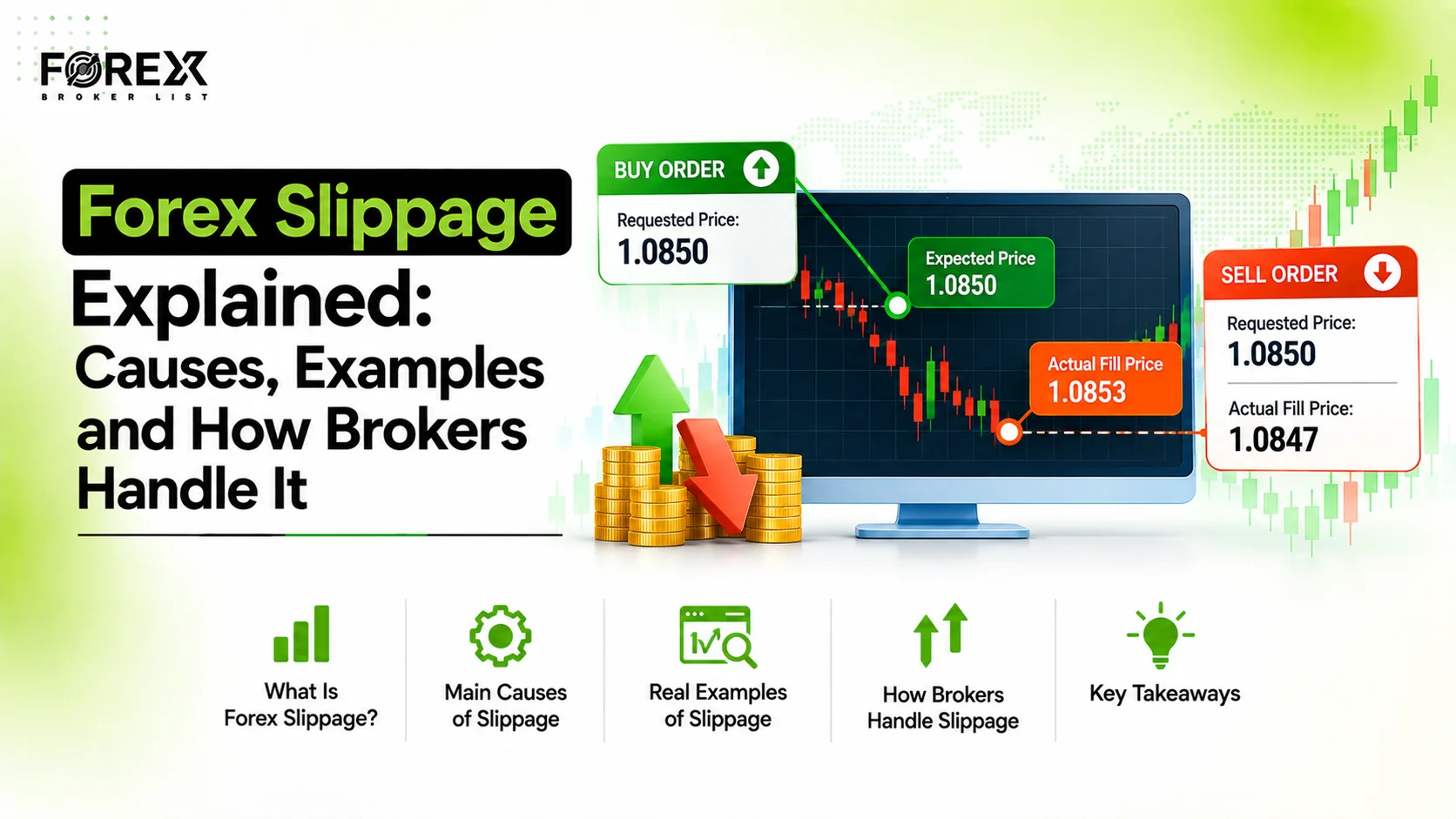
Forex slippage is the difference between the price you expected when you placed an order and the price your order actually filled at. It can work in your favor (positive slippage) or against you (negative slippage). Slippage happens most often during high volatility, low liquidity, or fast-moving news events, and it is a normal feature of live markets rather than a sign of broker misconduct.
Introduction
You click buy at one price and the confirmation shows a different one. That gap is slippage, and it happens on every broker's platform, in every execution model, whenever the market moves between the instant you submit an order and the instant it fills. Understanding how ECN, STP and market maker execution differ is the first step to knowing whether the slippage you experienced was ordinary market behavior or worth raising with your broker.
What Is Forex Slippage?
Forex slippage is the difference between the price you expected when submitting an order and the price at which the order actually executed.
Every order takes some amount of time to travel from your platform to the market, get matched against available liquidity, and confirm back to you. If the price moves during that window, even by a fraction of a second, your fill lands somewhere other than the price on screen when you clicked.
Slippage is not unique to forex. It happens in every liquid, electronically traded market. What varies is how much slippage a given trade experiences, and that depends heavily on the pair, the time of day, and the conditions in the market at that exact moment.
How Forex Slippage Works
The mechanic is straightforward: your order carries a submission price, but execution requires matching against a liquidity provider's live quote, and that quote can change in the interval between submission and confirmation.
For a market order, your platform sends an instruction to buy or sell immediately at the best available price rather than a specific price. If the best available price has moved since you saw the quote, your order fills at the new price, not the old one. This is the core reason market orders carry slippage risk that limit orders largely avoid.
For a limit order, you specify the exact price you're willing to accept. The order only fills at that price or better, which eliminates negative slippage risk on that order but introduces a different risk: the order may not fill at all if the market moves past your limit before it can be matched.
Positive vs Negative Slippage
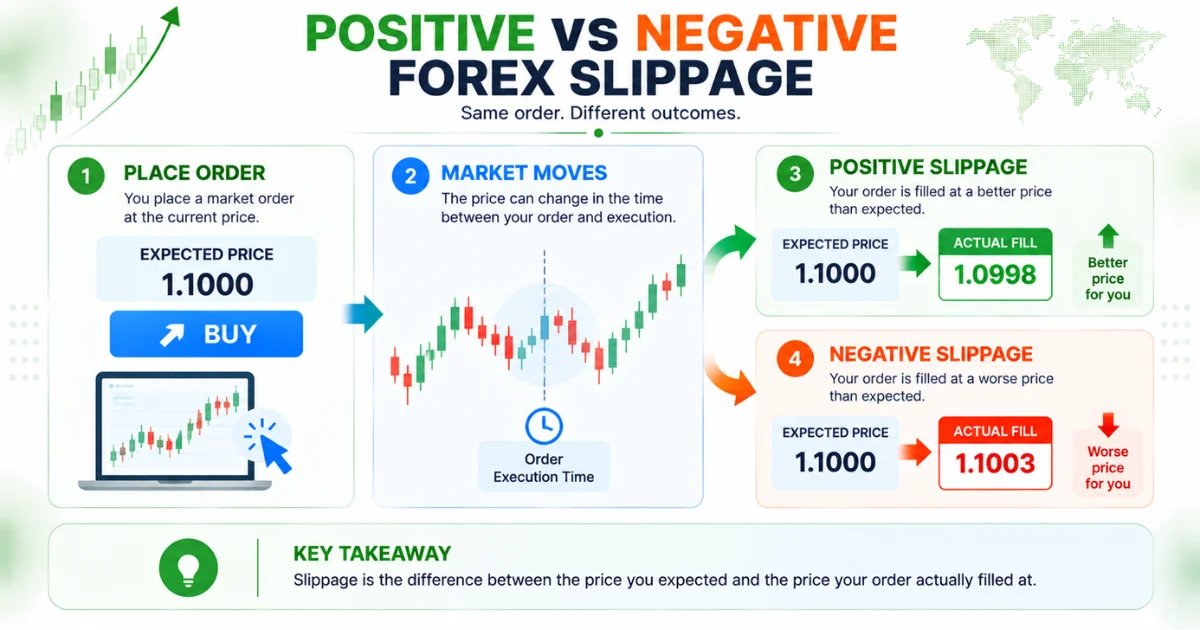
Slippage runs in two directions, though traders tend to notice only one of them.
Negative slippage means your order filled at a worse price than expected. You bought higher than you intended, or sold lower. This is the version that generates complaints and forum posts, since it directly costs money.
Positive slippage means your order filled at a better price than expected. You bought lower than you intended, or sold higher. This happens just as mechanically as negative slippage, driven by the same price movement in the opposite direction, but it rarely prompts the same scrutiny since it benefits the trader.
Published execution data from brokers that disclose their statistics shows both directions occurring at meaningful, comparable rates rather than negative slippage dominating. This is covered with real figures in the broker execution quality section below.
What Causes Forex Slippage?
Four factors combine to determine how much slippage a given order experiences.
- Market volatility. Fast price movement means more distance can be covered in the time between order submission and fill, widening the potential gap in either direction.
- Low liquidity. When fewer buyers and sellers are actively quoting a pair, the next available price can sit noticeably away from the last traded price, since there's a wider gap between quote levels.
- Execution speed and technology. The time between your click and the broker's liquidity provider confirming a fill matters. Faster bridge technology and deeper liquidity pools generally produce tighter, more consistent slippage.
- Order type. Market orders accept whatever price is available at execution. Limit and stop-limit orders trade fill certainty for price certainty, shifting the slippage risk profile entirely.
High-impact economic releases, such as central bank rate decisions or major employment reports, combine the first two factors at once: volatility spikes and liquidity providers simultaneously pull back their quotes, which is why slippage during news windows is disproportionately larger than during ordinary trading hours.
Real Example: Slippage During the 2015 Swiss Franc Shock
The clearest illustration of extreme slippage in modern forex history is the Swiss National Bank's removal of its EUR/CHF exchange rate cap on 15 January 2015.
The SNB had maintained a floor preventing the Swiss franc from strengthening past 1.20 per euro since 2011. When the SNB abruptly abandoned that cap without warning, the franc appreciated by roughly 30 percent against major currencies within minutes, and liquidity in CHF pairs effectively vanished for a period of nearly 45 minutes (Source: FinanceMagnates, SNB Crisis event coverage, 2015).
Retail traders holding CHF pair positions, even with stop-loss orders in place, found those stops could not be honored at anywhere near the intended price, since there was no liquidity at intervening levels to fill against. Orders that should have closed positions with a small, controlled loss instead executed tens or even hundreds of pips away from the stop price. The event pushed several retail brokers toward insolvency; FXCM required a $300 million loan to remain solvent after absorbing client losses, and one broker, Alpari UK, ceased operations entirely (Source: FinanceMagnates, 2015).
In the aftermath, several brokers, including Dukascopy and FXCM, voluntarily waived negative account balances for affected clients rather than pursuing clients for the shortfall, and the event is widely credited with accelerating the industry-wide adoption of negative balance protection as a standard client safeguard.
This remains the standard reference point for what slippage looks like at its most extreme: not a broker declining to honor a fair price, but a genuine absence of tradeable liquidity at any price close to the last quote.
How Brokers Handle Slippage: ECN vs STP vs Market Maker
Execution model shapes how slippage shows up on your account, and each model handles the underlying volatility differently.
ECN (Electronic Communication Network) brokers route your order directly into a pool of competing liquidity providers. Your order fills against whatever the best available price is at that instant, meaning slippage, in both directions, is a direct and transparent pass-through of real market movement. ECN brokers generally do not requote; the trade-off is that your fill price is whatever the market gives you.
STP (Straight Through Processing) brokers work similarly, forwarding orders to external liquidity providers rather than taking the other side internally, and generally exhibit slippage behavior close to ECN execution, though the exact liquidity pool and markup structure vary by broker.
Market maker brokers take the opposite side of client trades internally rather than routing to external liquidity. This structure allows some market makers to offer fixed spreads and reduced visible slippage under normal conditions, but it introduces a different mechanism during volatile periods: rather than filling you at a slipped price, some market maker brokers issue a requote, asking you to accept a new price before the order proceeds, or reject the order outright.
Neither slippage nor requotes are inherently worse. A trader who values certainty of execution price over certainty of fill may prefer a requote-based model. A trader who wants every order filled immediately, accepting whatever the resulting price turns out to be, is better served by an ECN or STP model.
Broker Execution Quality: Real Numbers
Few brokers publish detailed execution statistics, which makes the ones that do disclose particularly useful for understanding what typical slippage actually looks like across a large volume of real orders.
| Pair | Positive Slippage | Zero Slippage | Negative Slippage | Fill Rate |
|---|---|---|---|---|
| EUR/USD | 23.3% | 55.7% | 21.0% | 99.7% |
| GBP/USD | 26.0% | 51.5% | 22.5% | 99.7% |
| USD/JPY | 30.0% | 43.5% | 26.5% | 99.4% |
| AUD/USD | 24.6% | 52.7% | 22.7% | 98.9% |
Data sourced from Saxo Bank's published order-driven execution statistics, market order category, 2026. Figures represent aggregated execution outcomes across a large sample of client orders and vary by broker, order type, and market conditions. Compare execution disclosures across 750+ broker listings before choosing where to open an account.
Two things stand out in data like this. First, positive and negative slippage occur at broadly comparable rates on major pairs, undercutting the common assumption that slippage systematically favors the broker. Second, the outright majority of orders on major pairs fill at exactly the expected price with zero slippage at all, meaning the extreme cases that generate forum complaints represent a real but minority share of total order flow.
Is Forex Slippage Normal?
Yes. Some degree of slippage is a normal, expected feature of trading in a live, liquid market, not evidence of broker misconduct.
Under ordinary conditions on major pairs during active trading hours, typical slippage runs in the range of a fraction of a pip to roughly 2 pips, and the published data above shows more than half of orders on EUR/USD experiencing no slippage at all. During high-impact news events, that range can widen dramatically, sometimes to several pips or, in extreme cases like the 2015 SNB event, far beyond that. What separates ordinary slippage from a red flag is consistency and direction. A trader who experiences occasional slippage in both directions, roughly matching what published execution data shows, is seeing normal market behavior. A trader who experiences negative slippage on nearly every trade with almost no positive slippage in return has grounds to question their broker's execution quality specifically.
Can Forex Brokers Cause Slippage?
Genuine market slippage, driven by real price movement between order submission and fill, is not something a broker manufactures. It is a function of live market conditions and execution speed.
However, execution quality does differ meaningfully between brokers, and some practices can produce worse outcomes for the client than the underlying market conditions justify. Slow order routing, thin or poorly sourced liquidity pools, and, in rare and generally regulator-scrutinized cases, deliberately unfavorable execution against client interest have all been documented industry concerns historically. This is precisely why regulated brokers that publish execution statistics, and regulators that require negative balance protection and fair execution standards, matter when selecting where to trade. A broker with consistently one-sided negative slippage, especially one that cannot or will not produce execution data to explain it, is a legitimate reason for scrutiny.
How to Avoid or Reduce Forex Slippage
Several practical steps reduce slippage exposure, though none eliminate it entirely on a market order.
- Use limit orders when price certainty matters more than fill certainty. A limit order guarantees your price or better, at the cost of possibly not filling at all if the market moves past it.
- Avoid placing market orders in the minutes around high-impact news releases, when liquidity thins and volatility spikes simultaneously.
- Choose brokers with transparent, published execution statistics over those that disclose nothing about fill rates or slippage direction.
- Trade the most liquid major pairs during peak session overlap hours, when the deepest liquidity pools are active and typical slippage is narrowest.
- Widen stop-loss buffers around known news events rather than relying on a stop executing at the exact intended price during a liquidity gap, given how the 2015 SNB event demonstrated that stops cannot guarantee an exact fill when no liquidity exists at intervening levels.
Browsing by execution model when comparing brokers is a reasonable starting point, since ECN, STP, and market maker structures genuinely handle slippage and requotes differently, and matching that structure to your own trading style matters more than chasing the single lowest advertised spread.
Conclusion
Forex slippage is not a broker error and not, in the overwhelming majority of cases, evidence of foul play. It is the visible result of trading in a market that keeps moving between the moment you click and the moment your order fills. Published execution data shows it runs in both directions at roughly comparable rates on major pairs, with most orders filling at the expected price entirely. What separates ordinary slippage from a genuine problem is the direction and consistency of what you experience, and a broker's willingness to disclose real execution numbers rather than vague reassurances.
Risk Disclaimer: This article is for informational and educational purposes only. It does not constitute financial or investment advice. Forex and CFD trading involves significant risk of loss and is not suitable for all investors. Always verify a broker's regulatory status through official authorities such as FCA, ASIC, or CySEC before depositing funds.
Frequently Asked Questions
1. What is slippage in forex trading?
Slippage is the difference between the price you expected when placing an order and the price at which it actually executed. It happens because the market can move in the time between order submission and confirmation.
2. How does slippage work in forex?
Your order is sent to the market and matched against the best available liquidity at the moment of execution. If price has moved since you submitted the order, the fill lands at the new price rather than the one you saw when clicking.
3. Why does forex slippage occur?
Slippage occurs due to market volatility, low liquidity, execution speed, and order type. High-impact news events combine volatility and thinning liquidity simultaneously, which is why slippage widens most sharply around scheduled releases.
4. How to avoid slippage in forex?
Use limit orders instead of market orders when price certainty matters more than guaranteed fill, avoid trading directly into high-impact news releases, and choose brokers that publish transparent execution statistics.
5. How to reduce forex slippage?
Trade the most liquid major pairs during peak session overlap hours, widen stop-loss buffers around known news events, and compare execution quality across brokers before choosing where to trade.
6. Is forex slippage normal?
Yes. Published execution data shows the majority of orders on major pairs fill with zero slippage, and some slippage in both directions is a normal feature of live market execution rather than a sign of broker misconduct.
7. Can forex brokers cause slippage?
Genuine slippage results from real price movement and is not manufactured by a broker. However, execution quality varies between brokers, and consistently one-sided negative slippage with no published data to explain it is a legitimate reason for scrutiny.
8. Does slippage happen with every forex broker?
Yes, in some form, since it results from real market movement rather than a specific broker's policy. What varies between brokers is execution speed, liquidity pool depth, and whether the broker uses requotes instead of passing through slippage directly.
9. What causes negative slippage in forex?
Negative slippage occurs when the price moves against your intended direction between order submission and execution, most commonly during high volatility, low liquidity, or fast-moving news events.
10. What is positive slippage in forex?
Positive slippage occurs when the price moves in your favor between order submission and execution, filling your order at a better price than expected. It happens through the same mechanism as negative slippage, just in the opposite direction.
Dipak Dangodra | Financial Writer at Forex Broker List
I am Dipak Dangodra, a financial writer at Forex Broker List. I have published 200+ articles on forex broker reviews, trading platforms, spreads and commissions, and regulatory analysis using data from FCA, ASIC, and CySEC.
Related Blogs

Best Liquidity Providers for Forex Brokers (2026 Comparison)

 Your brand here