

PSP vs Traditional Payment Gateway for Forex Brokers
PSP vs payment gateway for forex explained, with a broker PSP selection checklist.
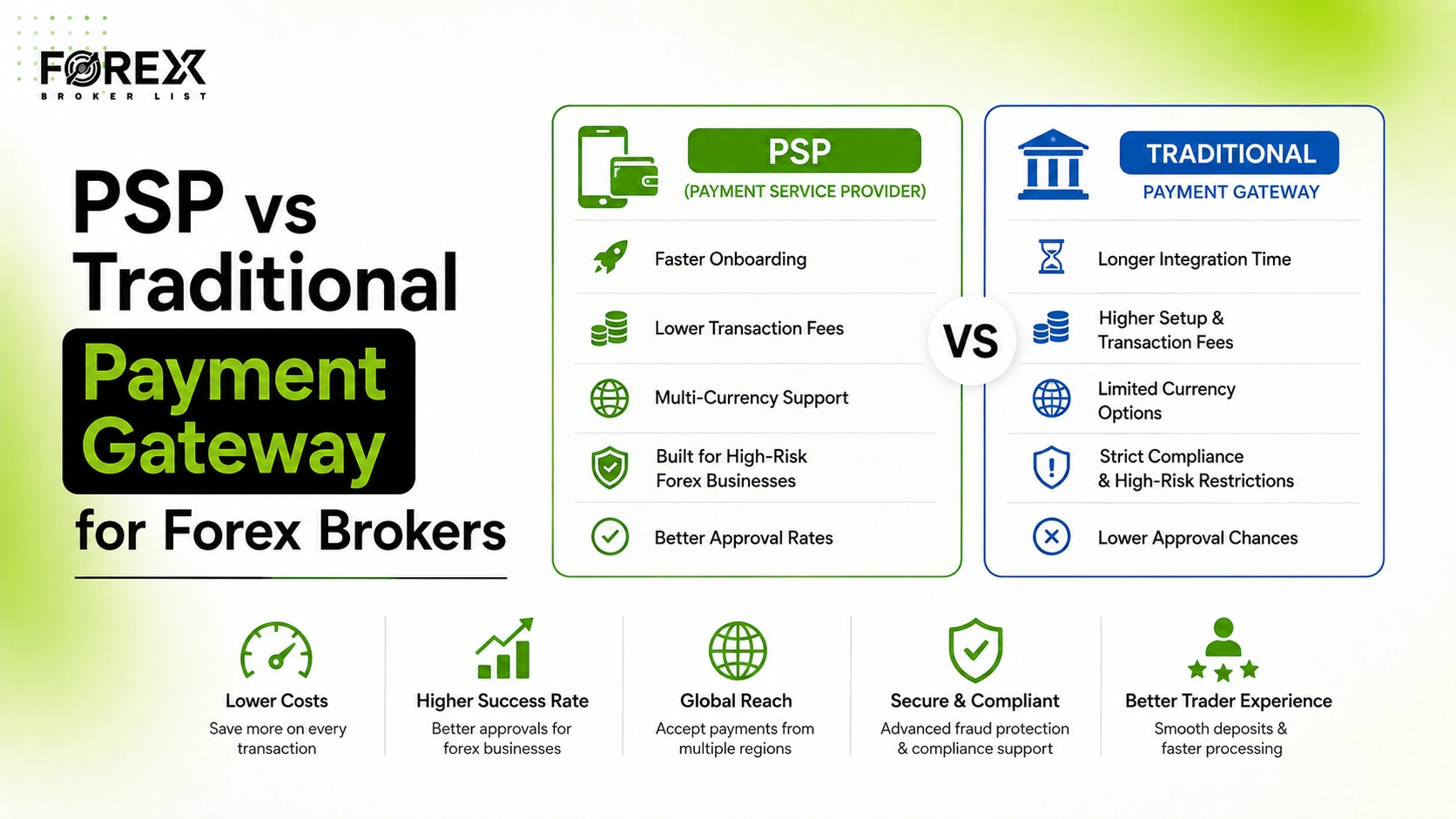
A payment gateway is the technology that securely transmits payment information between a client and a bank or card network, handling authorization only. A PSP (Payment Service Provider) bundles that gateway together with a merchant account, payment processing, settlement, and reporting into one integrated service, which is why most forex brokers work with a PSP rather than a standalone gateway.
Key Takeaways
- A payment gateway handles only the technical transmission and authorization of a transaction; a PSP bundles the gateway with a merchant account, processing, and settlement into one service
- Forex is classified as a high-risk industry by most payment processors, which limits which PSPs will work with brokers at all
- Most established brokers use multiple PSPs simultaneously for redundancy, since single-provider setups are vulnerable to sudden account freezes or reserve holds
- Rolling reserves, where a percentage of funds is held back temporarily, are standard practice in high-risk PSP relationships, not a sign of a problem broker
- PSP and payment gateway quality directly affects how fast your deposits and withdrawals actually process as a trader
What a Payment Gateway Actually Does
A payment gateway is narrowly technical. It securely transmits a customer's payment details from a checkout or deposit form to the card network or bank for authorization, then relays the approval or decline back.
It does not hold funds, manage settlement, or provide fraud tooling beyond basic encryption and transmission security. A standalone gateway suits businesses that already have their own merchant account and processor relationships and want granular control over each piece of the payment stack independently.
What a PSP (Payment Service Provider) Actually Does
A Payment Service Provider is the full-stack alternative. It bundles the payment gateway, an aggregated merchant account, transaction processing, fund settlement, and reporting into a single integrated service accessed through one contract and one integration.
For a forex broker, a PSP processes deposits and withdrawals, connecting client payment methods to card networks and banks. It also handles fraud screening, KYC-linked deposit checks, and the consolidated transaction reporting a broker's finance and compliance teams rely on.
Most brokers choose a PSP over a standalone gateway for one practical reason: forex is classified as a high-risk industry by most payment processors. Building separate direct relationships with acquiring banks, card networks, and fraud tooling providers takes more resources than most brokers, especially newer ones, can manage on their own. You can see how forex-specialized PSPs handle this differently from general processors in our forex PSP partners directory.
PSP vs Payment Gateway vs Merchant Account vs Processor
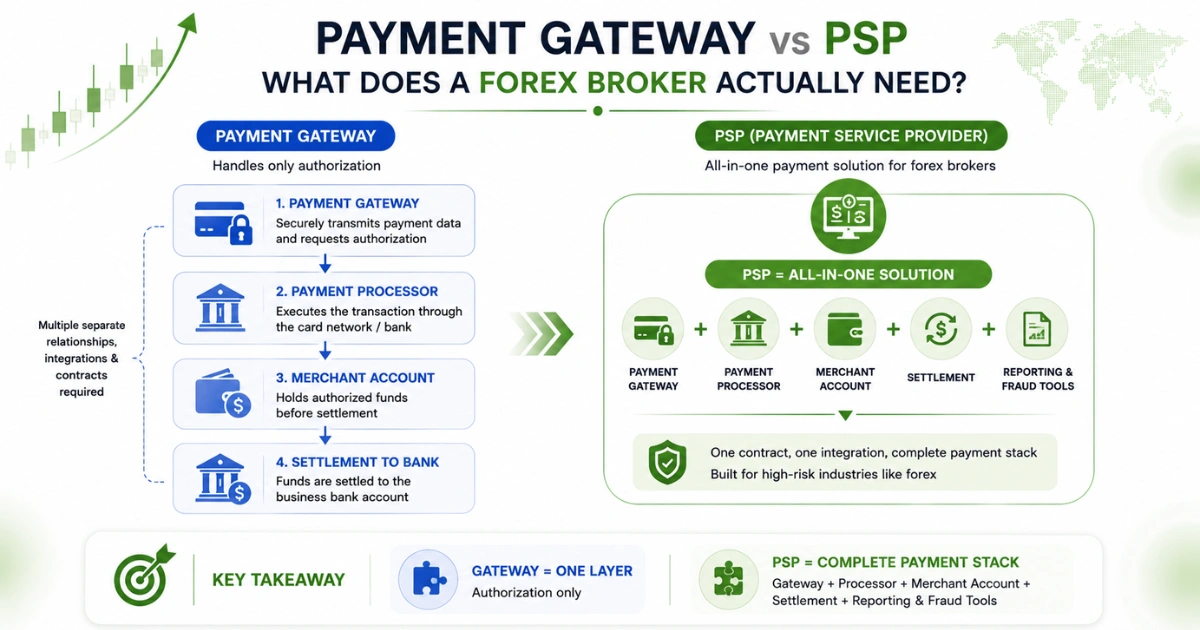
| Component | What It Does | Do You Need It Separately? |
|---|---|---|
| Payment Gateway | Transmits transaction data securely, requests authorization | Only if using a standalone processor and merchant account setup |
| Payment Processor | Executes the transaction, moving funds through the card network after gateway authorization | Bundled into most PSP relationships |
| Merchant Account | Holds authorized funds temporarily before settlement to the business's bank account | Bundled into most PSP relationships as an aggregated account |
| PSP (Payment Service Provider) | Combines all three above into one integrated service, plus fraud tools, reporting, and KYC/AML integration | This is the standard choice for most forex brokers |
Why Forex Is Treated as High-Risk by Payment Processors
Forex brokers face materially higher barriers to payment processing than typical e-commerce businesses. Payment processors generally classify a merchant as high-risk based on a few recurring factors:
- High multi-currency transaction volume
- Exposure to countries with elevated fraud rates
- High average transaction values
- A leveraged trading business model that carries inherent chargeback and regulatory scrutiny risk
Forex checks several of these boxes at once. That is why many mainstream payment processors decline forex merchants outright, and why a specialized forex PSP relationship matters more here than in most other industries.
How to Select a Forex PSP (Checklist)
Choosing a PSP for a forex brokerage involves criteria specific to the high-risk nature of the business, beyond simply comparing processing fees.
- Verify rail and geographic coverage against your actual target markets, since not every PSP supports every region or local payment method equally well
- Confirm at least one redundant provider per critical payment rail, so a single PSP freeze or outage doesn't halt deposits or withdrawals entirely
- Require clean, normalized transaction reporting with webhooks or server-to-server integration that your CRM, finance ledger, and commission engine can actually consume
- Assess built-in fraud and chargeback tooling, including 3-D Secure support, alert services, velocity rules, and BIN-level routing controls
- Confirm KYC/AML integration depth, including third-party deposit blocking, sanctions and PEP screening, and per-deposit risk scoring tied to client records
- Test failover and settlement predictability, specifically how quickly routing reroutes on a decline and how consistent fund settlement and reserve release timing actually is
Understanding Rolling Reserves and Why They're Normal
A rolling reserve is when a payment processor holds back a percentage of processed funds for a set period before releasing them to the broker. This is standard practice in high-risk payment processing, not a red flag on its own.
It exists because processors carry chargeback and fraud liability on behalf of the merchant, and a reserve gives them a buffer against that exposure. Brokers building payment infrastructure should expect and budget for this rather than treating it as unusual.
The specific reserve percentage and release timeline are genuinely worth negotiating and comparing across PSP options, since these terms vary meaningfully between providers.
How PSP and Gateway Quality Affects You as a Trader
This infrastructure layer is invisible to you as a trader, but it shapes something you notice immediately: how fast your deposit reflects in your account, and how fast a withdrawal actually reaches your bank or card.
A broker with a well-architected, multi-PSP payment setup typically processes deposits near-instantly and withdrawals within a predictable, published timeframe. A broker relying on a single, thin PSP relationship is more exposed to processing delays, payment method outages, or reserve shocks that create real friction for clients with no warning.
This is part of why some brokers advertise "instant withdrawals" credibly while others quietly take several business days for the same request, even when both claim similar payment method support on their homepage. Our guide on what " regulated broker " actually means covers a related angle worth checking alongside payment speed: whether the entity holding your funds is regulated at all.
Well-Known Payment Providers Used in Forex
Forex brokers commonly integrate a mix of global payment brands and forex-specialized PSPs to cover different regions and client preferences.
E-wallets like Skrill remain widely used specifically within the forex and trading industry for fast processing and broker familiarity.
Neteller is a close counterpart to Skrill in this space, often offered alongside it by brokers targeting the same regions.
For broader card and alternative payment coverage, Stripe and Adyen are common global infrastructure providers, though not all of their offerings serve forex merchants directly given the high-risk classification covered earlier.
Worldpay and Paysafe fill a similar role for brokers needing established card processing at scale.
For bank-transfer-based deposits specifically, Trustly is a widely used open banking provider across several European markets.
Payoneer rounds out the mix for brokers and IB partners who need cross-border payout flexibility beyond standard deposit and withdrawal rails.
This is only a sample. Our site tracks well over 100 forex-specialized PSP partners across different regions and payment rails in the full PSP partners category, which is the better starting point if you're comparing options beyond these well-known names.
Conclusion
The distinction between a payment gateway and a PSP matters more to forex brokers than most other businesses, precisely because forex's high-risk classification narrows which processors will work with the industry at all. Most brokers reasonably choose the bundled PSP model over managing separate gateway, processor, and merchant account relationships independently, and the quality of that PSP setup, including redundancy across multiple providers, directly shapes something traders notice immediately: how fast deposits and withdrawals actually process.
Understanding rolling reserves, KYC/AML integration depth, and multi-rail redundancy gives a clearer picture of what separates a broker with genuinely reliable payment infrastructure from one likely to hit processing friction. You can browse forex-specialized PSP partners, along with liquidity providers and bridge technology providers covered in our related guides, across our full payment partner directory.
Disclaimer This article is for informational and educational purposes only. It does not constitute financial or investment advice. Forex and CFD trading involves significant risk of loss and is not suitable for all investors.
Frequently Asked Questions
Dipak Dangodra | Financial Writer at Forex Broker List
I am Dipak Dangodra, a financial writer at Forex Broker List. I have published 200+ articles on forex broker reviews, trading platforms, spreads and commissions, and regulatory analysis using data from FCA, ASIC, and CySEC.
Related Blogs

Best Liquidity Providers for Forex Brokers (2026 Comparison)

 Your brand here