

What Is a Liquidity Provider in Forex? (Tier 1 vs Tier 2)
How forex liquidity providers work, Tier 1 vs Tier 2, and how they shape trader-facing spreads.
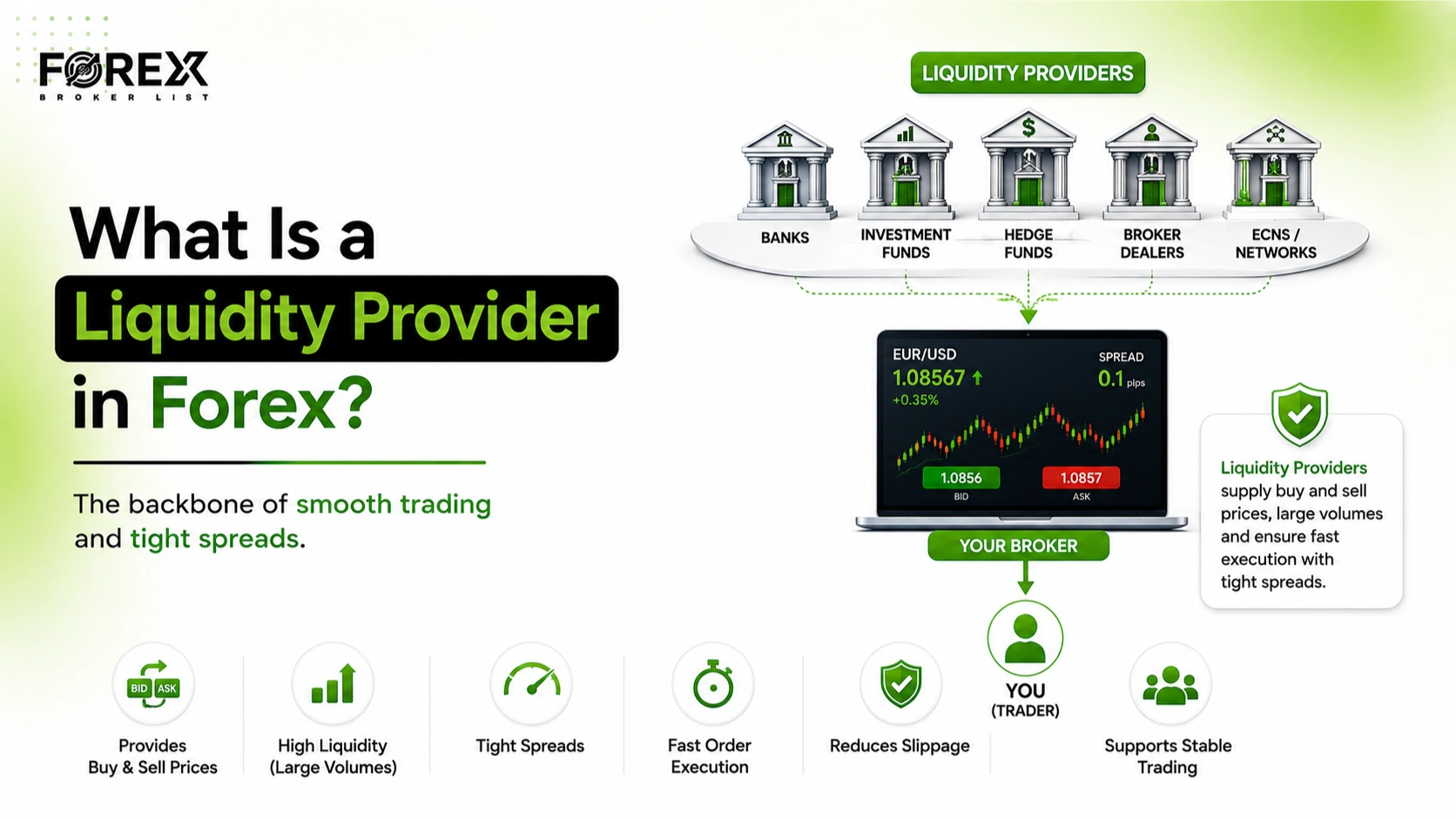
A liquidity provider (LP) is a financial institution, typically a Tier 1 bank, non-bank market maker, or Prime of Prime firm, that continuously quotes buy and sell prices and supplies the liquidity a forex broker needs to execute client trades. Tier 1 providers offer the deepest pools directly from the interbank market; Tier 2 providers aggregate that liquidity and make it accessible to smaller brokers.
Key Takeaways
- A liquidity provider supplies the bid and ask prices a broker passes on to its clients; without one, a broker has no live, tradable prices to offer
- Tier 1 providers are major global banks with direct interbank access; Tier 2 providers, including Prime of Prime firms, aggregate and redistribute that liquidity
- Most retail brokers cannot access Tier 1 banks directly and connect instead through a Prime of Prime intermediary
- Most established brokers connect to multiple LPs simultaneously for redundancy and more competitive pricing, not just one
- The quality of a broker's liquidity provider relationships directly affects the spreads, execution speed, and slippage a retail trader actually experiences
What a Liquidity Provider Actually Does
A liquidity provider is the upstream source of every tradable price a forex broker displays. It continuously quotes both a buy (bid) and sell (ask) price for a currency pair and stands ready to execute at those prices. A broker aggregates quotes from one or more LPs, then passes that pricing through to its own trading platform, sometimes with a small markup, so clients always have a live counterparty for their trades.
The distinction between a liquidity provider and a broker is fundamental, even though the two terms sometimes get blurred in casual conversation. An LP is a wholesale counterparty operating in the interbank or institutional market. A broker is the retail-facing intermediary that packages that liquidity into an accessible trading platform, account structure, and customer support layer for individual traders.
Tier 1 vs Tier 2 Liquidity Providers Explained
| Tier | Who They Are | Access Level | Examples |
|---|---|---|---|
| Tier 1 | Major global banks and top-tier financial institutions with direct interbank market access | Extremely high capital and volume requirements, largely inaccessible to small brokers directly | Deutsche Bank, UBS, Barclays, Citigroup, JPMorgan, Goldman Sachs |
| Tier 2 | Prime of Prime firms, non-bank market makers, and smaller financial institutions that source liquidity from Tier 1 providers | Far more accessible for retail-facing and mid-size brokers | Various specialist non-bank LPs and PoP providers |
Tier 1 providers offer the deepest liquidity pools, the tightest interbank spreads, and the fastest execution, since they sit at the core of the global currency market and set the reference pricing everyone else builds on. Tier 2 providers cannot match that raw depth, but they solve a real problem: most brokers, particularly newer or mid-size ones, simply cannot meet the capital, volume, and infrastructure requirements a direct Tier 1 relationship demands.
What Is a Prime of Prime (PoP)?
A Prime of Prime is an intermediary that aggregates Tier 1 bank liquidity and redistributes it to retail brokers that cannot access the interbank market directly. It sits structurally between Tier 1 banks and Tier 2-dependent brokers, effectively acting as a bridge that makes institutional-grade liquidity commercially accessible without requiring a broker to meet a bank's direct onboarding requirements.
For a growing brokerage, a Prime of Prime relationship is often the most realistic path to genuinely deep liquidity. It typically comes with more flexible commercial terms, faster onboarding, and smart order routing across multiple underlying sources, at the cost of an additional layer between the broker and the original Tier 1 price.
How Brokers Connect to Liquidity (Aggregation Explained)
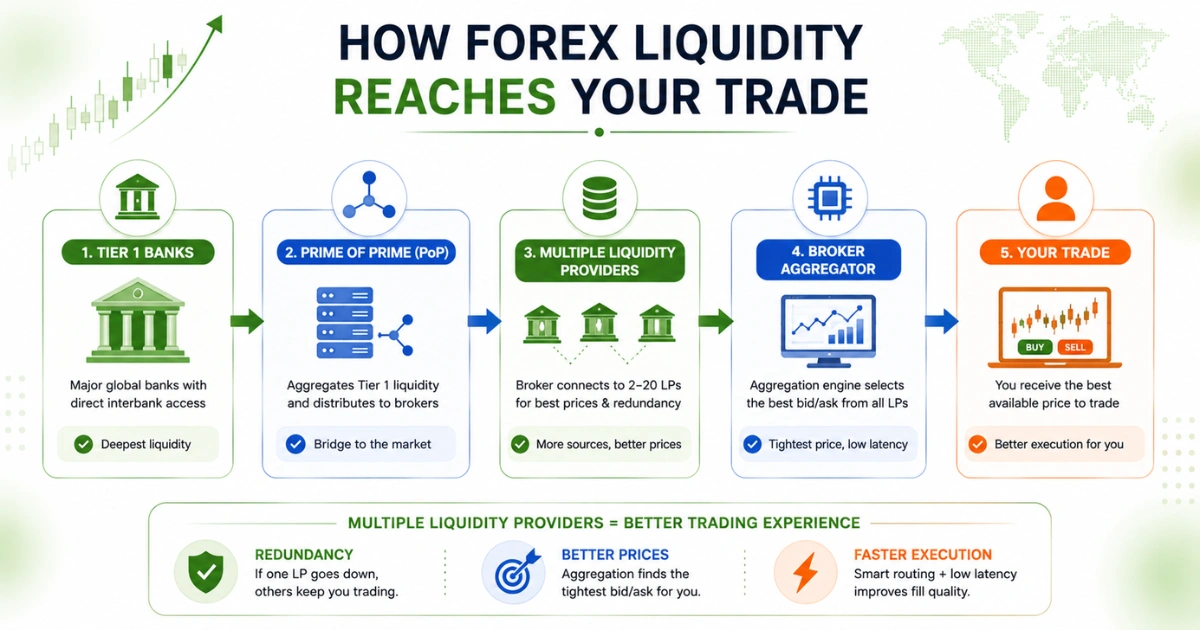
Most established brokers do not rely on a single liquidity provider. Industry practice typically involves connecting to somewhere between two and twenty LPs simultaneously, depending on the broker's size and sophistication, using a bridge or aggregation layer to combine their feeds into a single, competitive price stream.
This multi-LP setup solves two problems at once. First, it provides redundancy: if one liquidity provider's feed drops or degrades, the others continue supplying pricing, so clients don't experience a pricing outage. Second, it improves competitiveness: the aggregation bridge automatically selects the tightest available price across all connected sources for each quote, rather than relying on a single provider's spread. Connectivity between a broker's platform and its LPs is typically established through FIX API protocols and dedicated bridge middleware, the same technical infrastructure covered in more depth in our guide on what a forex bridge does.
A newer or smaller broker often starts with a single Prime of Prime provider and adds more connections as trading volume and capital grow, rather than building a multi-LP setup from day one.
How to Evaluate a Liquidity Provider (Checklist)
For brokers or fintech teams evaluating LP partners, a few criteria consistently separate a reliable relationship from a costly mistake.
- Spread competitiveness across market conditions, not just during quiet trading hours, since liquidity quality is most visible during volatility
- Execution speed and fill quality, including how the provider handles orders during high-volatility news events
- Regulatory status and counterparty risk, since an LP is a genuine counterparty exposure, not just a pricing feed
- Depth of instrument coverage, if the broker plans to offer more than major forex pairs
- Redundancy and uptime track record, particularly for providers a broker plans to rely on as a primary rather than backup source
- Named provider transparency, since a broker claiming "Tier 1 liquidity" without naming the actual provider is a signal worth questioning rather than accepting at face value
How Liquidity Providers Affect You as a Trader
This technical layer is not just a backend concern; it directly shapes what you experience as a retail trader, even though you never interact with an LP yourself. A broker with deep, well-aggregated liquidity from multiple competitive sources can typically offer tighter, more stable spreads, faster execution, and fewer requotes, particularly during volatile market conditions when thin liquidity elsewhere causes wider spreads and slippage at less well-connected brokers.
This is part of why two brokers can advertise similar headline spreads on a calm trading day but behave very differently the moment a major news release hits. The broker with deeper LP redundancy tends to hold execution quality steadier under stress, while a broker relying on a single, thinner liquidity source is more likely to widen spreads sharply or experience requotes at exactly the moment traders need reliable execution most.
Execution Models and Liquidity: ECN, STP, Market Maker
How a broker routes your order to its liquidity providers defines its execution model, and each model has a different relationship with the underlying liquidity. In an ECN model, orders are matched within an electronic network of participants, giving direct, transparent access to aggregated liquidity pricing. In an STP model, the broker passes client orders straight through to its liquidity providers, filling trades externally at the provider's price, often with a small markup. In a market maker model, the broker takes the other side of the trade itself internally, managing the resulting exposure on its own book rather than passing every order out to an LP.
None of these models is inherently better; each represents a different way of managing the relationship between client orders and underlying liquidity. Many established brokerages in 2026 run a hybrid approach, routing some flow out to liquidity providers while internalizing the rest under carefully managed risk limits. For the full breakdown of how these three models differ in cost and conflict of interest, see our guide on ECN vs STP vs market maker brokers.
Conclusion
Liquidity providers are the invisible infrastructure behind every price a forex broker shows you, and understanding the Tier 1 versus Tier 2 distinction, along with how Prime of Prime relationships and multi-LP aggregation work, explains why execution quality genuinely differs between brokers even when headline spreads look similar. For traders, this technical layer translates directly into spread tightness, execution speed, and how reliably a broker holds up during volatile market conditions. You can browse providers by category, including liquidity providers, bridge providers, and PSP partners, in our full liquidity provider directory.
Disclaimer This article is for informational and educational purposes only. It does not constitute financial or investment advice. Forex and CFD trading involves significant risk of loss and is not suitable for all investors.
Frequently Asked Questions
Dipak Dangodra | Financial Writer at Forex Broker List
I am Dipak Dangodra, a financial writer at Forex Broker List. I have published 200+ articles on forex broker reviews, trading platforms, spreads and commissions, and regulatory analysis using data from FCA, ASIC, and CySEC.
Related Blogs

Best Liquidity Providers for Forex Brokers (2026 Comparison)

 Your brand here