

Forex Broker Withdrawal Problems: Red Flags (2026)
Clear guide to forex withdrawal delays, red flags, and recovery steps for 2026.
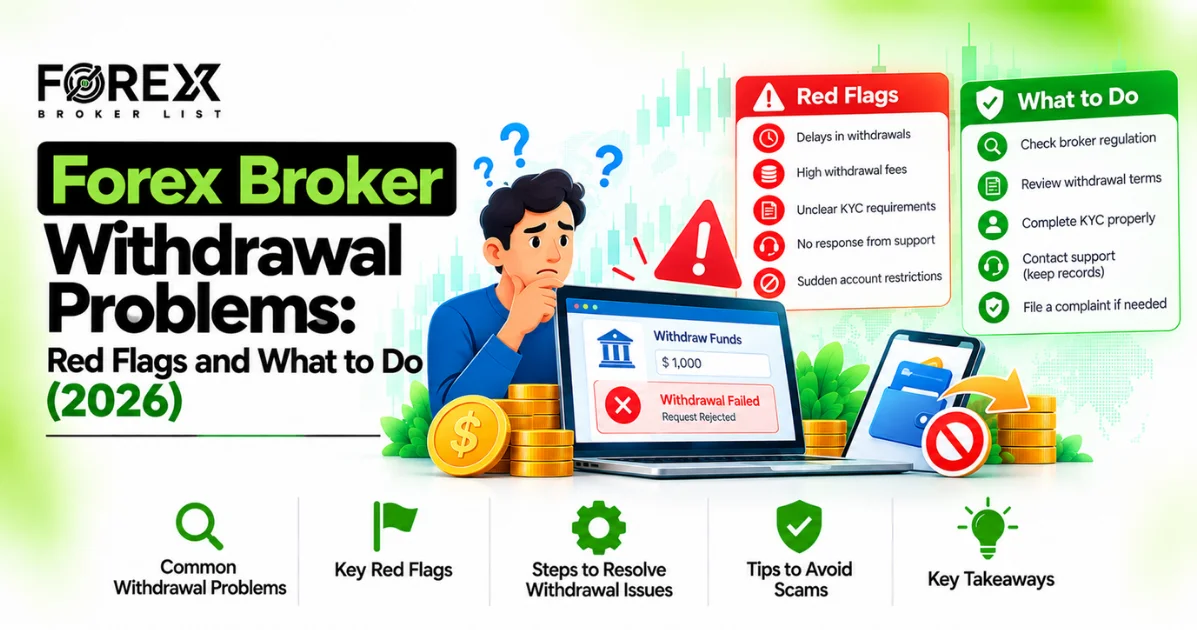
Forex broker withdrawal problems usually stem from incomplete KYC, mismatched account names, unmet bonus conditions, or slow payment rails. Legitimate Tier-1 regulated brokers process most requests within 1-2 business days. Red flags include demands for extra fees to release funds, sudden new conditions after a deposit, or silence past published timelines. Verify the exact entity on the FCA, ASIC, or CySEC register before escalating.
Introduction
Traders report forex broker withdrawal problems when funds stay pending longer than the broker’s published window or when support invents new requirements after the request. Most cases resolve once identity documents match the account name and the withdrawal method matches the original deposit. A smaller set of cases involve unregulated or clone firms that never intended to pay out. This guide shows the normal processing times at major brokers, the exact red flags that signal a problem, and the step-by-step actions that recover funds from regulated entities.
What Normal Forex Withdrawal Times Look Like
Regulated brokers publish processing windows. Once the broker approves the request, the remaining time depends on the payment method.
Pepperstone’s FCA entity recorded a median processing time of 0.63 hours (38 minutes) between 1 January and 4 September 2026 (Source: Good Money Guide data supplied by Pepperstone). Card and e-wallet withdrawals then take up to 1-2 business days to appear; bank transfers can take up to 7 business days.
IC Markets processes requests submitted before 12:00 AEST the same business day. Card withdrawals typically arrive in 3-5 business days; international wires can take up to 14 days (Source: IC Markets withdrawal page, October 2026).
AvaTrade states it processes withdrawal requests within 24 business hours on weekdays. E-wallets often complete within one business day total; international wires take 3-10 business days (Source: AvaTrade client documentation, 2026).
| Broker | Internal Processing (Typical) | Card / E-wallet Arrival | Bank Wire Arrival | Source |
|---|---|---|---|---|
| Pepperstone (FCA) | Median 38 minutes | Up to 1-2 business days | Up to 7 business days | Pepperstone / Good Money Guide, 2026 |
| IC Markets | Same day if before 12:00 AEST | 3-5 business days | Up to 14 days | IC Markets official page, Oct 2026 |
| AvaTrade | Within 24 business hours | 1 business day (e-wallets) | 3-10 business days | AvaTrade documentation, 2026 |
Data sourced from broker official sites and Good Money Guide. Last updated: October 2026.
These numbers come from Tier-1 entities. Offshore entities of the same brands can show longer or less consistent times.
Common Causes of Legitimate Withdrawal Delays
Most delays have simple explanations.
- Incomplete or mismatched KYC documents. The name on the trading account must match the bank or card name exactly.
- First withdrawal review. Many brokers run extra checks on the initial request.
- Withdrawal method differs from the deposit method. Anti-money-laundering rules require funds to return via the original channel up to the deposited amount.
- Active bonus or volume condition. Some bonuses lock the full balance until the required trading volume is met.
- Weekend or public holiday. Processing stops outside business hours.
- Large amount above daily limits. The broker may split the request or require manual approval.
A trader who deposited by card and then requested a full withdrawal to a new bank account will see the request rejected until the card portion returns first. This is standard practice under FCA and ASIC rules, not a scam signal.
Red Flags That Point to Real Forex Broker Withdrawal Problems
Certain patterns appear almost only with problematic brokers.
- The broker asks you to send additional money, pay a “tax,” or cover a “release fee” before it will send your balance. No regulated firm does this. The FCA describes similar patterns as recovery-room scams.
- Support that answered quickly before the withdrawal request goes silent afterward.
- New conditions appear only after you request a withdrawal (extra trading volume, sudden document requests that never end).
- The firm is not listed on the FCA, ASIC, or CySEC register under the exact legal name shown in your client agreement.
- Withdrawal status stays “pending” or “processing” well past the published window with no ticket updates.
In 2015, several unregulated firms collapsed after the Swiss National Bank removed the EUR/CHF floor. Traders who had deposited with those firms recovered little or nothing because client funds were not segregated. The same segregation failure appears in later insolvency cases.
How to Test a Broker Before Scaling Deposits
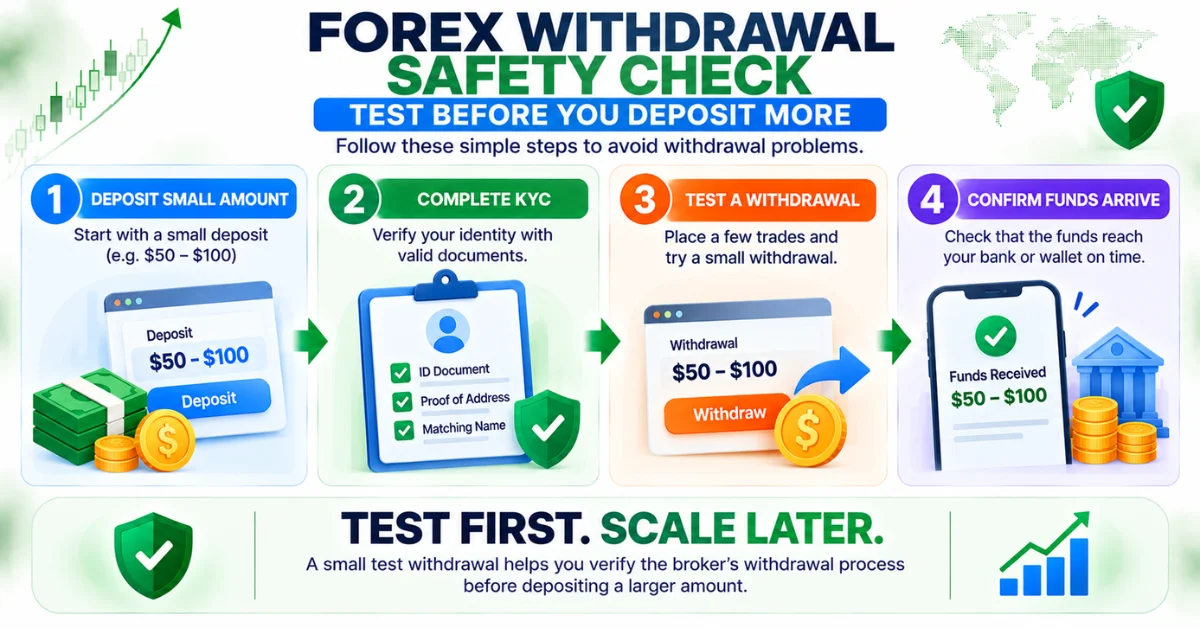
Deposit a small amount (for example $50-$100), complete full KYC, place a few trades, then request a full withdrawal.
Pepperstone and IC Markets both allow this test. If the small withdrawal returns within the published window, the larger balance is more likely to follow the same path. If the test withdrawal triggers new conditions or silence, stop depositing.
Link the test account to the same payment method you plan to use later so the name-match and method-match rules are already satisfied.
Step-by-Step: What to Do When a Withdrawal Is Delayed
- Confirm the request appears in your client area with a timestamp and reference number.
- Check the broker’s published processing window for your method. Wait that full window plus one extra business day.
- Open a support ticket that states the date of the request, the amount, the method, and the reference number. Keep the reply.
- If the delay continues, escalate inside the firm to the compliance or withdrawals team and ask for a final response.
- Identify the exact legal entity that holds your account (shown in the client agreement or account dashboard). Verify that entity on the regulator’s public register.
For an FCA-regulated entity, the firm must acknowledge a complaint within a few business days and provide a final response within eight weeks (Source: FCA consumer guidance, fca.org.uk). After that letter, or if eight weeks pass with no response, eligible clients can take the case to the Financial Ombudsman Service within six months of the final response.
ASIC clients can use the Australian Financial Complaints Authority (AFCA) for eligible disputes. CySEC clients can use the Financial Ombudsman of the Republic of Cyprus and, where applicable, the Investor Compensation Fund (up to €20,000).
Offshore entities have no equivalent binding ombudsman. Recovery is far less certain.
Escalation Routes by Regulator
| Regulator | First Step | External Body | Typical Timeline | Compensation if Firm Fails |
|---|---|---|---|---|
| FCA (UK) | Written complaint to firm | Financial Ombudsman Service | Firm: up to 8 weeks | FSCS up to £85,000 |
| ASIC (Australia) | Complaint to firm | AFCA | Varies; AFCA aims for faster resolution | None automatic |
| CySEC (Cyprus) | Complaint to firm | CySEC Ombudsman / ICF | Similar multi-week process | ICF up to €20,000 |
Data sourced from FCA, ASIC, and CySEC public guidance. Last updated: October 2026.
Always complain to the firm first. Regulators themselves do not recover individual withdrawals; the ombudsman or compensation scheme handles that step.
Bonus Terms and Withdrawal Restrictions
A 100% deposit bonus that requires 30 or 50 times the bonus amount in trading volume before any withdrawal is common. The terms usually lock both the bonus and the original deposit until the volume is met.
Read the exact multiplier and the instruments that count before accepting any bonus. Many traders discover the restriction only when they try to withdraw. Legitimate brokers state these rules in the client agreement; problematic ones hide or change them after the deposit.
Name Matching and Third-Party Withdrawals
Regulated brokers refuse withdrawals to any account whose beneficiary name does not match the verified trading account name. This rule follows anti-money-laundering standards applied by the FCA, ASIC, and CySEC.
You cannot withdraw to a relative’s account, a company account, or a different personal account unless that account was already verified under the same legal name. The rejection is automatic and is not a sign of bad faith.
What to Do If the Broker Is Unregulated or a Clone
If the firm does not appear on the official register of the claimed regulator, stop all further payments immediately. Document every deposit, trade, and support message. Report the firm to the regulator in your own country and to the regulator it claims to hold. Leave factual reviews on independent sites so other traders can see the pattern.
Chargebacks may be available if you deposited by card and the merchant has not yet settled, but success rates drop quickly after the first few weeks. Crypto deposits are effectively irreversible.
Prevention Checklist
- Verify the exact legal entity and licence number on the regulator’s own website before the first deposit.
- Complete full KYC on day one.
- Use only payment methods in your exact legal name.
- Avoid or carefully calculate any bonus before accepting it.
- Run a small test withdrawal after a few trades.
- Keep screenshots of balances, request timestamps, and all support replies.
- Prefer brokers that hold current FCA, ASIC, or CySEC licences for the entity that will hold your funds.
Compare regulated options on the FCA regulated brokers and ASIC regulated brokers pages. Check individual profiles such as Pepperstone and IC Markets for the entity that matches your country.
Conclusion
Most forex broker withdrawal problems clear once documents, name matching, and method matching are correct. The minority of cases that involve genuine refusal or silence require prompt escalation using the exact entity and the regulator’s published complaint path. A small test withdrawal before larger deposits remains the simplest way to confirm the process works for your account.
This article is for informational and educational purposes only. It does not constitute financial or investment advice. Forex and CFD trading involves significant risk of loss and is not suitable for all investors. Always verify a broker's regulatory status through official authorities such as FCA, ASIC, or CySEC before depositing funds.
Frequently Asked Questions
Dipak Dangodra | Financial Writer at Forex Broker List
I am Dipak Dangodra, a financial writer at Forex Broker List. I have published 200+ articles on forex broker reviews, trading platforms, spreads and commissions, and regulatory analysis using data from FCA, ASIC, and CySEC.
Related Blogs

Tools for Brokers: Starter Stack (2026)

 Your brand here