

Forex Swap Fees Explained: What Is the Overnight Trading Cost?
Forex swap fees explained: how overnight interest is calculated, why Wednesday triples it, and how to avoid the cost.
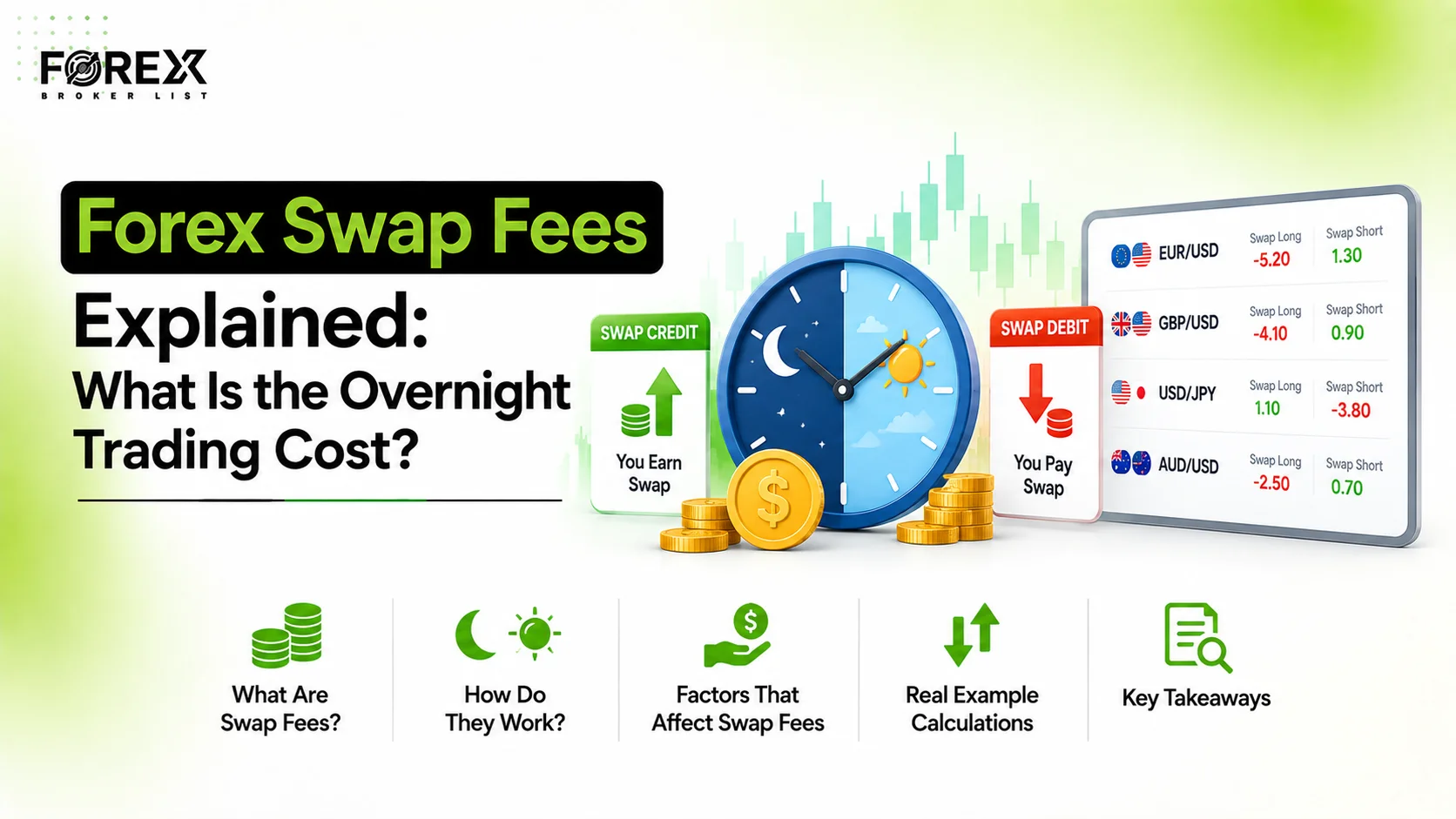
Forex swap fees are the interest charged or credited for holding a currency position past the daily rollover, typically 5pm New York time. The amount depends on the interest rate differential between the two currencies and the direction of your trade. Most brokers charge triple swap on Wednesday to account for the weekend, when no new settlement runs.
Introduction
Leave a forex position open past the daily rollover and your account picks up a charge or a credit you never clicked to approve. Most traders discover this the first time a statement shows an unexplained deduction after a multi-day hold. Understanding what a forex broker actually does behind the scenes when you hold overnight makes the charge predictable instead of mysterious, and predictable costs are costs you can plan around.
What Is a Forex Swap Fee?
A forex swap fee is the interest charged or credited for holding a currency position open past the broker's daily rollover time, most commonly 5pm New York time, equivalent to 22:00 GMT in winter and 21:00 GMT during daylight saving.
Every forex trade involves two currencies. Effectively, you borrow one to buy the other. Since currencies carry different interest rates, holding that borrowed position overnight generates either a cost or a credit depending on which side of the rate differential you sit on.
- Negative swap means you pay interest, deducted automatically from your account.
- Positive swap means you earn interest, credited automatically.
Any position still open at rollover time incurs swap. A position opened and closed the same day, before rollover, incurs none.
How Forex Swap Works
The mechanic behind forex swap is the interest rate differential between the two currencies in your pair.
Say you go long EUR/USD. You are effectively buying euros with borrowed dollars. If the euro's interest rate sits below the dollar's, you pay the difference nightly, since you are holding the lower-yielding currency and funding it with the higher-yielding one. If the euro's rate sits above the dollar's, you receive the difference instead.
Your broker's trading platform displays this automatically as separate "swap long" and "swap short" values for every pair, so you never calculate the raw interest rate differential yourself. What you see already reflects the broker's own funding markup layered on top of the pure rate differential, covered in a later section.
How Forex Swap Fees Are Calculated
The standard formula is:
Swap Rate x Lot Size x Number of Nights = Total Swap Fee
The swap rate itself is published per lot in your platform's contract specification, separately for long and short positions on each pair, since the two directions almost always carry different values and can even carry different signs.
Three inputs decide your total cost:
- The published swap rate for your direction, long or short, on that specific pair.
- Your position size, since swap scales linearly with lot size. A 2-lot position pays roughly double the swap of a 1-lot position.
- The number of nights held, counting Wednesday as three nights due to the triple swap rule covered next.
Worked Example: Calculating Your Overnight Cost
Real numbers make the formula concrete. IC Markets publishes an EUR/USD swap long rate of -8.654 and a swap short rate of 2.846 on its MetaTrader 4/5 platform, in the account's base currency units per standard lot, as of its most recently published swap table (Source: IC Markets, 2026).
Single night, long position: Holding 1 standard lot of EUR/USD long for one ordinary night costs approximately $8.65, deducted automatically.
One week, long position, spanning Wednesday: A position opened Monday and held through the following Monday incurs swap on Monday, Tuesday, Wednesday (tripled), and Thursday nights, four charging events totaling six nights of swap. 6 nights x $8.65 = approximately $51.90 for the week, on a single standard lot, before any spread or commission cost.
Short position, same week: The same hold on the short side, using the swap short rate of 2.846, would instead credit approximately $17.08 across the same six nights, since short EUR/USD sits on the positive side of this particular differential.
Swap rates change as central bank policy shifts, so treat these as illustrative rather than fixed. Always check your own platform's live contract specification before holding a position over multiple nights.
Triple Swap Wednesday Explained
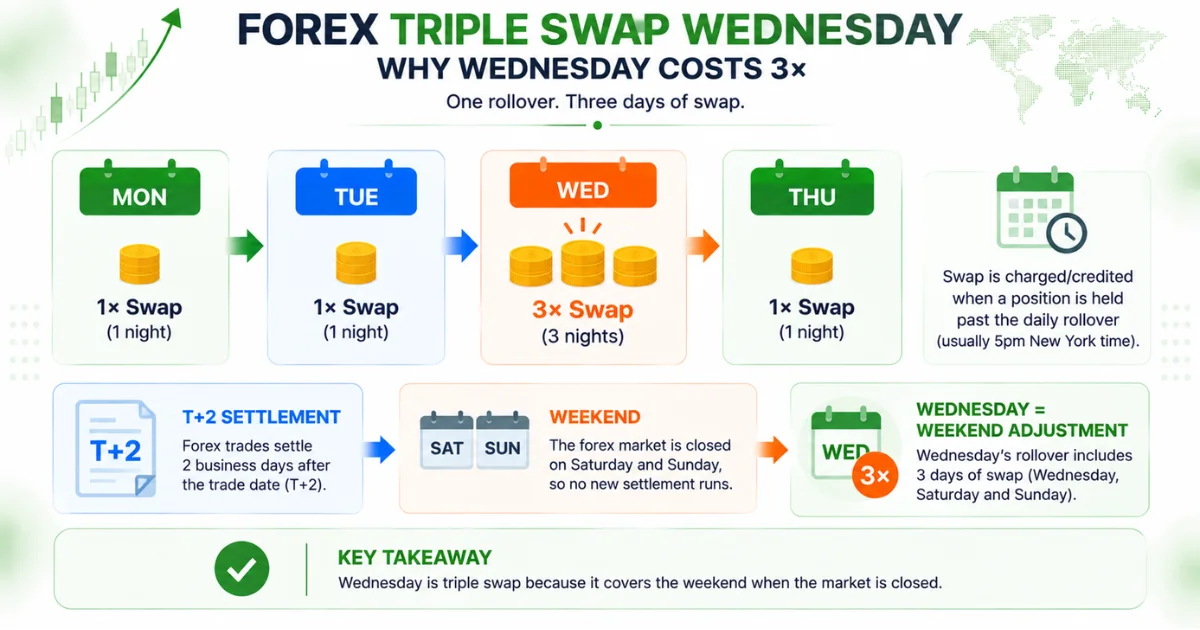
Wednesday carries triple swap because of how the forex market settles trades, not as an arbitrary broker rule.
Spot forex trades settle on a T+2 basis, meaning a trade executed today settles two business days later. A position opened on Wednesday would normally settle on Friday. But Saturday and Sunday are not business days, so no settlement activity happens over the weekend, and the interest that would have accrued across Friday, Saturday, and Sunday has to be collected somewhere. Brokers collect it in a single triple charge applied at Wednesday's rollover, covering all three of those days in one booking.
This means a position held from Wednesday to Thursday is charged three nights of swap in that single event, while a position held from Friday to Monday, spanning the actual weekend, is not charged again separately. Some brokers apply the triple charge to a different weekday for certain instruments, so check your platform's rollover field rather than assuming Wednesday applies universally to every product you trade (Source: FxPro Swap Calculator documentation, 2026).
Why Do Forex Brokers Charge Swap Fees?
Two layers combine into the swap rate you see on your platform.
The raw interest rate differential reflects genuine central bank policy rates for the two currencies in the pair. This portion exists independent of any broker and would apply in an idealized interbank market.
The broker's funding markup sits on top of that raw differential. Brokers add or subtract a spread on the swap itself as a revenue source, which is why the same pair can show noticeably different swap rates across different brokers even when the underlying interest rate differential is identical. This markup usually pushes net swap toward a cost on both the long and short side of a pair, rather than a clean mirror image of the raw rate.
Are Forex Swap Fees Charged Every Day?
Swap is charged or credited on every night a position remains open at rollover, except that Wednesday absorbs the weekend into a single triple charge rather than charging separately on Friday, Saturday, and Sunday.
Practically, that means a position held Monday through Friday incurs four charging events: Monday, Tuesday, Wednesday (tripled), and Thursday nights, which together account for six total nights of swap across a five-day trading week. A position opened and closed within the same trading day, before rollover, incurs no swap at all.
Real Broker Swap Rate Comparison
Swap rates vary meaningfully by broker, even on the exact same pair, because of the funding markup layered on top of the raw interest rate differential.
| Broker | Platform | EUR/USD Swap Long | EUR/USD Swap Short | Swap-Free Option |
|---|---|---|---|---|
| IC Markets | MT4/MT5 | -8.654 | +2.846 | Yes, on request |
| IC Markets | cTrader | -0.87 | +0.28 | Yes, on request |
| Pepperstone | MT4/MT5/cTrader | Calculated via TomNext rate, published in platform specifications | Calculated via TomNext rate, published in platform specifications | Yes, Standard account swap-free option available |
Data sourced from IC Markets swap tables and Pepperstone's UK Legal Costs and Charges document, version 8.0, updated July 2026. Swap rates change with central bank policy and are reviewed frequently by brokers; always confirm the live rate in your own platform's specifications section before holding a position overnight. Browse 750+ broker listings to compare swap policies across a wider set of regulated brokers.
Note the unit difference between IC Markets' MT4/MT5 figures and its cTrader figures for the identical pair. Always confirm which platform's contract specification you are reading, since the same broker can quote materially different-looking numbers depending on the platform.
How to Avoid Swap Fees in Forex
Four practical approaches reduce or eliminate swap exposure.
- Close positions before daily rollover. If your strategy is inherently short-term, exiting before 5pm New York time avoids swap entirely on that trade.
- Use a swap-free account. Many brokers, including IC Markets and Pepperstone, offer swap-free account options, originally built for traders following Islamic finance principles that prohibit interest, but generally available to any client on request.
- Trade the positive-swap direction when strategy allows. If your directional view is flexible and the pair currently pays a credit on the side you'd take anyway, that credit offsets other trading costs.
- Filter by regulation and account type when shopping for a broker, since swap-free availability and funding markup size vary meaningfully across regulated brokers.
Be aware that swap-free accounts are not free of all overnight cost. Some brokers substitute a fixed administrative fee for extended holds in place of the interest-based swap, so read the account terms rather than assuming zero cost across the board.
Can You Profit From Swap? Carry Trades Explained
A carry trade is built specifically around collecting positive swap. The strategy involves going long the higher-yielding currency in a pair against the lower-yielding one, then holding the position to collect the daily interest credit.
This can generate steady income over time when the rate differential is wide and stable, and historically some currency pairs with large central bank rate gaps have attracted meaningful carry trade flows. The risk sits in the price movement of the underlying pair itself. A currency can move against your position by far more in a single volatile session than weeks or months of accumulated positive swap would offset. Treat positive swap as a modest discount on a position you already wanted to hold for other reasons, not as a standalone income strategy, since the interest differential is typically far smaller than ordinary price volatility on the pair.
What Happens If You Hold Forex Overnight
The mechanics above play out in a very ordinary way for most retail traders. You open a position, get busy, and the trade stays open past rollover without a deliberate decision to hold it.
A common and costly version of this mistake is a trader who opens a swap-free account for religious or cost reasons, then later switches account types or brokers without checking whether the new account still carries the swap-free designation. Every overnight hold on the new account then accrues ordinary negative swap silently, and the cost only becomes visible once a statement is reviewed weeks later. Checking your account's swap status directly in the platform specifications, not just assuming it carries over from a previous account, avoids this specific and avoidable cost.
More generally, any position drifting from an intended day trade into a multi-week hold accumulates swap on every qualifying night, and that accumulated cost compounds against a losing position exactly when a trader can least afford it. Reviewing open positions against your actual holding-period intention, not just your open profit and loss, is a habit worth building.
Conclusion
Forex swap fees are not hidden charges. They are the visible cost of the interest rate differential built into every currency pair, applied automatically the moment a position crosses daily rollover. Understanding the T+2 mechanic behind Wednesday's triple charge, running the actual calculation on your position size, and checking whether a swap-free account fits your trading style turns an unexplained deduction into a cost you planned for from the start.
Risk Disclaimer: This article is for informational and educational purposes only. It does not constitute financial or investment advice. Forex and CFD trading involves significant risk of loss and is not suitable for all investors. Always verify a broker's regulatory status through official authorities such as FCA, ASIC, or CySEC before depositing funds.
Frequently Asked Questions
Dipak Dangodra | Financial Writer at Forex Broker List
I am Dipak Dangodra, a financial writer at Forex Broker List. I have published 200+ articles on forex broker reviews, trading platforms, spreads and commissions, and regulatory analysis using data from FCA, ASIC, and CySEC.
Related Blogs
What Is Forex Spread? Fixed vs Variable Explained

 Your brand here