

NYSE vs NASDAQ: Which Stock Exchange Is Better?
NYSE vs NASDAQ compared: auction vs dealer model, 2026 listing costs, volatility, and how to trade both from outside the US.
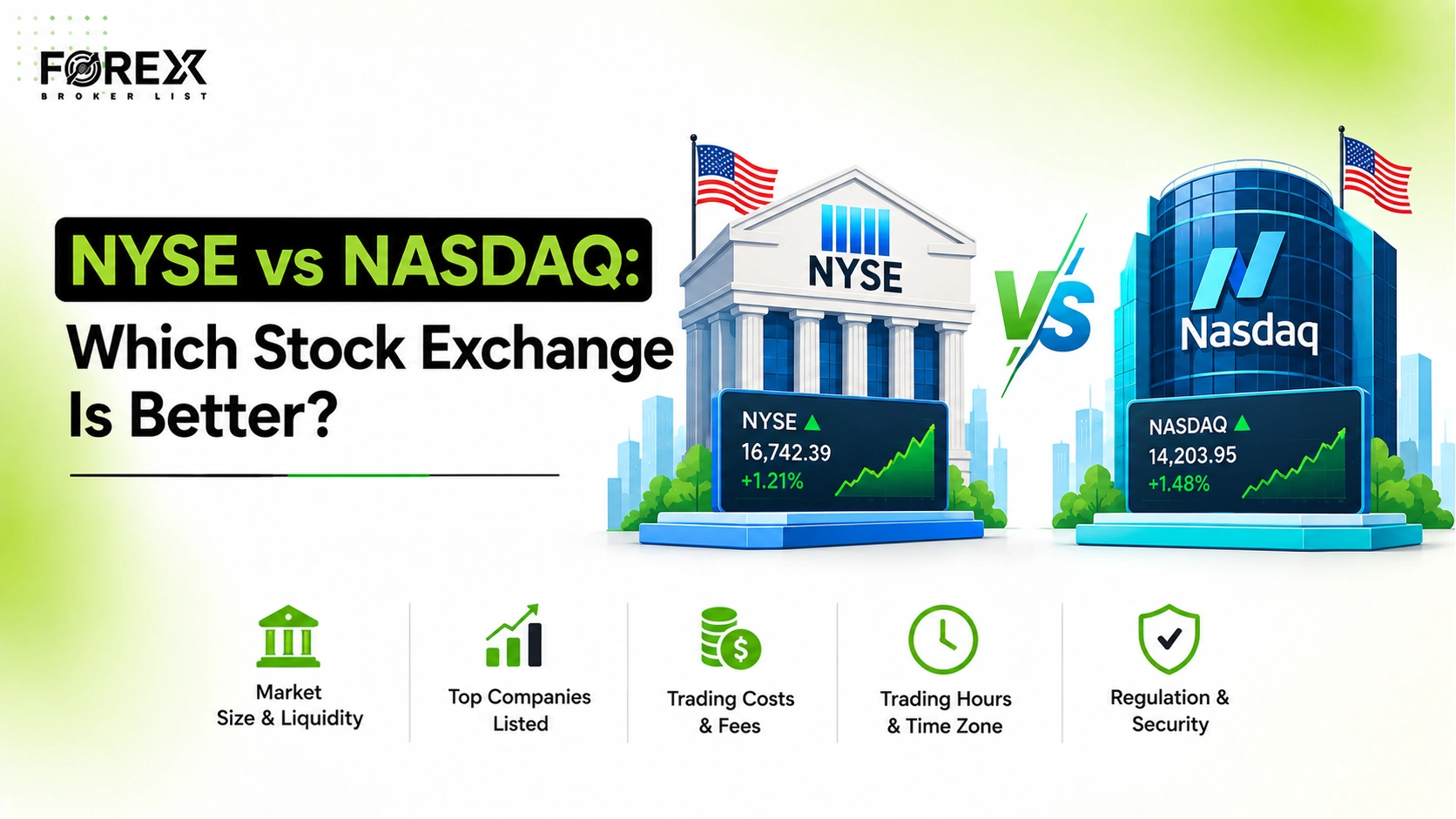
Neither exchange is better in absolute terms. NYSE vs NASDAQ comes down to two things: how your order gets filled, and what kind of companies you end up holding. The NYSE runs a human-supervised auction dominated by established, dividend-paying firms. The NASDAQ runs a fully electronic dealer market weighted toward technology and growth. Income and stability favour the NYSE. Momentum and volatility favour the NASDAQ.
NYSE vs NASDAQ
| Feature | NYSE | NASDAQ |
|---|---|---|
| Founded | 1792 | 1971 |
| Owner | Intercontinental Exchange (ICE) | Nasdaq, Inc. |
| Market model | Auction, with Designated Market Makers | Dealer, with competing electronic market makers |
| Physical floor | Yes, at 11 Wall Street | No, fully electronic since launch |
| Typical listing profile | Established, capital-intensive, dividend-paying | Technology, biotech, high-growth |
| Approximate listed companies | Around 2,100 | Around 4,000 |
| Flagship names | Berkshire Hathaway, JPMorgan, Coca-Cola, Exxon Mobil | Apple, Microsoft, Nvidia, Amazon, Alphabet |
| Headline index association | Dow Jones Industrial Average, NYSE Composite | NASDAQ Composite, NASDAQ-100 |
| Initial listing fee (2026) | $295,000 flat | $325,000 (Global and Global Select tiers) |
How the NYSE Works: The Auction Model
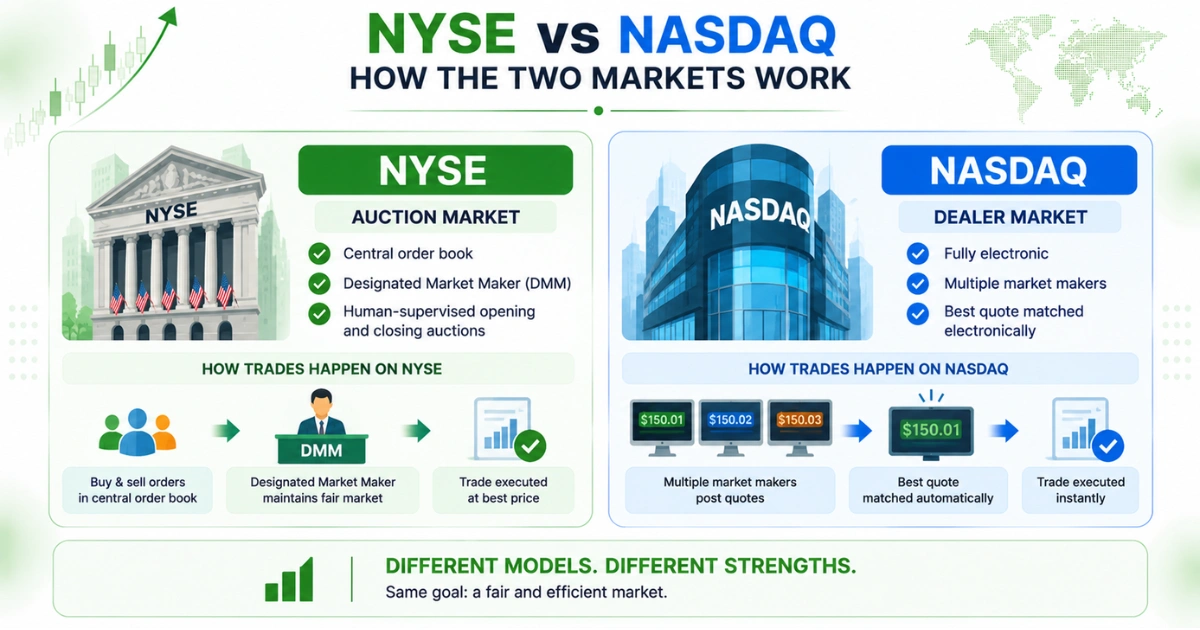
The NYSE is an auction market. Buy and sell orders meet in a central order book, and the highest bid is matched against the lowest offer. What separates it from a purely electronic venue is the Designated Market Maker, or DMM.
Each NYSE-listed stock is assigned to one DMM firm. The DMM has an obligation to maintain a fair and orderly market in that stock, which means quoting both sides, stepping in with its own capital when the book thins out, and manually running the opening and closing auctions when order flow is unbalanced.
That last point matters more than it sounds. The NYSE closing auction is one of the deepest liquidity events in global markets. A large share of the day's volume in NYSE-listed names prints in the final seconds of the session, because index funds, ETFs and institutional rebalancing programs all target the official closing price.
For a retail trader, the practical consequence is simple. If you want to enter or exit a large position in an NYSE blue chip with minimal slippage, the close is usually the cheapest moment of the day. If you trade thin NYSE names in the middle of the session, you are paying for the fact that most of the liquidity is waiting for 16:00 ET.
How the NASDAQ Works: The Dealer Model
The NASDAQ never had a floor. It launched in 1971 as the world's first electronic quotation system, and it operates as a dealer market rather than an auction.
Instead of one DMM per stock, a NASDAQ security can have dozens of registered market makers competing to quote it. Each posts its own bid and offer. Your order is matched against whichever quote is best at that instant, and the competition between dealers is what compresses the spread.
In heavily traded names the result is excellent. Spreads on Apple or Microsoft are typically a single cent during regular hours because so many participants are fighting for the flow. The trade-off appears further down the market. In a small NASDAQ Capital Market listing with two or three interested dealers, the quoted spread can be several percent wide, and that cost is invisible until you try to exit.
The structural difference is therefore not about speed. Both venues are electronic in practice. It is about whether one accountable firm carries an obligation to smooth the market, as on the NYSE, or whether liquidity is left to competition, as on the NASDAQ.
Listing Requirements and Costs in 2026
Listing economics explain a great deal about why particular companies end up where they do.
NASDAQ's Three Tiers
The NASDAQ splits its market into three tiers with different financial and governance thresholds. The Capital Market tier is the entry point for smaller companies. The Global Market sits above it. The Global Select Market carries the strictest financial and liquidity standards of the three.
On 1 January 2026, the NASDAQ raised its entry fee for a company listing its first class of securities on the Global or Global Select Market from $295,000 to $325,000. The change was filed with the Securities and Exchange Commission under rule filing SR-NASDAQ-2025-099, with a transition window for companies that applied before that date and listed before 15 February 2026. The Capital Market tier remains far cheaper, at $50,000 to $75,000 depending on shares outstanding.
Annual costs follow the same logic. NASDAQ runs an all-inclusive annual fee that bundles most ongoing listing services into one number, scaled by shares outstanding.
Source: The Nasdaq Stock Market LLC, Rule 5910, as amended per SEC filing SR-NASDAQ-2025-099; Nasdaq Initial Listing Guide, January 2026.
NYSE's Single Standard
The NYSE does not tier its main market in the same way. It charges a flat $295,000 initial listing fee for a first class of common shares, including a $25,000 application fee, and then bills an annual fee on a per-share basis subject to a minimum and a cap.
The historical position was that the NYSE was the expensive, prestigious venue and the NASDAQ was the affordable alternative. As of 2026 that framing no longer holds at the top tier, since the NASDAQ headline entry fee now exceeds the NYSE's. The cost gap survives only lower down, where the NASDAQ Capital Market has no real NYSE equivalent at that price point.
For a trader this is not trivia. Cheap entry tiers are where speculative micro-cap listings cluster, and those are the names most prone to sudden dilution, reverse splits and delisting notices.
Which Exchange Is Bigger?
This question has no permanent answer, and most articles that assert one are quoting a stale figure.
Measured by number of listed companies, the NASDAQ has been comfortably ahead for years, with roughly twice the NYSE's count. Measured by market capitalisation, the two have been converging. World Federation of Exchanges data showed the domestic market capitalisation of the two venues running close to level through late 2025, after years in which NASDAQ grew substantially faster than the NYSE. During 2026, NASDAQ's domestic market capitalisation moved ahead of the NYSE's.
Two cautions apply. First, the ranking is sensitive to the measure. Domestic market capitalisation excludes foreign listings, so figures that include them can reverse the order. Second, a lead built on a handful of mega-cap technology names is fragile, because a 15 percent drawdown in the largest NASDAQ constituents can hand the position back within weeks.
The useful takeaway is not who is ahead this quarter. It is that NASDAQ's value is concentrated in a narrow group of very large companies, while the NYSE's is spread across a wider base. That concentration is the subject of the next section.
Volatility and Sector Concentration
The NASDAQ-100 tracks the largest non-financial companies on the NASDAQ, and it is heavily weighted toward information technology and communication services. A small number of names drive a large share of its movement.
The NYSE Composite is broader and includes significant weightings in financials, energy, industrials, healthcare and utilities. The Dow Jones Industrial Average, the index most associated with the NYSE in the public mind, is a 30-stock price-weighted index that now includes several NASDAQ-listed members, so it is not a clean proxy for either venue.
What this means in practice:
- Earnings season hits harder on the NASDAQ. When a top-five constituent reports, the index-level move can be several times what a comparable NYSE report would produce, because the weighting is concentrated.
- Interest rate sensitivity differs. Growth companies with earnings projected far into the future are more sensitive to changes in rate expectations than mature cash-generating firms. That asymmetry shows up between the two venues.
- Correlation is not diversification. Holding five NASDAQ-100 technology names is close to holding one position five times over. The apparent spread across tickers does not spread the risk.
If you trade index products rather than single stocks, this is the difference between the US100 and the US30 or US500 instruments your broker quotes. Same market, materially different risk profile.
Trading Hours, Sessions and Ticker Conventions
Both exchanges keep identical core hours: 09:30 to 16:00 Eastern Time, Monday to Friday, excluding US market holidays. In Indian Standard Time that is roughly 19:00 to 02:30 during US daylight saving, and 20:00 to 02:30 outside it.
Both also support pre-market and after-hours sessions, broadly 04:00 to 09:30 ET and 16:00 to 20:00 ET. Extended-hours trading carries thinner volume and wider spreads on either venue, and many brokers restrict order types during these windows.
On tickers, the old rule was that NYSE symbols ran one to three letters and NASDAQ symbols ran four or five. That convention has been eroding for years. Both exchanges now accept a broader range of symbol lengths, and you cannot reliably infer the listing venue from the ticker alone. Check the exchange field on the quote instead of guessing.
How to Trade NYSE and NASDAQ Stocks From Outside the US
This is where most comparison articles stop being useful, because they assume a US brokerage account. If you are outside the United States, you generally have two routes, and they are not equivalent.
Direct Ownership vs CFD Exposure
Direct share ownership means you buy the actual security through a broker with US market access. You own the share, you receive dividends net of US withholding tax, you get voting rights, and you can hold indefinitely with no ongoing financing charge. Settlement, tax reporting and currency conversion are your responsibility.
Contract for difference exposure means you trade a derivative that tracks the share price. You never own the stock. You can go short as easily as long, you can size positions with margin, and you can trade fractional exposure. In exchange you pay an overnight financing charge on leveraged positions, you receive a dividend adjustment rather than a dividend, and you have no shareholder rights. CFDs are not available to US retail clients and are restricted in several other jurisdictions.
The route you choose should follow your holding period. A position you intend to hold for years is poorly served by daily financing charges. A position you intend to hold for days, or to short, is poorly served by the constraints of direct ownership.
Verifying Your Broker's Regulation
Whichever route you pick, verify the entity before you deposit. Check the licence number on the regulator's own public register rather than on the broker's website:
- FCA (United Kingdom) Financial Services Register
- ASIC (Australia) Professional Registers
- CySEC (Cyprus) Regulated Entities list
- Central Bank of Ireland registers, for EU-facing entities
A broker group may hold several licences across several entities, and the entity that onboards you determines your protections. Investor compensation schemes, negative balance protection and leverage caps all vary by entity, not by brand. Among the 750+ broker listings available for comparison, the specific entity matters more than the logo.
What It Actually Costs to Trade Them
The exchange sets the structure. Your broker sets the bill. Here is how three commonly used multi-regulated brokers compare on the elements that determine what a US stock position costs you.
| Pepperstone | IC Markets | AvaTrade | |
|---|---|---|---|
| Key regulators | FCA, ASIC, CySEC, DFSA, BaFin | ASIC, CySEC, FSA (Seychelles) | Central Bank of Ireland, ASIC, FSCA, ADGM |
| Founded | 2010 | 2007 | 2006 |
| US stock access | Share CFDs | Share CFDs | Share CFDs |
| Platforms | MT4, MT5, cTrader, TradingView | MT4, MT5, cTrader | AvaTradeGO, MT4, MT5, WebTrader |
| Stock CFD pricing model | Commission per side | Commission per side | Spread-based |
| Overnight financing on stock CFDs | Yes | Yes | Yes |
| Minimum deposit | No fixed minimum | $200 | $100 |
Sources: broker official websites and regulator public registers, checked September 2026. Spreads on share CFDs are variable and move with underlying liquidity, so confirm live pricing and current financing rates on the broker's own schedule before trading. See our full Pepperstone review for the detailed cost breakdown.
Three cost components decide the outcome, and the headline spread is only one of them:
- Spread or commission. On liquid NASDAQ mega-caps this is small. On mid-cap NYSE industrials or small NASDAQ Capital Market names it is not.
- Overnight financing. Charged daily on leveraged positions. On a multi-week hold this frequently exceeds the entry cost several times over.
- Currency conversion. If your account is denominated in anything other than USD, every trade carries a conversion cost at both ends.
One episode makes the point about why structure matters. During the late January 2021 volatility in GameStop, an NYSE-listed stock at the time, repeated trading halts and extreme spread widening left retail traders unable to execute at anything near the screen price. Several brokers restricted opening orders outright, and some CFD providers force-closed leveraged positions at prices far from where clients expected. The lesson was not about that single stock. It was that in a stressed market, your effective cost is set by liquidity and by your broker's risk policy, not by the advertised spread. Read the broker's policy on halts, gapping and forced liquidation before you need it.
Which One Should You Choose?
Match the venue to what you are actually trying to do.
If you want income and lower drawdowns: the NYSE suits you better. Its listing base is weighted toward mature, dividend-paying companies across diversified sectors, and its auction structure with DMM obligations tends to produce steadier fills.
If you want growth exposure and can tolerate volatility: the NASDAQ suits you better. You get concentrated exposure to technology and biotech, tighter spreads in the large caps, and larger moves in both directions.
If you are trading short-term with leverage: venue matters less than instrument liquidity and broker cost. Stay in the top tier of either exchange, where spreads are tightest, and watch financing charges on anything held past the close.
Most traders end up using both, and that is reasonable. What is not reasonable is holding six NASDAQ technology names and believing you are diversified.
Conclusion
The NYSE vs NASDAQ question is not a contest with a winner. It is a choice between two structures that suit different objectives. The NYSE gives you an auction model with accountable market makers and a listing base built on established companies. The NASDAQ gives you a competitive dealer model and concentrated exposure to growth.
Decide your holding period first, then your exposure, then your access route. Verify the regulated entity behind whichever broker you use, and price in financing and conversion costs before you judge whether a trade is worth taking. The venue shapes the risk. Your broker decides what that risk costs you.
Disclaimer: This article is for informational and educational purposes only. It does not constitute financial, investment, or legal advice. Forex and CFD trading involves significant risk of loss and is not suitable for all investors. Regulatory frameworks, including those governing Indian residents under FEMA, change periodically; always verify current rules directly with the relevant regulator or a licensed legal advisor before trading.
Frequently Asked Questions
Dipak Dangodra | Financial Writer at Forex Broker List
I am Dipak Dangodra, a financial writer at Forex Broker List. I have published 200+ articles on forex broker reviews, trading platforms, spreads and commissions, and regulatory analysis using data from FCA, ASIC, and CySEC.
Related Blogs
Forex Swap Fees Explained: What Is the Overnight Trading Cost?
 Your brand here