

What Is Forex Spread? Fixed vs Variable Explained
Forex spread explained: bid/ask basics, real pip cost examples, and how fixed vs variable spreads compare.
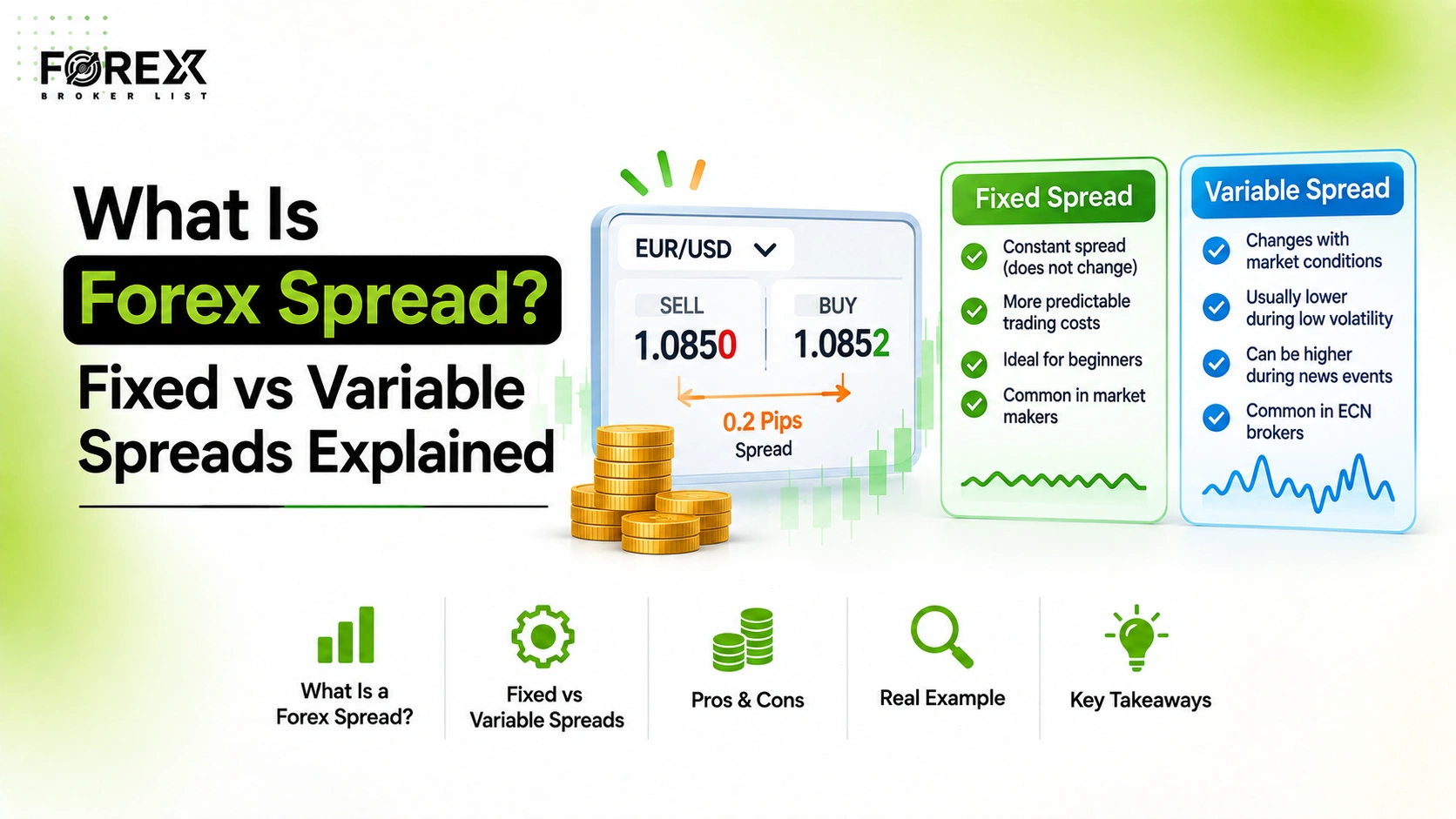
A forex spread is the gap between the bid price (what you sell at) and the ask price (what you buy at), measured in pips. It is the core cost built into almost every forex trade, charged before you make a single dollar of profit. Fixed spreads stay constant; variable spreads move with liquidity and widen during volatile or low-liquidity periods.
Introduction
Every forex trade carries a cost before the market even moves in your favor, and that cost is the spread. Most beginners glance at a quote, place the trade, and never notice they paid anything at all. Understanding how the spread works, and how it differs between broker types, is one of the fastest ways to cut your real trading costs. Before opening an account anywhere, it is worth taking time to compare forex brokers on spread pricing, not just on marketing claims.
What Is a Forex Spread?
A forex spread is the difference between the bid price and the ask price of a currency pair, expressed in pips. It is how most brokers get paid for executing your order.
If EUR/USD is quoted at 1.0950 bid and 1.0952 ask, the spread is 2 pips. You buy at the higher ask price and sell at the lower bid price, and that gap is your entry cost.
A pip is the smallest standard unit of price movement for most currency pairs, equal to 0.0001. For pairs quoted with the Japanese yen, a pip equals 0.01. The spread exists on every pair, at every broker, on every trade.
How Forex Spread Is Calculated
The spread formula is simple: ask price minus bid price, expressed in pips.
Example: GBP/USD is quoted at 1.2645 bid and 1.2648 ask. Spread = 1.2648 - 1.2645 = 0.0003 = 3 pips.
For yen pairs, the same logic applies with two decimal places. USD/JPY quoted at 149.20 bid and 149.23 ask gives a spread of 0.03, which equals 3 pips.
Your trading platform typically displays the spread in real time next to the quote, so you rarely need to calculate it manually. What matters is understanding what that number costs you in real currency, covered next.
Forex Spread Cost: A Worked Example
The forex spread cost depends on your lot size and the pip value for the pair you are trading. On most USD-quoted pairs, a standard lot (100,000 units) carries a pip value of approximately $10.
Standard lot example: EUR/USD spread of 1.0 pip on a standard lot costs 1.0 x $10 = $10 paid at entry, before the trade has moved at all.
Mini lot example: The same 1.0 pip spread on a mini lot (10,000 units), where pip value is roughly $1, costs $1 at entry.
Micro lot example: On a micro lot (1,000 units), where pip value is roughly $0.10, the same 1.0 pip spread costs $0.10.
Scale this to volume. A trader placing 50 standard lots a month at a 1.0 pip average spread pays roughly $500 a month in spread cost alone, before commission, swap, or any losing trades. This is why spread comparison matters more as trading frequency increases.
Fixed vs Variable Spreads
Fixed spreads stay the same regardless of market conditions. A broker quoting a fixed 1.5 pip spread on EUR/USD holds that spread during both calm and volatile sessions. Fixed spreads are typically offered by market maker or dealing desk brokers, which take the other side of client trades internally rather than routing to external liquidity.
Variable spreads, also called floating spreads, move with real-time market liquidity. They tighten during high-liquidity periods like the London and New York session overlap, and widen when liquidity thins out, such as during the Asian session or around major news releases. Variable spreads are typical of ECN and STP brokers, which pass client orders through to external liquidity providers and often charge a separate commission per lot.
Neither model is inherently cheaper. The right choice depends on when and how you trade, covered in the comparison below.
Fixed vs Variable: Side-by-Side Comparison
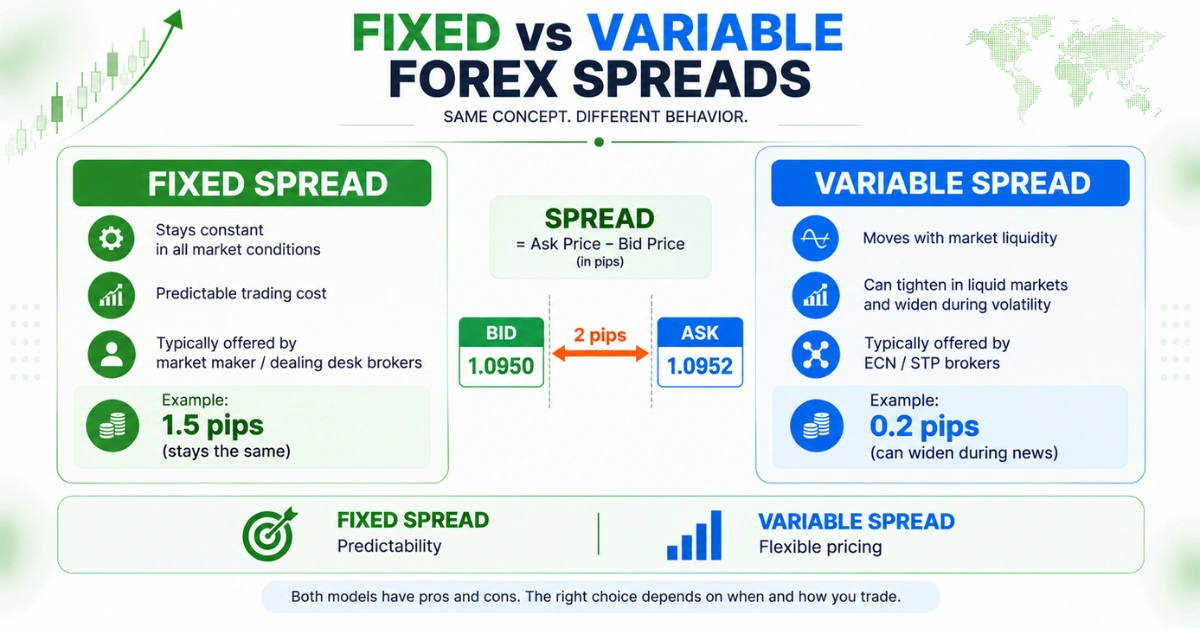
| Factor | Fixed Spread | Variable Spread |
|---|---|---|
| Predictability | Constant, known in advance | Changes with market conditions |
| Typical EUR/USD range | 1.5 to 3.0 pips | 0.0 to 0.5 pips in liquid hours, wider during news |
| Broker model | Market maker / dealing desk | ECN / STP / no dealing desk |
| Commission | Usually built into spread | Often charged separately per lot |
| Requote risk | Higher during extreme volatility | Lower, but slippage risk increases |
| Best liquidity window | No effect on spread size | London and New York overlap, roughly 12:00 to 16:00 GMT |
Data compiled from broker execution models and industry pricing structures. Individual broker spreads vary and should be confirmed on the broker's live pricing page before trading.
Which Is Better for Your Trading Style?
There is no universal answer. Match the spread model to how you actually trade.
Scalpers: Variable spreads on a raw ECN account are almost always better. Scalping strategies depend on tight spreads during liquid hours, and the commission-plus-raw-spread model usually beats a fixed markup over hundreds of trades.
News traders: This is trickier. Variable spreads can widen sharply the moment a high-impact release hits, sometimes past what a fixed spread would have charged. Some news traders prefer fixed spreads specifically to avoid unpredictable widening at the exact moment they need certainty, accepting the requote risk as a trade-off.
Swing traders: Spread cost matters less since it is a small fraction of a multi-day price target. Either model works, and the decision usually comes down to overall broker cost and execution quality rather than spread type alone.
Small-account beginners: Fixed spreads offer predictability while learning position sizing and risk management, which has real value even if the average cost runs slightly higher than a raw variable spread.
Why Do Forex Spreads Change?
Variable spreads move for three main reasons.
Liquidity provider depth. More liquidity providers actively quoting a pair means tighter competition on price, which compresses the spread.
Session overlap. The London and New York session overlap, roughly 12:00 to 16:00 GMT, carries the highest trading volume of the day. Spreads on major pairs are typically tightest during this window.
Currency pair type. Major pairs like EUR/USD and USD/JPY carry the tightest spreads due to deep liquidity. Minor pairs run wider, and exotic pairs such as USD/TRY or EUR/SEK can run 5 to 10 pips wider due to thin liquidity.
Why Spreads Widen During News
Spreads widen sharply around high-impact economic releases, and the mechanism is different from ordinary volatility.
Liquidity providers reduce or pull their quotes in the seconds before a scheduled release like a central bank rate decision or a Non-Farm Payrolls report, because they cannot price risk accurately in that window. With fewer active quotes competing, the remaining spread on offer widens, sometimes from under 1 pip to 8 or 10 pips within moments.
A trader who places a market order right into that window can be filled at a price significantly worse than the pre-release quote, even without any broker misconduct involved. It is simply the visible effect of liquidity stepping back. Traders who hold positions with stops set too close to current price during known high-impact release times have been caught by this widening even when their overall market direction call was correct, getting stopped out on the spread spike itself rather than genuine price movement. Checking an economic calendar and either avoiding new entries in the minutes around major releases, or widening stop-loss buffers accordingly, is standard practice among experienced traders.
What Affects Forex Spreads
Several factors combine to determine the spread you see on your platform.
- Currency pair liquidity. Majors tighter, minors wider, exotics widest.
- Time of day. Overlap hours tighter, low-volume Asian session or holiday periods wider.
- Account type. Raw/ECN accounts show tighter spreads plus commission; standard accounts show wider all-in spreads with no separate commission.
- Broker execution model. Market maker brokers set their own spread; ECN/STP brokers pass through liquidity provider pricing with a small markup.
- Market volatility. Unscheduled volatility, not just news events, can also cause temporary widening as liquidity providers reprice risk.
Real Broker Spread Comparison
Real spread data illustrates how much the numbers vary by account type and broker.
| Broker | Account Type | EUR/USD Typical Spread | Commission | Regulation |
|---|---|---|---|---|
| IC Markets | Raw Spread | 0.0 to 0.1 pips | $3.50 per side per lot | ASIC, CySEC, FSA (Seychelles) |
| Pepperstone | Razor | 0.0 to 0.2 pips | $3.50 per side per lot | FCA, ASIC, CySEC, DFSA |
| Pepperstone | Standard | 1.0 to 1.3 pips | None, built into spread | FCA, ASIC, CySEC, DFSA |
Data sourced from broker official pricing pages. Last updated: September 2026. Live spreads are variable and change with real-time liquidity; confirm current pricing on the broker's own platform before trading. Browse 750+ broker listings for a full side-by-side comparison across regulation and account types.
For a deeper breakdown of how ECN, STP, and market maker execution models differ beyond just spread pricing, see our guide on ECN vs STP vs Market Maker brokers.
What Is a Good Forex Spread?
A good forex spread depends on the pair and the account type, but general benchmarks help set expectations.
- EUR/USD: 0.0 to 0.5 pips on a raw ECN account during liquid hours is competitive. 1.0 to 1.5 pips on a standard no-commission account is typical.
- GBP/USD: Slightly wider than EUR/USD, commonly 0.2 to 0.8 pips on ECN, 1.5 to 2.0 pips on standard.
- USD/JPY: Comparable to EUR/USD in tightness, 0.1 to 0.4 pips on ECN.
- Minor and exotic pairs: No single benchmark applies; compare against the broker's own major pair spreads for context, since exotics are inherently wider everywhere.
If a broker's advertised spread looks far tighter than these ranges with no commission disclosed, check whether the commission is hidden elsewhere in the account terms before assuming it is the better deal.
Conclusion
The forex spread is not a hidden fee. It is the visible, unavoidable cost printed directly into every quote you see, and understanding it changes how you evaluate a broker. Fixed spreads trade predictability for a higher average cost. Variable spreads trade lower average cost for exposure to widening during thin liquidity and news. Neither wins outright. What matters is matching the model to your trading style, checking real pip cost against your typical lot size, and confirming live pricing on the broker's own platform rather than relying on marketing numbers.
Risk Disclaimer: This article is for informational and educational purposes only. It does not constitute financial or investment advice. Forex and CFD trading involves significant risk of loss and is not suitable for all investors. Always verify a broker's regulatory status through official authorities such as FCA, ASIC, or CySEC before depositing funds.
Frequently Asked Questions
Dipak Dangodra | Financial Writer at Forex Broker List
I am Dipak Dangodra, a financial writer at Forex Broker List. I have published 200+ articles on forex broker reviews, trading platforms, spreads and commissions, and regulatory analysis using data from FCA, ASIC, and CySEC.
Related Blogs
Forex Swap Fees Explained: What Is the Overnight Trading Cost?

 Your brand here