

Forex Brokers With Highest Leverage: Full 2026 List
High leverage forex brokers compared, offshore vs regulated entities, plus US leverage rules explained.
The forex brokers with high leverage in 2026 include FBS (up to 1:3000), FXTM and HFM (up to 1:2000), and Exness (unlimited under specific equity tiers), all offered through offshore-regulated entities. Regulated Tier 1 entities of the same brokers typically cap retail leverage at 1:30, while US-regulated brokers are limited to 1:50 under NFA rules.
Key Takeaways
- The highest leverage available (1:1000 to 1:3000) comes specifically through offshore-regulated entities, not Tier 1 ones
- The same broker brand can offer 1:30 under FCA/ASIC and 1:1000+ under an offshore license, depending on which entity you sign up with
- US forex brokers with high leverage do not exist in the way offshore ones do; NFA rules cap majors at 1:50 and minors at 1:20, and this applies regardless of broker brand
- Negative balance protection matters as much as the leverage number itself when trading at high ratios
- Higher leverage does not mean a better broker, only a higher risk ceiling
Why Leverage Limits Differ So Much by Broker Entity
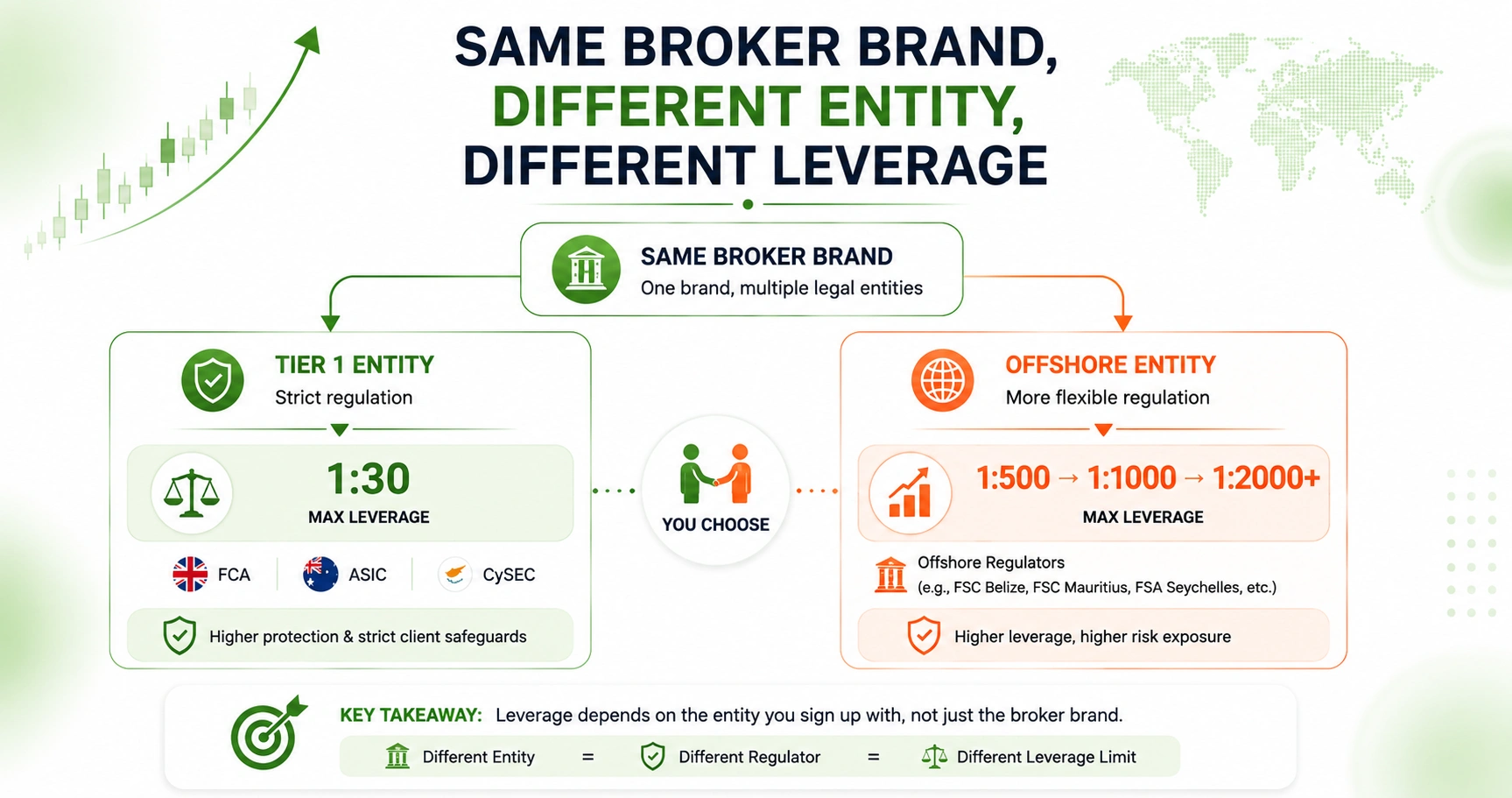
A single broker brand often operates multiple legal entities across different countries, and each entity follows the leverage rules of its own regulator, not a single global standard. A broker regulated by the FCA in the UK or ASIC in Australia must cap retail leverage at 1:30. The same broker's entity registered under an offshore regulator, such as the Financial Services Commission in Belize or Mauritius, faces no such cap and can offer 1:500, 1:1000, or higher.
This is why trading with leverage figures like 1:2000 or 1:3000 almost always means signing up through a broker's offshore subsidiary rather than its UK, EU, or Australian entity. It is not a different broker "tier," it is a different legal entity with a different regulator and a different risk profile attached.
Highest Leverage Brokers Compared (Verified Data Table)
| Broker | Max Leverage (Offshore Entity) | Max Leverage (Tier 1 Entity) | Regulator (Offshore) |
|---|---|---|---|
| FBS | Up to 1:3000 (tiered by account equity) | 1:30 (CySEC/ASIC entities) | FSC Belize |
| FXTM | Up to 1:2000 | 1:30 (FCA/CySEC entities) | FSCA (South Africa), FSC Mauritius |
| HFM | Up to 1:2000 | 1:30 (regulated entities) | FSCA, FSC Mauritius |
| InstaForex | Up to 1:1000 | Varies by jurisdiction | BVI FSC |
| Exness | Unlimited under $1,000 equity; scales down above that | 1:30 (FCA/CySEC entities) | FSA Seychelles |
| Pepperstone | Up to 1:200 (Bahamas/Seychelles); 1:500 for verified professionals | 1:30 (FCA/ASIC entities) | SCB Bahamas, FSA Seychelles |
| XTB | Up to 1:500 (offshore subsidiaries) | 1:30 (FCA/CySEC entities) | Offshore-regulated subsidiary |
| Forex4you | Up to 1:1000 (widely cited) | Not applicable, offshore-focused broker | IFSC Belize |
Data sourced from TradersUnion, ForexBrokers.com, RationalFX, CompareForexBrokers.com, and OffbeatForex broker leverage guides, and FBS/InstaForex official leverage pages. Leverage tiers frequently scale down as account equity increases; always confirm current terms and your specific entity's regulator before opening an account.
1. FBS: Highest Advertised Leverage on This List
FBS advertises leverage up to 1:3000 through its FSC Belize-regulated entity, tiered by account equity, with the highest ratios available only on smaller account balances and automatically scaling down as equity grows. Its CySEC and ASIC-regulated entities cap retail leverage at the standard 1:30, consistent with those regulators' rules. FBS includes negative balance protection across its offshore entity, which is a meaningful safeguard given how aggressively leveraged some of its account tiers are.
2. FXTM: Highest Leverage Among Widely Regulated Brokers
FXTM offers up to 1:2000 leverage, but only through its South African (FSCA) and Mauritius (FSC) regulated entities, not its FCA or CySEC entities, which follow the standard 1:30 retail cap. This makes FXTM one of the higher-leverage options among brokers that maintain a broader multi-jurisdiction regulatory footprint rather than relying on a single offshore license.
3. HFM: Matching 1:2000 With Multi-Jurisdiction Regulation
HFM matches FXTM's 1:2000 maximum leverage, also available specifically through its FSCA and FSC Mauritius regulated entities. HFM holds a comparatively broad spread of regulatory licenses across several jurisdictions, which can appeal to traders who want offshore-level leverage while still choosing from a wider set of regulated entity options depending on their location.
4. InstaForex: Long-Standing Offshore High-Leverage Option
InstaForex offers leverage up to 1:1000 through its BVI FSC-regulated entity. This sits below the 1:2000 to 1:3000 ceiling of some competitors on this list, but InstaForex has operated in the offshore high-leverage space for an extended period, and its maximum leverage applies broadly across major currency pairs rather than being tiered as aggressively by account equity as some peers.
5. Exness: Leverage That Scales With Account Equity
Exness takes a distinct approach, offering effectively unlimited leverage on accounts with equity under $1,000 through its FSA Seychelles-regulated entity, then automatically scaling the maximum ratio down as account equity grows. This structure specifically favors traders starting with small capital who want maximum leverage at that stage, while naturally reducing leverage exposure as the account grows and the dollar risk per trade increases.
6. Pepperstone and XTB: High Leverage With Stronger Regulatory Backing
Pepperstone offers up to 1:200 through its Bahamas (SCB) and Seychelles (FSA) entities, notably lower than the 1:1000+ ceiling of several brokers on this list, but pairs it with a 20% stop-out level for professional accounts and negative balance protection across its offshore entities. Verified professional clients can access up to 1:500 even under some of Pepperstone's more heavily regulated entities. XTB offers up to 1:500 through its offshore subsidiaries, giving traders access to meaningfully higher leverage than its FCA/CySEC entities' 1:30 cap, while maintaining the broader platform quality and educational resources XTB is known for.
7. Forex4you: Established IFSC-Regulated High Leverage Option
Forex4you is commonly cited across broker comparison sources as offering leverage up to 1:1000 under its IFSC Belize regulation, positioning it similarly to InstaForex in terms of maximum ratio. As with any offshore-only broker, confirming current terms and the specific regulatory protections in place matters more here than with dual-regulated brokers that also maintain a Tier 1 entity.
US Forex Brokers With High Leverage: Why They Don't Really Exist
If you're specifically searching for the highest leverage forex broker USA has to offer, the honest answer is that true high leverage is not available through NFA-regulated US brokers. Under CFTC and NFA rules, US-regulated retail forex brokers are capped at 1:50 leverage on major currency pairs and 1:20 on minor pairs, regardless of broker brand or size. This is a hard regulatory limit, not a broker-specific policy choice, and it applies uniformly across every NFA-registered firm.
US residents cannot legally open accounts with most offshore entities offering 1:500 or higher, since those offshore brokers generally exclude US clients specifically to avoid CFTC/NFA jurisdiction conflicts. Some brokers that serve US clients do offer futures-based leverage products with different mechanics, but standard offshore-style ultra-high forex leverage through a compliant, regulated route is not realistically available to US-based traders.
Leverage Limits by Country
| Country/Region | Regulator | Max Retail Leverage (Majors) |
|---|---|---|
| United States | CFTC/NFA | 1:50 (1:20 on minor pairs) |
| United Kingdom | FCA | 1:30 |
| European Union | ESMA/national regulators | 1:30 |
| Australia | ASIC | 1:30 |
| Singapore | MAS | 1:50 |
| Hong Kong | SFC | 1:20 |
| South Africa | FSCA | Up to 1:500 (less restrictive) |
| Malaysia | Securities Commission Malaysia | Up to 1:500 (entity-dependent) |
| Offshore (Belize, Seychelles, Mauritius, BVI) | FSC/FSA/BVI FSC | No standardized cap; up to 1:3000 at some brokers |
Sources: CFTC/NFA, FCA, ESMA, ASIC, MAS, SFC, FSCA published regulatory frameworks, and broker comparison data from FXStreet and RationalFX.
Negative Balance Protection and Stop-Out Levels (Table)
| Broker | Negative Balance Protection (Offshore Entity) | Typical Stop-Out Level |
|---|---|---|
| FBS | Yes | Varies by account type |
| FXTM | Yes | Varies by account type |
| HFM | Yes | Varies by account type |
| Exness | Yes | Scales with leverage tier |
| Pepperstone | Yes | 20% (professional accounts) |
| XTB | Yes | Varies by account type |
At high leverage ratios, negative balance protection is arguably more important than the leverage number itself, since it caps your maximum possible loss at your account balance rather than allowing debt beyond your deposit. Always confirm this feature is active specifically on the entity and account type you're opening, since protection terms can differ between a broker's regulated and offshore entities.
Is High Leverage Trading Actually Risky?
Yes, meaningfully so, and this needs to be stated plainly rather than softened. Higher leverage does not increase your probability of winning a trade; it only increases the dollar impact of whatever the outcome turns out to be. A 1:2000 leverage account can be wiped out by a far smaller adverse price movement than a 1:30 account holding the same position size relative to deposit, since the margin cushion is proportionally much thinner.
This does not mean high leverage is inherently reckless for every trader. Experienced traders with strict position-sizing discipline sometimes use high available leverage while keeping their actual real leverage, the ratio of total position value to account equity, far below the account's maximum. The risk comes specifically from using a high percentage of the leverage a broker makes available, not from the availability of high leverage itself. For a full breakdown of margin calls, stop-out mechanics, and how to calculate your real leverage, see our guide on what leverage means in forex trading.
How to Choose Between Leverage and Regulatory Safety
Chasing the single highest leverage number available is rarely the right framework for choosing a broker. A more useful approach weighs three factors together: how much leverage you would realistically use given your position-sizing discipline, how much regulatory protection you're willing to trade away for that leverage, and whether the specific entity you'd be signing up with actually offers the terms advertised on the broker's homepage. Two traders with identical strategies but different risk tolerance can reasonably choose different points on this spectrum. Before committing to any offshore high-leverage entity, confirm exactly what regulatory protection you'd have and don't have by reading our guide on what "regulated broker" actually means.
Conclusion
The forex brokers with the highest leverage in 2026, including FBS at up to 1:3000 and FXTM and HFM at up to 1:2000, all deliver those ratios through offshore-regulated entities rather than their FCA, ASIC, or CySEC-licensed ones. Understanding this regulated-versus-offshore split matters more than the headline leverage number itself, since it determines both your available leverage and your actual investor protection. US-based traders in particular should note that NFA rules cap leverage at 1:50 regardless of broker brand, making offshore-style high leverage largely inaccessible through compliant channels. Whichever leverage tier you're considering, confirm the specific regulated entity, its negative balance protection terms, and your own risk tolerance before opening an account. You can compare additional regulated brokers across leverage tiers in our full forex broker directory.
Disclaimer This article is for informational and educational purposes only. It does not constitute financial or investment advice. Forex and CFD trading involves significant risk of loss due to leverage and is not suitable for all investors. High leverage trading can result in losses exceeding your initial deposit where negative balance protection does not apply. Always verify a broker's regulatory status, leverage terms, and negative balance protection directly before depositing funds.
Frequently Asked Questions
Dipak Dangodra | Financial Writer at Forex Broker List
I am Dipak Dangodra, a financial writer at Forex Broker List. I have published 200+ articles on forex broker reviews, trading platforms, spreads and commissions, and regulatory analysis using data from FCA, ASIC, and CySEC.
Related Blogs

Best Liquidity Providers for Forex Brokers (2026 Comparison)

 Your brand here