

Negative Balance Protection Forex: Brokers & Rules
Negative balance protection limits retail forex losses to your deposit. See which brokers and regulators guarantee it in 2026.
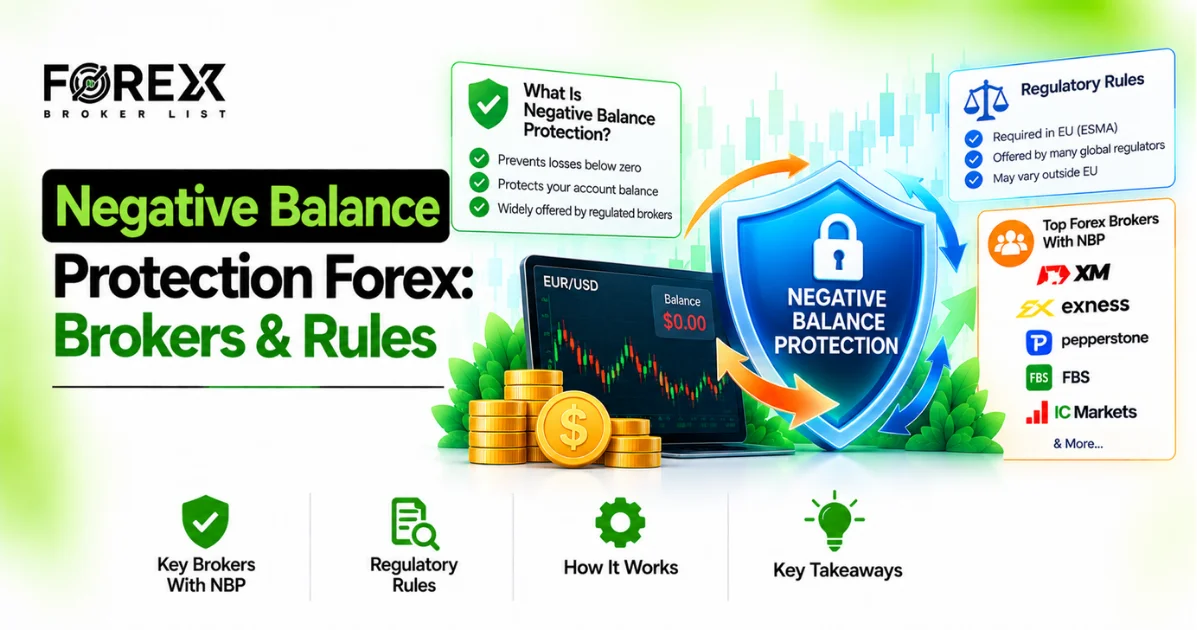
Negative balance protection forex limits a retail trader’s maximum loss to the funds deposited in their trading account. If a sudden market move pushes the balance below zero, the broker resets it to zero and absorbs the shortfall. This protection is mandatory for retail clients of brokers regulated by the FCA, ASIC, and CySEC under ESMA-aligned rules.
A trader deposits $1,000 and opens leveraged positions. A weekend gap or flash crash drops the market so far that the account would show -$400 after all positions close. With negative balance protection, the broker clears the debt and the balance returns to $0. Without it, the trader owes the broker $400.
What Negative Balance Protection Actually Means
Negative balance protection (often called NBP) is a regulatory safeguard that caps losses at the amount of money in the CFD trading account. The broker cannot demand additional funds to cover a deficit caused by market gapping, extreme volatility, or failed stop-outs.
ESMA defines it clearly: the retail client’s aggregate liability for all CFDs connected to a CFD trading account is limited to the funds in that account. Funds include cash plus unrealised net profits from open positions. Money held for other purposes does not count.
The rule exists because leveraged trading can produce losses larger than the deposit when liquidity disappears. During the 15 January 2015 Swiss National Bank decision to abandon the EUR/CHF floor, many accounts went deeply negative within minutes. Brokers without robust NBP pursued clients for the shortfall. Regulators later made the protection mandatory for retail clients in major jurisdictions.
How Negative Balance Protection Works in Practice
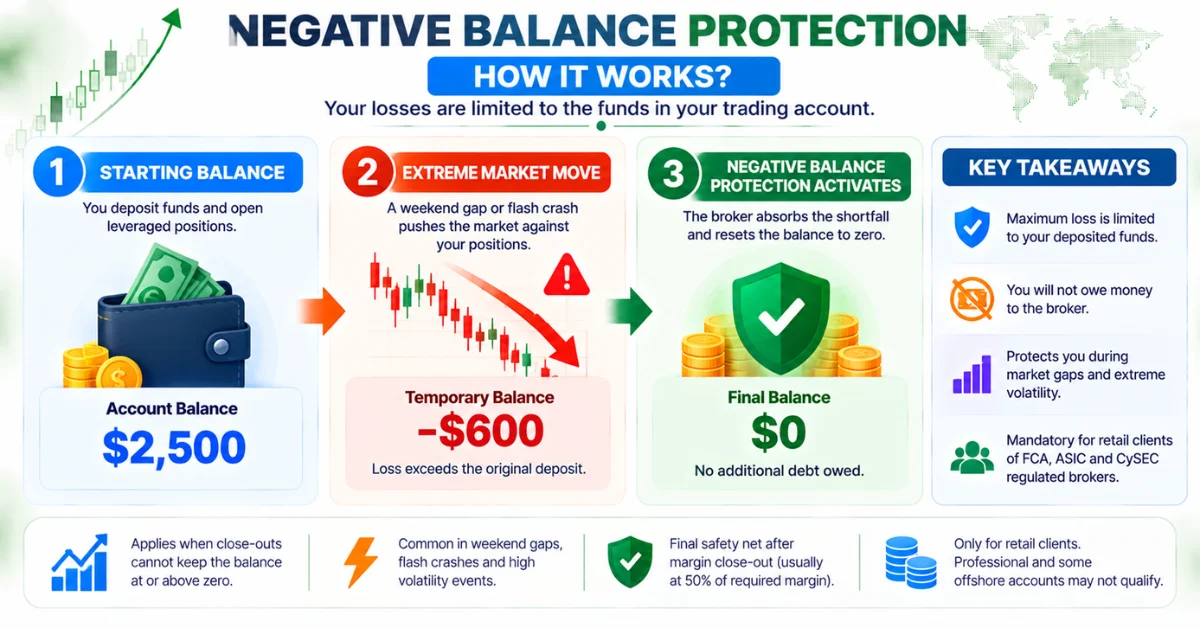
Most platforms use a margin close-out rule first. Under FCA, ASIC, and CySEC rules, the broker must start closing positions when equity falls to 50 percent of the required margin. This is the primary defence.
NBP is the final backstop. It activates only if the close-out cannot keep the balance at or above zero. Typical triggers include:
- Weekend or news gaps that jump past stop-loss levels
- Flash crashes with thin liquidity
- Server or pricing delays during extreme volatility
Pepperstone states on its official support page that it returns any negative balance to zero for retail clients as soon as possible. The same policy does not apply to Pepperstone Pro or professional clients. IC Markets, XM, and AvaTrade apply equivalent rules on their FCA, ASIC, and CySEC entities.
A concrete example: a retail account holds $2,500. A sharp move closes all positions at a combined loss of $3,100. The temporary balance is -$600. The broker credits $600 and the balance becomes $0. The trader has lost the original $2,500 but owes nothing more.
Regulatory Requirements by Jurisdiction
FCA (United Kingdom)
Mandatory for retail clients under the FCA Handbook and post-ESMA rules. The 50 percent margin close-out and negative balance protection both apply. Eligible clients also have access to the Financial Services Compensation Scheme up to £85,000 if the firm fails.
ASIC (Australia)
Required since the 2020 product intervention order for retail CFD clients. ASIC’s leverage caps (30:1 on major pairs) and NBP were introduced after large retail losses during the March 2020 volatility.
CySEC (Cyprus / EU)
Mandatory under ESMA product intervention measures that took effect in 2018 and remain in force through national rules. CySEC-regulated entities must provide NBP to retail clients and participate in the Investor Compensation Fund (up to €20,000).
Other jurisdictions
CFTC/NFA rules in the United States do not mandate NBP for forex in the same way; leverage is capped at 50:1 and product rules differ. Offshore regulators (FSA Seychelles, VFSC, IFSC Belize, etc.) generally treat NBP as voluntary. Some offshore entities of multi-regulated brokers still offer it; others do not. Always confirm the exact legal entity that holds your account.
Professional or elective professional clients can waive NBP in exchange for higher leverage and fewer protections. The waiver must be explicit.
Brokers That Offer Negative Balance Protection
The table below lists established brokers that provide NBP to retail clients on their main regulated entities. Data reflects published terms as of October 2026.
| Broker | NBP for Retail Clients | Key Regulators | Typical Min Deposit | EUR/USD Spread Example | Notes |
|---|---|---|---|---|---|
| Pepperstone | Yes | FCA, ASIC, CySEC | $0 | From 0.0 pips (Razor) + $3.50 commission | Explicit retail policy; excludes Pro accounts |
| IC Markets | Yes | ASIC, CySEC | $200 | From 0.0–0.1 pips (Raw) + $3.50 commission | Applied on regulated entities |
| XM | Yes | CySEC, ASIC | $5 | From ~0.6–1.0 pips | Multi-entity coverage for retail |
| AvaTrade | Yes | CySEC, ASIC, CBI | $100 | From ~0.9 pips | Standard retail protection |
| HFM (HotForex) | Yes | FCA, CySEC | $0 | Variable | Offered across retail accounts |
| Exness | Yes | FCA, CySEC (entities) | $0–$10 | From 0.0 pips | Policy confirmed on regulated entities |
Data sourced from Pepperstone official support pages, IC Markets and XM account terms, and FCA/ASIC/CySEC public registers. Last updated: October 2026.
Pepperstone’s Razor account shows raw spreads from 0.0 pips on EUR/USD with a $3.50 per lot per side commission (Source: Pepperstone, October 2026). Its FCA and ASIC entities enforce the retail NBP rule. IC Markets Raw Spread accounts list similar raw pricing under ASIC and CySEC licences.
You can compare full profiles of these brokers on ForexBrokerList.io at the main brokers directory, the FCA-regulated brokers page, and individual reviews such as Pepperstone and IC Markets.
How to Confirm a Broker Actually Offers It
- Identify the exact legal entity that will hold your account. Brand names often cover several companies.
- Search the entity name on the official regulator register (FCA Financial Services Register, ASIC Professional Registers, or CySEC public list).
- Open the client agreement or product disclosure statement and search for “negative balance” or “aggregate liability”.
- Check the account type. Retail status is required; professional status usually removes the protection.
- Ask support in writing and keep the reply.
A broker that advertises high leverage of 1:500 or higher on an offshore entity is less likely to provide enforceable NBP. Tier-1 regulated entities (FCA, ASIC, CySEC) must offer it to retail clients. For a step-by-step licence check, see our guide on how to verify a forex broker’s licence.
Limitations and Common Mistakes
Negative balance protection does not prevent the loss of your entire deposit. It only stops the account from going further into debt. A trader who uses maximum leverage can still lose 100 percent of the balance in a single session.
It does not apply automatically to every account. Professional clients, certain corporate accounts, and many offshore entities are excluded. During the 2015 CHF event, traders on brokers without NBP received invoices for tens of thousands of dollars. Some brokers later went insolvent; clients of firms inside strong compensation schemes recovered more of their funds than clients of offshore firms.
Another frequent error is assuming every “regulated” broker offers the same protection. An FSA Seychelles licence does not carry the same NBP mandate as an FCA licence. Always match the entity, the client category, and the jurisdiction.
Margin close-out at 50 percent is the first line of defence. NBP is only the last resort when the market moves faster than the platform can close positions. Keeping position size modest reduces the chance of ever reaching that stage.
Practical Checklist Before You Deposit
- Confirm the legal entity and its regulator.
- Verify retail (not professional) status.
- Read the clause on negative balance or aggregate liability.
- Note the margin close-out level (usually 50 percent).
- Compare spreads and commissions on the same account type.
- Start with a demo account to observe execution during news.
Traders who follow these steps and stick to FCA, ASIC, or CySEC retail accounts have a clear, enforceable limit on losses. Those who chase the highest leverage on lightly regulated entities accept the risk of unlimited liability.
For broader selection criteria that include regulation, costs, and platforms, review our article on how to choose the best forex broker in 2026.
Conclusion
Negative balance protection forex is a hard regulatory limit for retail clients of FCA, ASIC, and CySEC brokers. It ensures that extreme market moves cannot create a debt beyond the funds already in the account. Pepperstone, IC Markets, XM, AvaTrade, and several other multi-regulated firms apply the rule on their retail entities. Offshore and professional accounts frequently lack the same guarantee. Verify the exact entity and account category before depositing, keep leverage moderate, and treat NBP as a final safety net rather than a reason to over-trade.
This article is for informational and educational purposes only. It does not constitute financial or investment advice. Forex and CFD trading involves significant risk of loss and is not suitable for all investors. Always verify a broker's regulatory status through official authorities such as FCA, ASIC, or CySEC before depositing funds.
Frequently Asked Questions
Dipak Dangodra | Financial Writer at Forex Broker List
I am Dipak Dangodra, a financial writer at Forex Broker List. I have published 200+ articles on forex broker reviews, trading platforms, spreads and commissions, and regulatory analysis using data from FCA, ASIC, and CySEC.
Related Blogs
Tools for Brokers: Starter Stack (2026)
 Your brand here