

What Is a Forex Bridge? Complete Guide (2026)
Forex bridge technology explained: how it works, real costs, and warning signs of a failing bridge.
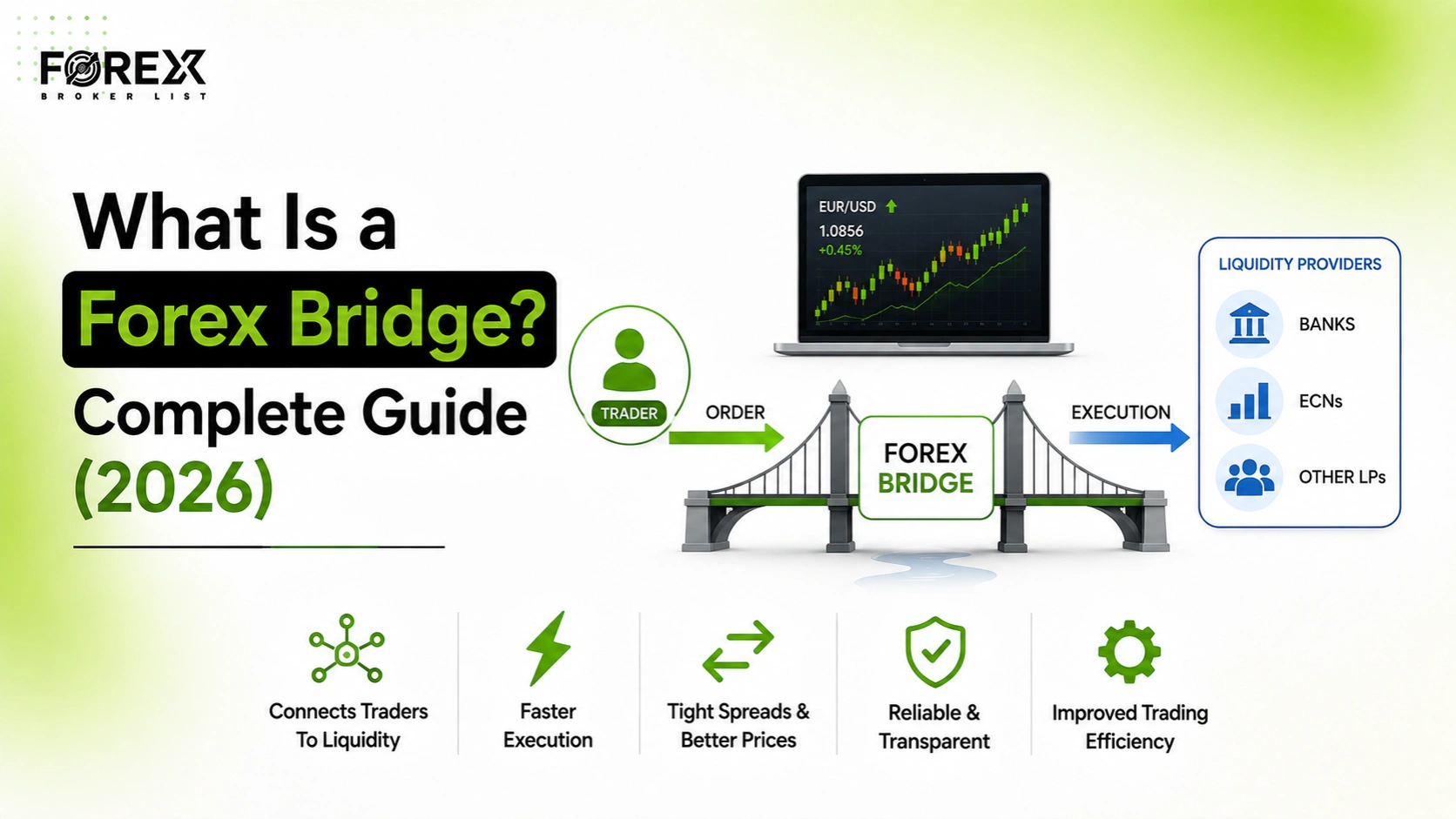
A forex bridge is middleware that connects a broker's trading platform, such as MT4 or MT5, to one or more liquidity providers, translating protocols, aggregating prices, and routing orders in real time. Without a bridge, platforms like MetaTrader cannot access external liquidity at all, since they do not natively speak the FIX API protocol liquidity providers use.
Key Takeaways
- A forex bridge sits between a trading platform and liquidity providers, handling price aggregation, order routing, and protocol translation
- MetaTrader 4 and MetaTrader 5 cannot connect directly to liquidity providers without bridge middleware, since they don't natively support the FIX API protocol
- Bridge infrastructure typically adds $1,500 to $5,000+ per month on top of core platform licensing costs, depending on scale
- A failing bridge often shows up first as client complaints or rejected trades, not as an obvious technical alert
- Bridge quality directly affects the execution speed and slippage a retail trader experiences, even though the bridge itself is invisible to them
What a Forex Bridge Actually Does
A forex bridge, sometimes called a liquidity bridge, is the technical middleware layer that connects a broker's client-facing trading platform to its liquidity providers. It performs four core functions continuously: streaming live prices in from one or more liquidity sources, aggregating those prices into a single competitive feed, routing client orders out to the appropriate liquidity provider for execution, and translating between the different communication protocols each side of that connection uses.
This forex bridge technology is what makes STP and ECN execution models possible at all. Without it, a broker's platform would have no live external connection to draw pricing from, and would have to operate as a pure internal market maker instead, quoting its own prices with no outside reference point.
Why MT4 and MT5 Can't Connect to Liquidity Without One
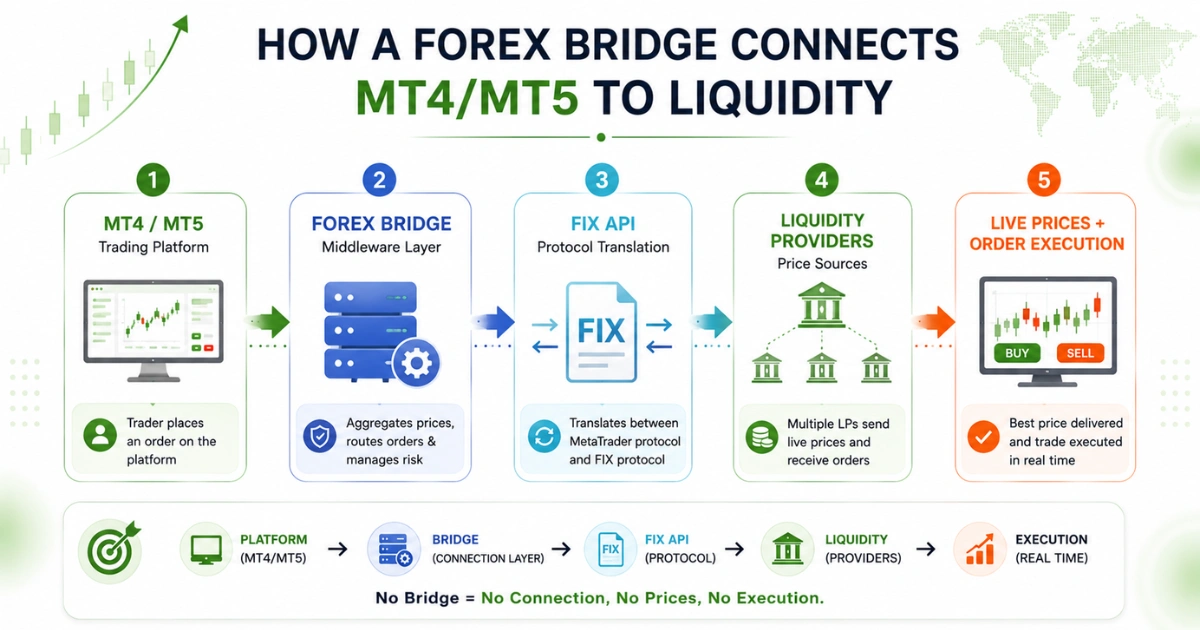
MetaTrader 4 and MetaTrader 5, the two most widely used retail trading platforms, do not natively speak FIX API, the standard messaging protocol the institutional forex market uses to stream prices and route orders. A liquidity provider sends quotes and receives orders over a FIX session, commonly FIX 4.4, while MetaTrader expects a different internal protocol entirely.
An MT4 bridge or MT5 liquidity bridge exists specifically to translate between these two worlds: receiving FIX messages from the liquidity provider side and converting them into a format MetaTrader can display and act on, then doing the reverse when a client places a trade. This is why virtually every broker running STP or ECN execution on MetaTrader relies on some form of bridge integration, whether built in-house or purchased from a specialist bridge provider.
STP Bridge vs ECN Bridge
Forex bridge solutions generally fall into two categories, mirroring the execution models covered in our ECN vs STP vs market maker guide. An STP bridge creates a more direct, typically single-provider connection between a broker's platform and a liquidity source, streamlining straight-through order execution to that provider without significant aggregation logic. An ECN bridge, by contrast, connects to multiple liquidity providers simultaneously and builds a genuine aggregated order book, giving clients access to the best available price across the whole pool rather than a single source.
The choice between the two isn't purely technical. It reflects the broker's underlying execution model decision, since a bridge implements whatever routing and markup logic the broker has already decided on at the business level, rather than determining that strategy itself.
Core Components of a Forex Bridge
A functioning forex bridge solution is built from several distinct components working together, and understanding them helps when evaluating a bridge provider.
- FIX API connectivity, the industry-standard protocol layer that lets the bridge communicate with liquidity providers on one side and the trading platform on the other
- Price aggregation engine, which combines quotes from multiple connected liquidity providers and filters for the best available price to pass through to clients
- Symbol mapping, which reconciles differences in how each liquidity provider labels the same instrument, so a single unified symbol reaches the trading platform regardless of the source
- Risk management module, which monitors exposure and can apply limits or trigger hedging logic automatically; a bridge with no built-in risk management is generally considered a red flag by experienced brokerage operators
- Reporting and reconciliation layer, which keeps records detailed enough for dealing, risk, support, and finance teams to reconstruct exactly what happened on any given trade
What a Forex Bridge Actually Costs
Bridge infrastructure is rarely priced as a fully standalone line item, since it's often bundled into a broader white label or platform package, but its cost component can be isolated with reasonable accuracy. On top of core MT4 or MT5 platform licensing, which itself commonly runs $5,000 to $25,000 upfront plus $1,500 to $5,000 per month, bridge connectivity and the liquidity, data feed, and aggregation infrastructure around it typically add a further $1,500 to $5,000 or more per month depending on the number of connected liquidity providers and the sophistication of the aggregation setup.
For a new brokerage building a full technology stack from scratch, including CRM, back office, KYC, payments, and support alongside the platform and bridge, a realistic first-year budget often lands somewhere in the $40,000 to $150,000 range. Many newer or smaller brokers avoid this cost entirely at launch by using a white label or turnkey provider with bridge connectivity already built into the package, adding dedicated bridge infrastructure later as trading volume justifies the investment.
Signs Your Broker's Bridge Is Failing (Checklist)
Bridge problems rarely announce themselves clearly. They tend to surface as symptoms elsewhere in the business well before anyone identifies the bridge itself as the cause.
- A noticeable rise in client complaints about execution, particularly around slippage or delayed fills, without an obvious change in market conditions
- An increase in rejected or requoted trades, especially during otherwise normal trading hours rather than only around major news events
- Reports and reconciliation data that don't line up between the trading platform, the liquidity provider's confirmations, and internal risk records
- Unexplained or unexpected exposure appearing on the broker's book that doesn't match the flow the risk team expected to see
- Inconsistent pricing across account groups or symbols that should otherwise be receiving the same aggregated feed
Any one of these on its own can have other causes, but a cluster of them appearing together is a strong signal that the bridge middleware itself needs investigation before assuming the problem lies elsewhere.
How Bridge Quality Affects You as a Trader
The bridge is invisible to retail traders, but its quality shapes what you experience every time you place a trade. A well-built bridge with a solid aggregation engine and reliable FIX API integration to multiple liquidity providers can deliver fast, consistent execution and tighter effective spreads, since it's actively selecting the best available price across several sources in real time.
A poorly built or under-resourced bridge tends to show up as the opposite: inconsistent execution speed, more frequent requotes, and wider effective spreads during volatile periods, since a thinner or less sophisticated aggregation setup has fewer alternative price sources to fall back on when one liquidity provider's feed degrades. This is part of why two brokers advertising similar spreads on paper can feel meaningfully different in practice, particularly during high-volatility news events when bridge and liquidity infrastructure gets tested hardest.
How to Choose a Bridge Provider
- Test execution quality directly, not just on paper specifications; most reputable bridge providers offer a trial period specifically for this
- Confirm multi-LP support, since a bridge limited to a single liquidity connection loses the redundancy and competitive pricing benefit aggregation provides
- Check built-in risk management capability, since a bridge without this is generally not considered production-ready by experienced operators
- Review reporting and reconciliation depth, since this becomes critical the first time a dispute or audit requires reconstructing exactly what happened on a specific trade
- Ask about integration support for your specific platform, since MT4, MT5, and cTrader integrations can differ meaningfully in maturity between bridge providers
Conclusion
A forex bridge is the largely invisible infrastructure layer that makes STP and ECN execution possible on platforms like MT4 and MT5, connecting them to external liquidity through FIX API, price aggregation, and order routing. Understanding what it actually costs, what a functioning bridge is built from, and the early warning signs of a failing one matters for anyone evaluating broker infrastructure, while understanding how bridge quality translates into execution speed and effective spread matters directly for the trader on the other end of that connection. You can browse bridge and liquidity providers by category in our full forex bridge provider directory.
Disclaimer: This article is for informational and educational purposes only. It does not constitute financial or investment advice. Forex and CFD trading involves significant risk of loss and is not suitable for all investors.
Frequently Asked Questions
Dipak Dangodra | Financial Writer at Forex Broker List
I am Dipak Dangodra, a financial writer at Forex Broker List. I have published 200+ articles on forex broker reviews, trading platforms, spreads and commissions, and regulatory analysis using data from FCA, ASIC, and CySEC.
Related Blogs

Best Liquidity Providers for Forex Brokers (2026 Comparison)

 Your brand here