

Cent Account vs Standard Account: Which Is Right for You?
Compare cent vs standard forex accounts: sizing, risk, costs, and when to upgrade from small live balances.
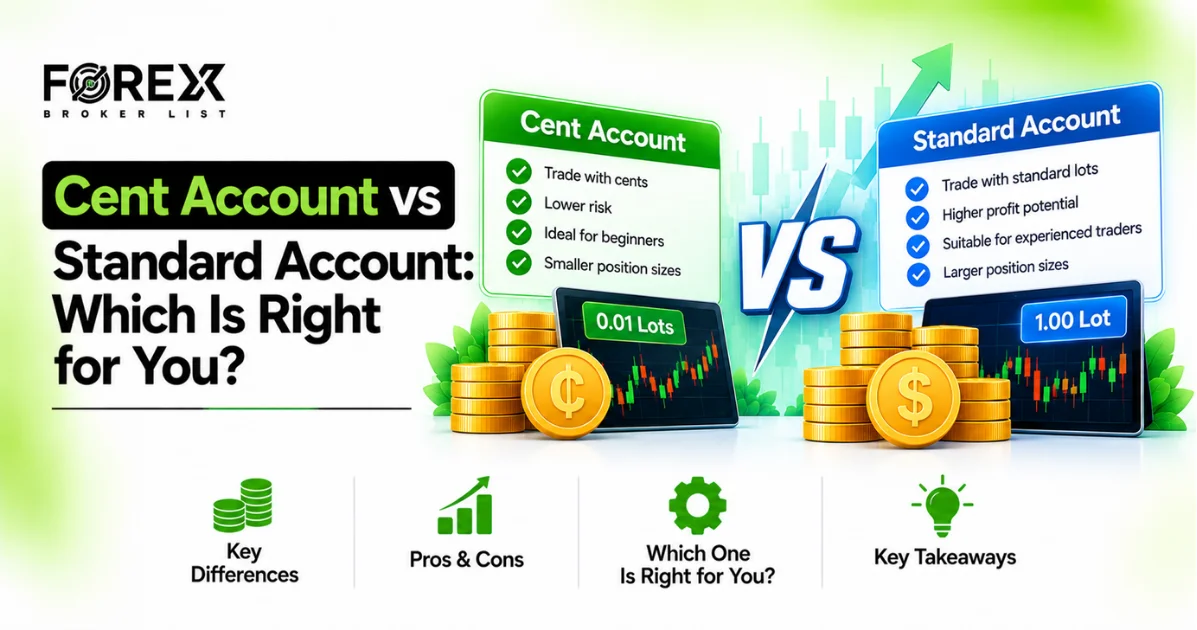
Cent account vs standard account differs mainly in balance display and position sizing. A cent account shows balances in cents (a $10 deposit appears as 1,000 USC) and uses lots that are 100 times smaller, so pip values drop to fractions of a cent. Standard accounts use full dollar balances and normal lot sizes. Choose cent accounts for balances under $200 or first live trading. Move to standard once consistent profits allow 1-2% risk on 0.01 lots.
New traders often ask whether to open a cent account or a standard account when starting live forex trading. The choice affects how much capital you need, how large each trade feels, and how quickly small mistakes wipe out your balance. Both account types exist at many brokers, but they serve different stages of a trading career.
What Is a Cent Account in Forex?
A cent account is a live trading account denominated in cents rather than full currency units. Deposit $10 and the platform displays 1,000 USC. One cent lot typically equals 1,000 units of the base currency, or 0.01 standard lots. Pip values shrink by a factor of 100.
Exness Standard Cent accounts show this structure clearly. A $5 deposit appears as 500 USC. Spreads start from 0.3 pips with no separate commission (Source: Exness Help Center, October 2026). Symbols carry a "c" suffix such as EURUSDc. Instruments cover major forex pairs, gold, silver, and limited crypto on MT5.
This setup lets a trader with $50 risk 1% of the account on a normal stop distance. The same stop on a standard account might require several hundred dollars of capital.
What Is a Standard Account?
A standard account displays balances and P&L in the base currency, usually USD. One standard lot equals 100,000 units. The smallest common trade size is 0.01 lots (1,000 units), worth about $0.10 per pip on EUR/USD.
Pepperstone Standard accounts follow this model. Spreads start from 1.0 pips with no commission on most forex pairs (Source: Pepperstone official site, October 2026). Minimum deposits often sit at $0 or $200 depending on the entity. Full instrument lists include forex, indices, commodities, and stocks.
Standard accounts suit traders who can afford proper position sizing without micro-scaling every trade. Profit potential scales directly with the larger pip values.
Cent Account vs Standard Account: Side-by-Side Comparison
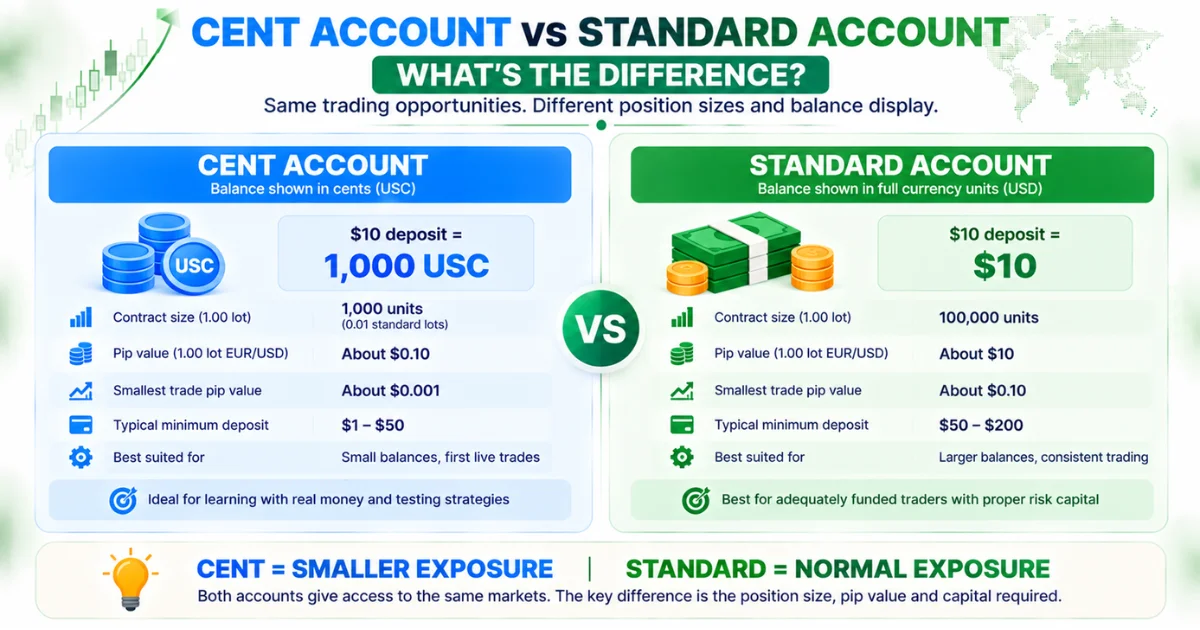
| Feature | Cent Account | Standard Account |
|---|---|---|
| Balance display | Cents (USC): $10 = 1,000 | Dollars: $10 = $10 |
| Contract size (1.00 lot) | Often 1,000 units | 100,000 units |
| Pip value (1.00 lot EUR/USD) | About $0.10 | About $10 |
| Smallest trade pip value | About $0.001 | About $0.10 |
| Typical minimum deposit | $1 to $50 | $50 to $200 |
| Available instruments | Main pairs + gold, limited extras | Full range including indices and stocks |
| Spreads | Often similar or slightly wider | Competitive on raw/ECN versions |
| Best suited for | Balances $10-$300, first live trades | Balances $500+, consistent trading |
Data sourced from Exness official site, Vantage official site, and XM public account pages. Last updated: October 2026.
Vantage Cent accounts require a $50 minimum deposit and display the balance as 5,000 cents on MT5. Spreads start from 0.0 pips with commission ranging from $0 to $3 per side depending on the exact setup (Source: Vantage account comparison, October 2026).
XM offers Micro accounts that function similarly for small balances, with a $5 minimum (Source: XM official site via prior comparisons, 2026).
How Position Sizing and Risk Differ
On a standard account the smallest EUR/USD trade (0.01 lots) moves about $0.10 per pip. A 25-pip stop risks $2.50. To keep that risk at 1% of the account you need roughly $250. Many beginners start with far less.
A cent account reduces that same 25-pip stop to about $0.025 on a 0.01 cent lot. A $50 balance can now risk 1% while using a realistic stop distance. The trading logic stays identical. Only the absolute dollar exposure shrinks.
Traders who ignore this difference often over-leverage on standard accounts. A 2015 Swiss franc flash crash illustrated the danger: accounts without negative balance protection or proper sizing saw large losses overnight when the Swiss National Bank removed the EUR/CHF floor.
When a Cent Account Makes Sense
Cent accounts fit three common situations.
- Your starting capital is under $200 and you want real-money execution rather than pure demo trading.
- You are testing a new strategy or Expert Advisor and want live fills without large capital at risk.
- You are moving from a demo account and need to experience the psychology of real losses at a tiny scale.
Exness allows Standard Cent accounts from low deposits that vary by region and payment method. The platform supports MT4 and MT5. Maximum leverage can reach high levels on certain entities, though regulated ones limit it (Source: Exness Help Center, October 2026).
Use the best cent account forex brokers comparison to see current options that match your country and preferred regulation.
When a Standard Account Is the Better Choice
Switch to a standard account once three conditions hold.
- Your balance supports 1-2% risk on 0.01 standard lots with your normal stop sizes, typically $400 or more for major pairs.
- You have followed a written trading plan for at least two to three months on the cent account.
- You need instruments or tighter raw spreads that the cent version does not offer.
Pepperstone and IC Markets focus on standard and raw accounts rather than cent versions. Pepperstone does not offer a cent account at all (Source: broker listings verification, 2026). Their Standard and Razor accounts provide the full product range under ASIC, FCA, and CySEC entities.
See our how to choose the best forex broker guide for the full checklist that includes regulation verification and total cost comparison.
Costs, Spreads, and Practical Differences
Cent accounts are usually commission-free. Costs sit inside the spread. On Exness Standard Cent the spread starts at 0.3 pips. On some Vantage Cent setups spreads can start from 0.0 pips with a small commission.
Because position sizes are tiny, the absolute dollar cost per trade is very small. The percentage cost relative to expected profit remains similar to a standard account. Wider spreads on certain cent products can still matter if you scalp frequently.
Standard raw or ECN accounts at brokers such as Pepperstone Razor or IC Markets Raw Spread often deliver tighter effective costs once volume rises. Commission of $3.50 per lot per side becomes reasonable only after a certain monthly volume.
Our lowest minimum deposit forex brokers article lists brokers that accept $1, $5, or $10 starts, many of which pair those deposits with cent or micro options.
Regulation and Entity Differences
Many cent accounts sit on offshore entities. Exness, for example, offers high leverage on certain entities while CySEC and other regulated entities apply standard leverage caps. Always check the specific legal entity before depositing.
Tier-1 regulated brokers such as those under FCA or ASIC more often emphasize standard and raw accounts. They still allow small lot sizes (0.01), but they rarely use the cent denomination model.
Verify any license on the official regulator register. Our guide on what a regulated forex broker means explains the practical differences between FCA, ASIC, and CySEC oversight.
How to Move from Cent to Standard
Most brokers let you open both account types under the same login. Fund the standard account separately when ready. Transfer only the capital you are prepared to risk under normal position sizing rules.
Keep a trading journal during the cent phase. Record every trade, stop distance, and result. After 50-100 trades that follow the plan, evaluate whether the edge holds at larger size. Many traders discover that the strategy works on paper or cent accounts but fails when real dollar amounts increase emotional pressure.
A common mistake is scaling up too early after a short winning streak. The 2020 oil price crash to negative territory showed how sudden moves can exceed expected ranges. Proper sizing on the standard account prevents a single event from ending the account.
Practical Checklist Before Choosing
- Calculate the capital needed for 1% risk on your typical stop using 0.01 lots.
- Confirm the broker offers the instruments you actually trade on the cent account.
- Check current spreads and any commission on both account types.
- Verify the regulatory entity and leverage limits that apply to you.
- Open a demo first, then a small cent account if the demo results look consistent.
Start with the forex demo account process if you have never traded live. Demo removes the psychological element that cent accounts reintroduce at low cost.
Conclusion
Cent accounts solve the position-sizing problem for balances under a few hundred dollars. They let you trade real markets with realistic stops while risking only pennies. Standard accounts become the logical next step once capital and consistency support normal lot sizes. Most traders benefit from using a cent account as a short bridge rather than a permanent home. Match the account type to your current capital and proven results, then reassess every few months.
This article is for informational and educational purposes only. It does not constitute financial or investment advice. Forex and CFD trading involves significant risk of loss and is not suitable for all investors. Always verify a broker's regulatory status through official authorities such as FCA, ASIC, or CySEC before depositing funds.
Frequently Asked Questions
Dipak Dangodra | Financial Writer at Forex Broker List
I am Dipak Dangodra, a financial writer at Forex Broker List. I have published 200+ articles on forex broker reviews, trading platforms, spreads and commissions, and regulatory analysis using data from FCA, ASIC, and CySEC.
Related Blogs
Tools for Brokers: Starter Stack (2026)
 Your brand here