

Best Forex Bridge Providers Compared 2026
2026 comparison of leading forex bridge providers, pricing examples, and how to choose the right liquidity bridge for your setup.
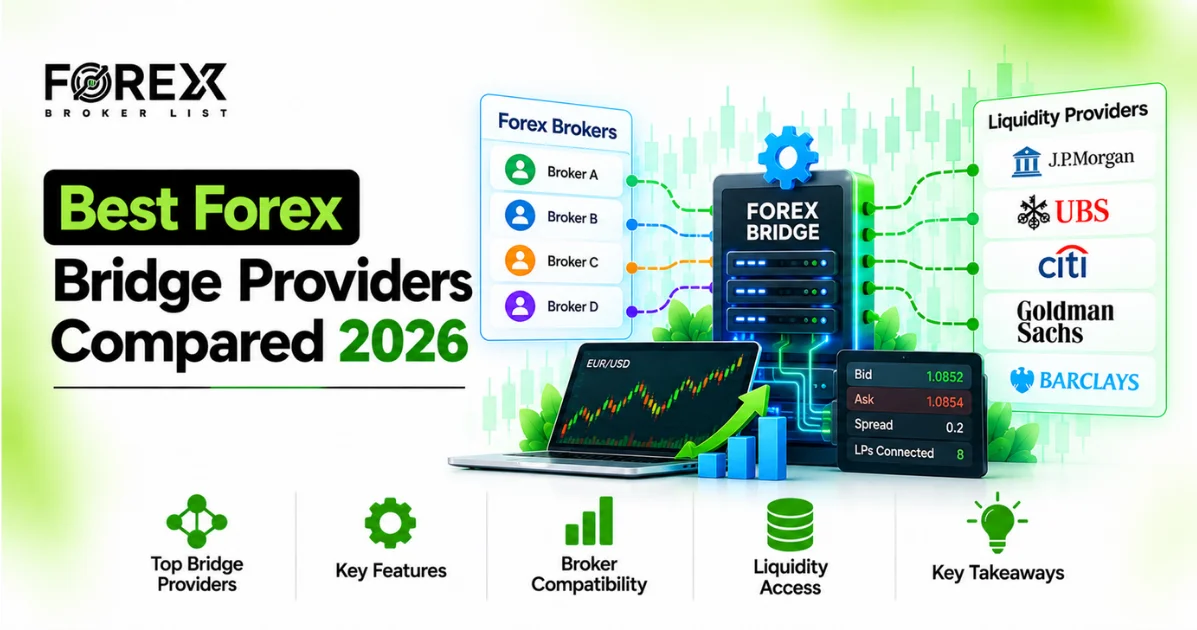
How to check if a forex broker is legit starts with verifying the technology that powers its execution. A forex bridge provider supplies the middleware that connects a broker's trading platform to liquidity providers, handling price aggregation, order routing, and protocol translation in real time. The choice of bridge determines execution quality, latency, and how effectively a broker can manage A-book, B-book, or hybrid flow.
This comparison covers the leading forex bridge provider options in 2026, including Centroid, oneZero, PrimeXM, Gold-i, and FXCubic, with real pricing examples and selection criteria based on platform needs and scale.
What a Forex Bridge Provider Does
A forex bridge provider builds and maintains the software layer that sits between MetaTrader 4, MetaTrader 5, cTrader, or a custom platform and the liquidity providers a broker uses. It streams live prices, aggregates the best bid and ask across multiple sources, routes client orders for execution, and translates between the platform's internal protocol and the FIX API used by institutional liquidity providers.
Without a bridge, platforms like MT4 and MT5 cannot access external liquidity because they do not natively support FIX. Our guide on what a forex bridge is explains the core mechanics in more detail. For traders, bridge quality shows up as fill speed, slippage, and whether rejected trades increase during volatile periods.
Leading Forex Bridge Providers in 2026
The market for liquidity bridges is concentrated among a small number of specialist vendors. Enterprise options serve large brokerages and prime-of-prime firms. Mid-market options suit growing MT4/MT5 operations. Newer providers emphasize faster onboarding and protocol flexibility.
Centroid Bridge
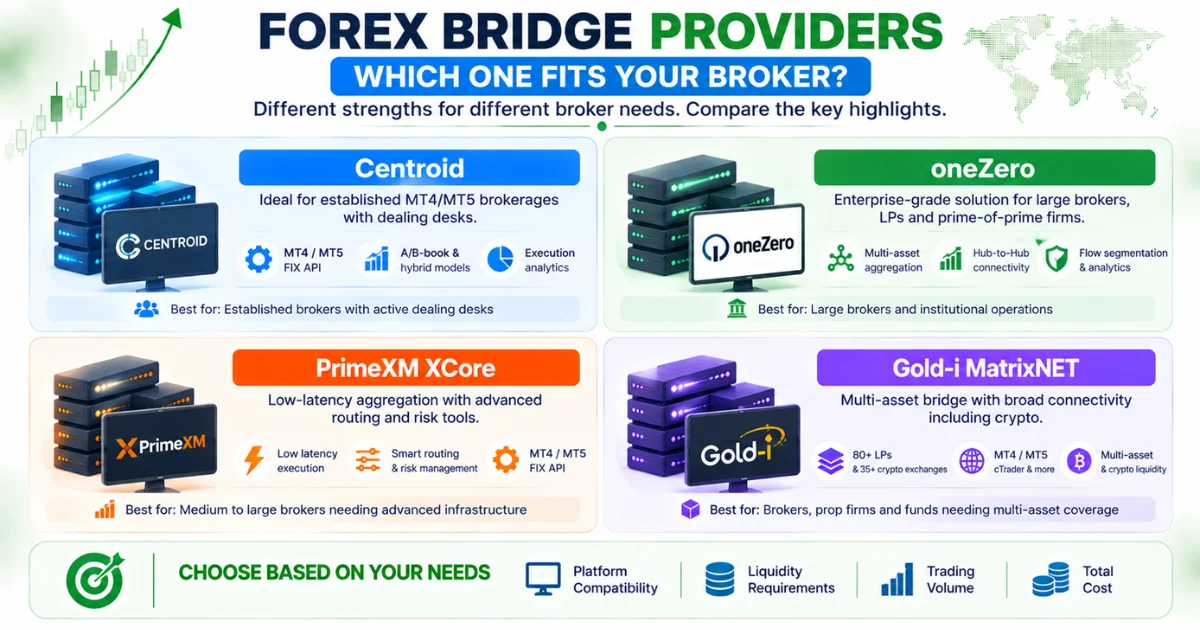
Centroid Solutions, headquartered in Dubai and established in 2017, offers a bridging and execution engine with liquidity aggregation across 200+ sources. It supports MT4, MT5, and FIX API, with tools for A-book, B-book, and hybrid models plus execution analytics covering fill rates, slippage, and LP performance. Centroid has integrated with multiple liquidity providers, including recent additions for multi-asset distribution. It is best suited for established MT4/MT5 brokerages with active dealing desks. See our Centroid Solutions review for platform details.
oneZero Liquidity Hub
oneZero, founded in 2009 and based in the United States, operates an enterprise-grade execution management system. Its Hub aggregates pricing from a broad network of liquidity providers, supports Hub-to-Hub connectivity, and includes client flow segmentation and analytics. oneZero reports handling over 100 billion USD in average daily volume across its network, with more than 10 billion USD hedged externally each day (Source: oneZero official site, 2025). It supports multi-platform setups beyond MetaTrader and is widely used by institutional brokers, liquidity providers, and prime-of-prime businesses. Pricing sits at the higher end and typically requires experienced technical staff for onboarding.
PrimeXM XCore
PrimeXM provides the XCore aggregation and order management engine, with connectivity for MT4 Bridge, MT5 Gateway, and FIX API. It supports multi-LP aggregation from banks, ECNs, and other venues, with real-time risk tools, synthetic symbols, and configurable routing by client, symbol, and order size. Latency on major nodes is reported in the low single-digit milliseconds. Public pricing lists an XCore instance fee of $2,000 per month, plus connectivity fees such as $600 per FIX maker connection and $1,200 per MT4/MT5 taker (Source: PrimeXM public listings referenced in industry comparisons, 2026). A basic setup with one instance, one LP, and one MT5 platform starts near $3,800 per month before volume fees. PrimeXM is positioned for medium-to-large brokers needing low-latency infrastructure and advanced aggregation.
Gold-i MatrixNET
Gold-i, a UK-based provider, offers MatrixNET as a multi-asset liquidity bridge with connectivity to 80+ liquidity providers and 35 crypto exchanges. It supports MT4, MT5, DXtrade, cTrader, TradeLocker, and FIX or WebSocket, with aggregation methods, smart routing, and B-book management tools for toxic flow. Recent expansions include regulated digital asset liquidity via Crypto Finance Group (Deutsche Börse) and Hyperliquid node connectivity. MatrixNET is used by brokers, prop firms, and fund managers seeking both traditional FX and crypto distribution. Reported internal latency is sub-2 milliseconds in published materials (Source: Gold-i announcements, 2026).
FXCubic and Mid-Market Options
FXCubic provides an accessible bridge for growing MT4/MT5 brokerages. It supports multi-LP aggregation with best-price and priority routing, risk management, and analytics without the full complexity of enterprise systems. Takeprofit Tech Bridge and similar newer solutions emphasize faster onboarding (often days rather than weeks), flexible platform connectivity including TradeLocker and custom builds, and direct access to development teams for custom features. These options suit startups and mid-size operations that do not yet require institutional-scale analytics or Hub-to-Hub networks.
Forex Bridge Providers Comparison Table
| Provider | Best Suited For | Key Platforms | Notable Features | Pricing Notes |
|---|---|---|---|---|
| Centroid | Established MT4/MT5 with dealing desks | MT4, MT5, FIX | A/B/hybrid, analytics, 200+ LPs | Enterprise; managed options around higher monthly fees |
| oneZero | Large brokers, PoP, institutional | Multi-platform, Hub | Flow segmentation, Hub-to-Hub, high ADV | Higher end; volume-scaled |
| PrimeXM XCore | Medium-large needing low latency | MT4 Bridge, MT5 Gateway, FIX | Risk module, synthetics, configurable routing | $2,000/instance + connectivity (example: ~$3,800 base) |
| Gold-i MatrixNET | Multi-asset including crypto | MT4/5, DXtrade, cTrader, TradeLocker | 80+ LPs, crypto exchanges, B-book tools | Custom; institutional focus |
| FXCubic / Takeprofit | Growing or startup MT4/MT5 | MT4, MT5, custom | Faster onboarding, standard aggregation | More accessible; volume or setup + volume models |
Data sourced from provider official sites, public pricing references, and industry comparisons. Last updated: October 2026.
How Bridge Choice Affects Traders and Brokers
Bridge quality is invisible to most retail traders yet shapes every fill. A well-configured aggregation engine that switches LPs when one feed degrades reduces slippage during news events. Poor bridge performance shows up as rising requotes or inconsistent pricing across account groups. For brokers, the bridge implements the execution model: pure A-book STP routes nearly all flow externally, while hybrid models use risk rules to internalize selective flow. One common operational lesson from past market stress, including the 2015 Swiss franc event, is that bridges without robust monitoring and automatic failover can leave exposure unmanaged when multiple LPs pull quotes simultaneously.
Brokers should test fill quality and reject rates on a trial instance rather than relying on marketing claims. Liquidity provider relationships still matter; a strong bridge cannot compensate for thin underlying liquidity. Our liquidity providers guide covers Tier-1 versus Tier-2 sources that feed these bridges.
Pricing Structure and Total Cost of Ownership
Bridge pricing rarely appears as a single flat number. Common components include a setup or onboarding fee, a monthly instance or minimum fee, per-connection charges for LPs and platforms, volume-based fees (often per million traded), transaction fees, hosting near major data centers (LD4, NY4, TY3), and optional modules for advanced analytics or risk tools. PrimeXM's published example shows how connectivity fees quickly add to the base instance cost. Enterprise providers such as oneZero and Centroid typically sit in the $3,000 to $10,000+ monthly range depending on configuration and volume (Source: industry comparisons of enterprise bridges, 2026). Mid-market options often use simpler setup-plus-volume models that scale more gradually for smaller brokers.
Total cost also includes operational overhead: staff time for configuration, monitoring, and LP onboarding. Brokers evaluating options should model expected monthly volume against the full fee schedule rather than comparing headline monthly rates alone.
How to Choose a Forex Bridge Provider
Start with platform requirements. If the brokerage runs primarily MT4 and MT5 with an active dealing desk, Centroid or a mature MT-centric solution may fit. Brokers needing multi-entity operations or institutional distribution often evaluate oneZero or PrimeXM. Growing firms can test FXCubic or Takeprofit-style options for faster deployment.
Next, confirm liquidity connectivity. Ask which of your preferred LPs are already integrated and what the timeline is for a new connection. Review risk and reporting tools: real-time exposure monitoring, A/B routing rules by percentage or volume, and post-trade reconciliation that aligns with regulatory needs. Test latency and stability under load, ideally with sample flow near the data centers you plan to use. Finally, review contract flexibility, support SLAs, and the ability to add platforms or LPs without full re-architecture.
Browse verified forex bridge providers on our directory for current listings and integration notes. Cross-check any broker claims about their technology stack against the provider's own materials before depositing.
Conclusion
A forex bridge provider supplies the critical infrastructure that turns a trading platform into an STP or hybrid execution venue. In 2026 the main options range from enterprise systems such as oneZero and PrimeXM, through established MT-focused solutions like Centroid, to multi-asset and more accessible mid-market bridges. The right choice depends on current volume, platform mix, execution model, and growth plans. Traders benefit when brokers select and maintain bridges that deliver consistent fills; brokers benefit when the technology supports scalable risk management and competitive pricing. Always verify the specific entity, license, and technology details through official sources.
This article is for informational and educational purposes only. It does not constitute financial or investment advice. Forex and CFD trading involves significant risk of loss and is not suitable for all investors. Always verify a broker's regulatory status through official authorities such as FCA, ASIC, or CySEC before depositing funds.
Frequently Asked Questions
1. What is the best forex bridge provider in 2026?
There is no single best option. Centroid and oneZero suit established MT4/MT5 brokerages with dealing desks. PrimeXM fits medium-to-large operations needing low-latency aggregation. Gold-i MatrixNET adds multi-asset and crypto connectivity. FXCubic and similar mid-market bridges work for growing firms. Match the provider to platform, volume, and execution model.
2. How much does a forex bridge cost?
Costs vary. PrimeXM lists a $2,000 monthly XCore instance fee plus connectivity charges; a basic setup can start near $3,800 per month before volume fees (Source: public pricing references, 2026). Enterprise solutions often range higher. Mid-market options may use setup plus volume-based fees. Model total cost of ownership including hosting and support.
3. Do MT4 and MT5 need a bridge?
Yes. MT4 and MT5 do not natively support the FIX protocol used by liquidity providers. A bridge or gateway translates between the platform and external LPs, enabling price streaming and order routing. Most STP and ECN brokers on MetaTrader use a third-party or proprietary bridge.
4. How does bridge quality affect traders?
Bridge quality influences fill speed, slippage, and reject rates. Strong aggregation and failover reduce the impact of individual LP feed issues. Weak bridges can produce more requotes or inconsistent pricing, especially during high-volatility periods. Traders notice the results even though the bridge itself remains invisible.
5. What should brokers check when selecting a bridge provider?
Confirm platform and LP integrations, risk management and reporting tools, latency under load, total pricing structure, onboarding timeline, and support. Run a trial with real or simulated flow. Verify current connectivity lists directly with the provider rather than relying on marketing materials alone.
Frequently Asked Questions
Dipak Dangodra | Financial Writer at Forex Broker List
I am Dipak Dangodra, a financial writer at Forex Broker List. I have published 200+ articles on forex broker reviews, trading platforms, spreads and commissions, and regulatory analysis using data from FCA, ASIC, and CySEC.
Related Blogs
Tools for Brokers: Starter Stack (2026)
 Your brand here