

Offshore vs Tier-1 Regulated Forex Brokers
Offshore vs Tier-1 regulated forex brokers explained with real entity data, FSCS limits, and leverage differences.

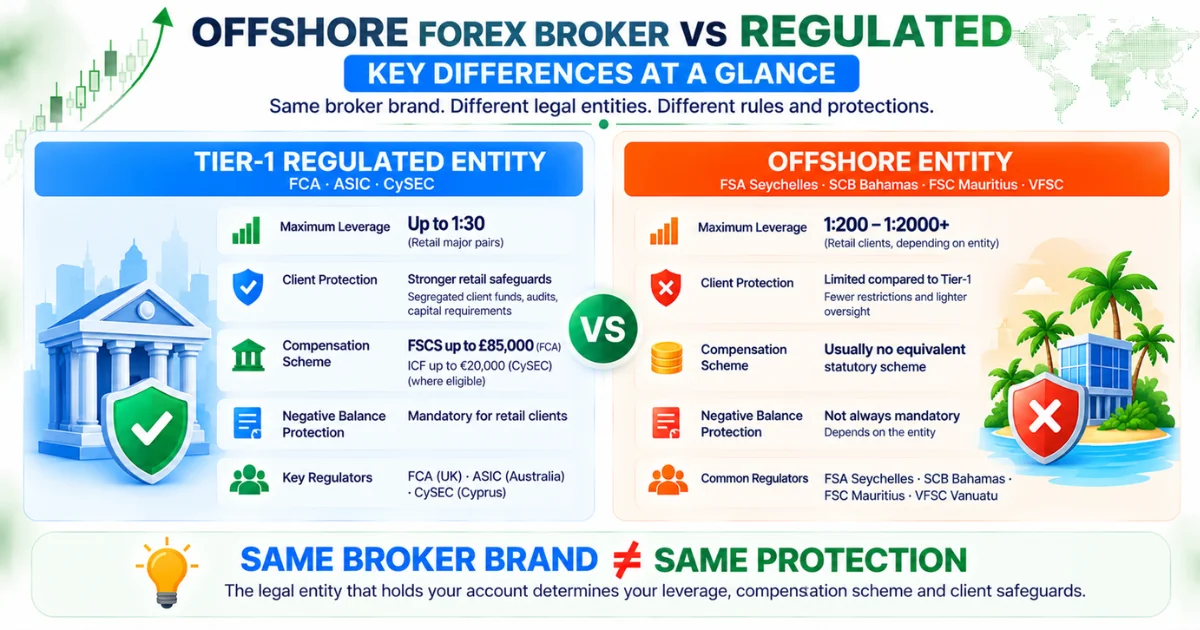
Offshore forex broker vs regulated Tier-1 entities differ mainly in compensation schemes, leverage caps, and client fund safeguards. Trading under an offshore entity of the same brand typically means no FSCS or ICF protection, higher available leverage (often 1:200 to 1:2000), and lighter oversight, while Tier-1 entities (FCA, ASIC, CySEC) provide statutory compensation and mandatory negative balance protection for retail clients.
Traders often see the same broker brand advertise both 1:30 leverage under an FCA entity and 1:500 or higher under an offshore subsidiary. The difference is not marketing. It is the legal entity that holds your account, and only that entity’s rules and protections apply to you.
What Tier-1 Regulation Actually Provides
Tier-1 regulators require brokers to segregate client funds, meet minimum capital thresholds, undergo independent audits, and participate in compensation schemes if the firm fails.
Under the UK Financial Conduct Authority, eligible retail clients of an FCA-authorised firm receive Financial Services Compensation Scheme cover of up to £85,000 per person per firm for investment claims if the broker becomes insolvent (Source: FSCS, confirmed October 2026). This is distinct from the higher £120,000 bank deposit limit that took effect on 1 December 2025.
CySEC-regulated entities in Cyprus provide Investor Compensation Fund cover up to €20,000. ASIC in Australia requires negative balance protection for retail clients and membership of the Australian Financial Complaints Authority for dispute resolution, though it does not operate a statutory cash compensation scheme equivalent to the FSCS.
These protections activate only when the firm itself fails or acts improperly. They do not cover ordinary trading losses from market moves.
What You Give Up With an Offshore Entity
Offshore entities licensed by authorities such as the FSA Seychelles, FSC Mauritius, VFSC Vanuatu, or SCB Bahamas typically offer:
- Higher maximum leverage, often 1:200 to 1:2000 or higher for retail clients
- Lower or zero minimum deposits in some cases
- Access for clients from more countries
- Fewer restrictions on bonuses or promotions
In exchange, you usually lose:
- Statutory compensation schemes (no FSCS or ICF equivalent)
- Mandatory negative balance protection in some jurisdictions
- The same level of independent audit and capital requirements
- Straightforward access to an independent ombudsman or compensation process if the firm fails
A common trader mistake is depositing with a well-known brand assuming the FCA or ASIC license covers the account, only to discover later that the contract is with the offshore subsidiary. During the 2015 Swiss franc flash crash, several offshore entities faced severe liquidity and withdrawal issues while their Tier-1 counterparts managed the event under stricter capital and margin rules.
Real Broker Entity Comparison
| Broker | Tier-1 Entity Leverage (Retail Majors) | Offshore Entity Leverage (Retail) | Compensation Scheme (Tier-1) | Compensation Scheme (Offshore) |
|---|---|---|---|---|
| Pepperstone | 1:30 (FCA/ASIC/CySEC) | Up to 1:200 (SCB Bahamas) | FSCS up to £85,000 (FCA entity) | None |
| Exness | 1:30 (FCA/CySEC entities; limited retail access) | Up to 1:2000 or unlimited (FSA Seychelles under conditions) | FSCS / ICF where applicable | None |
| IC Markets | 1:30 (ASIC/CySEC) | Higher via offshore entity | Limited or none under ASIC; ICF under CySEC | None |
Data sourced from broker official regulatory disclosures and entity pages. Last updated: October 2026. Leverage and entity routing can change; always confirm the exact legal entity in your account agreement.
Pepperstone’s FCA entity (firm reference 684312) and ASIC entity (AFSL 414530) cap retail major-pair leverage at 1:30. Its Bahamas entity (Pepperstone Markets Limited, SCB licence SIA-F217) offers up to 1:200 for retail clients and higher for professional clients (Source: Pepperstone entity disclosures, 2026).
Exness routes most international retail clients to Exness (SC) Ltd under FSA Seychelles licence SD025, where high leverage is available. Its FCA and CySEC entities exist but do not onboard the majority of retail traders from unrestricted jurisdictions.
How to Check Which Entity You Are Actually Using
- Open the account agreement or legal documents in your client area.
- Note the exact legal company name and jurisdiction listed.
- Search that company name (not the brand) on the regulator’s official register: FCA Financial Services Register, ASIC Professional Registers, or CySEC regulated entities list.
- Confirm whether the entity participates in a compensation scheme.
If the documents name a company in Seychelles, Mauritius, Bahamas, or Belize, the Tier-1 protections do not apply, even if the brand also holds an FCA or ASIC licence elsewhere.
You can browse verified Tier-1 regulated brokers and compare FCA-regulated brokers or ASIC-regulated brokers directly on ForexBrokerList.io.
When an Offshore Entity Can Still Be Reasonable
Some traders deliberately choose an offshore entity of a multi-regulated group because they want higher leverage and accept the reduced protections. This is a conscious trade-off, not an oversight.
It is generally lower risk when:
- The group also holds active Tier-1 licences (showing it can meet stricter standards)
- You keep account size small relative to what you can afford to lose
- You test withdrawals early with small amounts
- You understand there is no compensation scheme if the specific entity fails
Pure offshore brokers with no Tier-1 licences anywhere in the group carry higher counterparty risk.
For more on high-leverage options, see our guide to forex brokers with highest leverage.
Negative Balance Protection and Other Practical Differences
Most Tier-1 regulators require negative balance protection for retail clients, meaning you cannot lose more than your deposited funds even in extreme market moves. Many offshore entities offer it as a voluntary policy, but it is not always mandatory.
Withdrawal processing times, dispute resolution speed, and the strength of client-money segregation rules also tend to be stronger under Tier-1 oversight.
Conclusion
Choosing between an offshore entity and a Tier-1 regulated entity of the same broker is a decision about how much protection you want versus how much leverage and flexibility you prioritise. Tier-1 entities provide real statutory compensation (up to £85,000 under the FSCS for FCA firms) and stricter retail safeguards. Offshore entities typically give higher leverage and broader access but remove those safety nets.
Always verify the exact legal entity in your account documents and on the regulator’s register before depositing. The brand name alone does not determine your protections.
This article is for informational and educational purposes only. It does not constitute financial or investment advice. Forex and CFD trading involves significant risk of loss and is not suitable for all investors. Always verify a broker's regulatory status through official authorities such as FCA, ASIC, or CySEC before depositing funds.
Frequently Asked Questions
Dipak Dangodra | Financial Writer at Forex Broker List
I am Dipak Dangodra, a financial writer at Forex Broker List. I have published 200+ articles on forex broker reviews, trading platforms, spreads and commissions, and regulatory analysis using data from FCA, ASIC, and CySEC.
Related Blogs
Tools for Brokers: Starter Stack (2026)
 Your brand here