

How to Verify a Forex Broker License (FCA, ASIC, CySEC)
Step-by-step guide to verify forex broker licenses on official FCA, ASIC, CySEC, and FSA registers.
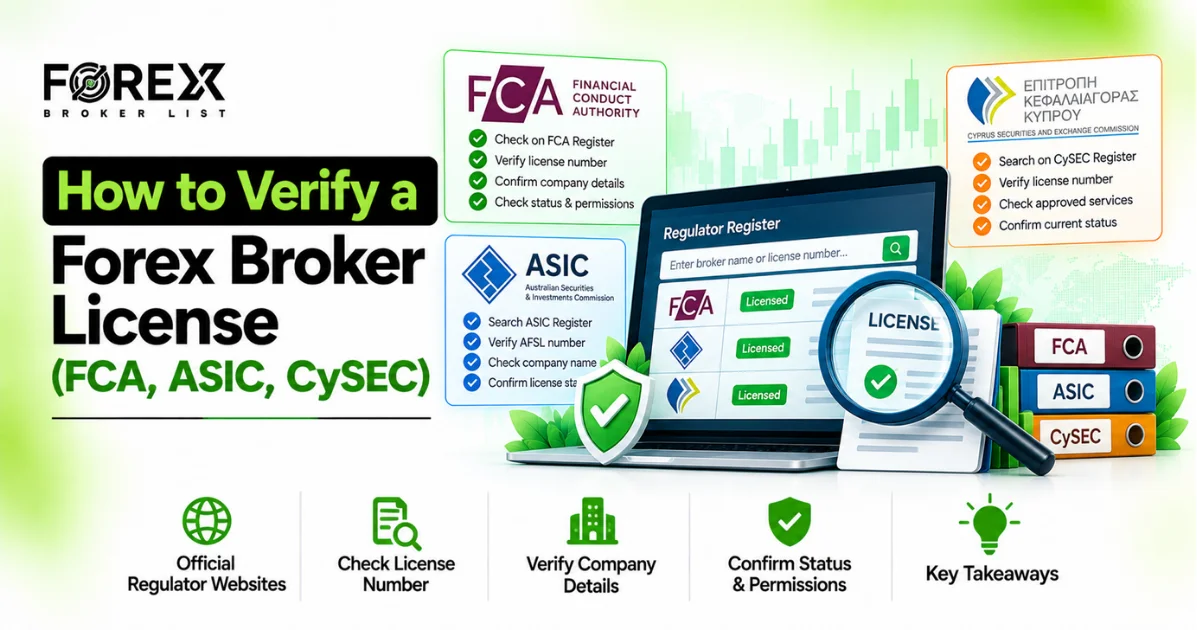
How to verify a forex broker license starts with the exact legal entity name and license number from the client agreement, then a direct search on the regulator’s own public register. Never rely on a logo, badge, or link supplied by the broker. Confirm the status is Authorised or Active, the permissions cover forex or CFDs, and the website domain matches the one listed on the register.
You open a live account and the broker shows a shiny FCA or ASIC badge in the footer. Before you deposit, you need to confirm that license yourself. A fake or mismatched license is one of the clearest red flags that your money may never return.
This guide walks you through the exact steps for the FCA, ASIC, CySEC, and Seychelles FSA. It uses real license numbers you can check today, shows common clone-firm traps, and explains why the entity on your agreement matters more than the brand name. For a broader view of what regulation actually protects, see our guide on what a regulated forex broker means.
Why You Must Verify the License Yourself
Brokers display regulatory logos because they attract deposits. Scammers copy those logos easily. Even legitimate multi-entity groups can list a Tier-1 license that does not apply to the company holding your account.
The only reliable check is the regulator’s official register. These registers are free, public, and updated by the authorities themselves. Searching them takes under five minutes and is the single strongest protection against losing your deposit to an unlicensed firm.
Real example: Pepperstone Limited holds FCA Firm Reference Number 684312. You can confirm this on the FCA Financial Services Register as of October 2026 (Source: FCA register). The same group’s Australian entity, Pepperstone Group Limited, holds ASIC AFSL 414530. Different entity, different protections.
You can browse more FCA-regulated brokers and ASIC-regulated brokers on our directory.
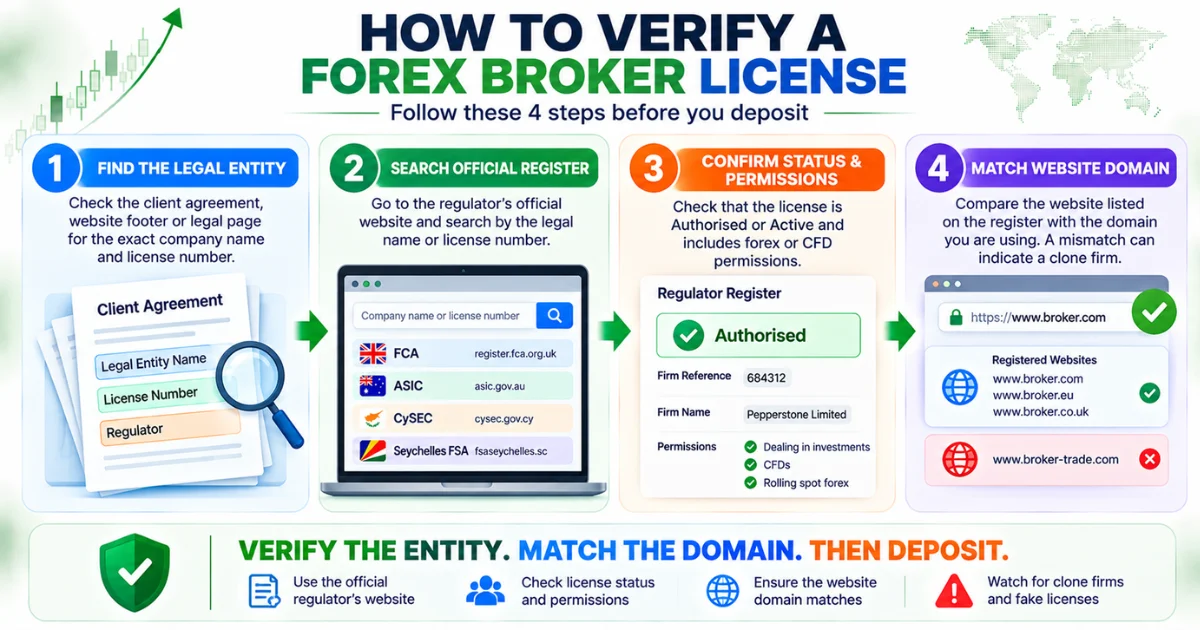
Step 1: Find the Exact Legal Entity and License Number
Start in the client agreement or terms of business, not the homepage banner. Note the full company name, including “Ltd”, “Pty Ltd”, or “Limited”, plus the license number and the regulator.
Also check the website footer and any “Regulation” or “Legal” page. Write both the brand name and the legal entity. Many groups run several companies under one brand. Only the company named on your agreement protects your funds.
Common places to look:
- Footer of the website
- Account opening agreement
- Product disclosure statement or client terms
- “About us” or “Regulation” page
If the documents only show the brand name and no license number, treat that as a warning. This step is also the first filter in our full how to choose the best forex broker process.
How to Check an FCA License (United Kingdom)
The Financial Conduct Authority maintains the Financial Services Register at register.fca.org.uk.
Steps:
- Go directly to register.fca.org.uk (type the address yourself).
- Search by the Firm Reference Number (FRN, usually six digits) or the exact legal name.
- Confirm the status reads “Authorised”.
- Open the permissions and check they include dealing in investments, CFDs, or rolling spot forex.
- Compare the websites listed on the register with the domain you are using. A mismatch often signals a clone.
Pepperstone Limited (FRN 684312) shows as Authorised on the FCA register (Source: FCA, checked October 2026). UK clients of this entity may have access to the Financial Services Compensation Scheme up to £85,000 per person per firm under current FSCS rules.
Always cross-check the domain. Clone firms copy real FRNs and then use a different website. For more brokers under this regulator, see our list of FCA-regulated forex brokers.
How to Check an ASIC License (Australia)
ASIC publishes the Professional Registers Search at asic.gov.au.
Steps:
- Visit asic.gov.au and open the Professional Registers Search (or use connectonline.asic.gov.au for company searches).
- Search by the AFSL number or the exact licensee name.
- Confirm the license type is Australian Financial Services Licensee and the status is Current.
- Check the authorised financial services include dealing in derivatives or foreign exchange contracts for retail clients.
- Note any conditions or limitations listed on the entry.
International Capital Markets Pty Ltd (IC Markets) holds ASIC AFSL 335692 and has been current since 2009 (Source: ASIC registers and IC Markets disclosures, October 2026). Pepperstone Group Limited holds AFSL 414530. Searching only the brand name “Pepperstone” or “IC Markets” can return incomplete results; always use the legal entity.
ASIC does not run a client compensation fund equivalent to the UK FSCS. Protection relies on capital requirements and client-money rules. Explore more options in our ASIC-regulated brokers directory.
How to Check a CySEC License (Cyprus)
CySEC maintains a public list of regulated investment firms at cysec.gov.cy under Entities > Investment Firms (Cypriot).
Steps:
- Go to cysec.gov.cy and navigate to the list of Cypriot Investment Firms.
- Search by company name or CIF license number (format usually number/year, e.g. 120/10).
- Confirm the status is Active and not suspended or under voluntary renunciation.
- Check the approved domains listed for that firm. The site you are using must appear.
- Review any notes attached to the entry.
Trading Point of Financial Instruments Ltd (XM) holds CySEC license 120/10 (Source: CySEC public list and XM disclosures, October 2026). EU clients of CySEC firms may be covered by the Investor Compensation Fund up to €20,000 under current rules.
CySEC also publishes a separate list of approved domains. Matching the domain is one of the fastest ways to spot a clone. See our full list of CySEC-regulated brokers for comparison.
How to Check a Seychelles FSA License
The Seychelles Financial Services Authority lists regulated entities at fsaseychelles.sc under Regulated Entities > Capital Markets > Securities Dealers.
Steps:
- Visit fsaseychelles.sc and open the regulated entities section.
- Select Capital Markets, then Securities Dealers.
- Search for the exact company name.
- Confirm the firm appears with a Securities Dealer license and matching address or trade names.
- Note that the FSA register often shows less detail than Tier-1 registers (no full status field in some views).
Exness (SC) Ltd holds Seychelles FSA Securities Dealer license SD025 (Source: Exness official disclosures and FSA register references, October 2026). Many international clients of multi-entity groups are routed to the Seychelles entity rather than a Tier-1 one.
Seychelles FSA is an offshore regulator. Capital requirements and client protections are lighter than those of the FCA, ASIC, or CySEC. Always confirm which entity actually holds your account. For stronger protection options, compare Tier-1 regulated brokers.
Real License Numbers You Can Check Today
| Broker (Brand) | Legal Entity | Regulator | License Number | Status Note |
|---|---|---|---|---|
| Pepperstone | Pepperstone Limited | FCA | 684312 | Authorised (UK) |
| Pepperstone | Pepperstone Group Limited | ASIC | 414530 | Current AFSL |
| IC Markets | International Capital Markets Pty Ltd | ASIC | 335692 | Current since 2009 |
| XM | Trading Point of Financial Instruments Ltd | CySEC | 120/10 | Active CIF |
| Exness | Exness (SC) Ltd | FSA Seychelles | SD025 | Securities Dealer |
Data sourced from FCA, ASIC, CySEC, and broker official disclosures. Last updated: October 2026.
These are public numbers. Search them on the registers yourself before depositing. A matching number does not guarantee the entity serving you is the same one.
Clone Firms and Warning Lists
Clone firms use a real broker’s name and license number but operate a different website or phone number. The FCA and other regulators publish warnings about clones on their registers.
Practical checks:
- Type the regulator website address yourself. Do not click links sent by email or chat.
- Match the website domain listed on the register exactly.
- Search the broker name on the regulator’s warning list and on IOSCO’s I-SCAN tool.
- Confirm the company name in your agreement matches the register entry letter for letter.
If the domain on the register differs from the one you are using, stop and do not deposit. This is one of the key red flags covered in our related guide on how to check if a forex broker is legit.
Which Entity Actually Holds Your Account?
Many groups (Pepperstone, IC Markets, XM, Exness) operate multiple regulated companies. The homepage may highlight the FCA or ASIC license while your account is opened with an offshore entity.
Check the footer of your Personal Area or the final client agreement after registration. The entity named there determines your compensation scheme, leverage limits, and dispute resolution path. An FCA license on the website does not automatically cover an account held by a Seychelles company.
Common Mistakes That Cost Traders Money
Traders often stop after seeing a logo. They deposit, then discover the license is expired, the entity is different, or the firm was never authorised for forex.
In 2015 the Swiss franc flash crash caused large losses at some brokers. Clients of properly regulated firms with negative balance protection recovered faster than those at unregulated or poorly capitalised firms. The same principle applies today: verification before the deposit is cheaper than recovery after a problem.
Another frequent error is trusting a certificate image on the broker’s site. These images are easy to fake. Only the live register counts.
What to Do If the License Does Not Match
Do not deposit. Contact the regulator’s consumer helpline using the phone number on the official website (never a number supplied by the broker). Report the mismatch.
If you already deposited, document everything and contact the regulator and any available compensation scheme immediately. Recovery chances drop sharply once funds leave a regulated entity.
Conclusion
Verifying a forex broker license takes five minutes and uses free public registers. Find the legal entity and license number, search the regulator’s own site, confirm status and permissions, and match the domain. Use the real numbers above as practice. The entity on your agreement decides your actual protection, not the badge on the homepage.
For the next step after verification, use our how to choose the best forex broker in 2026 framework or browse Tier-1 regulated brokers.
Disclaimer: This article is for informational and educational purposes only. It does not constitute financial or investment advice. Forex and CFD trading involves significant risk of loss and is not suitable for all investors. Always verify a broker's regulatory status through official authorities such as FCA, ASIC, or CySEC before depositing funds.
Frequently Asked Questions
Dipak Dangodra | Financial Writer at Forex Broker List
I am Dipak Dangodra, a financial writer at Forex Broker List. I have published 200+ articles on forex broker reviews, trading platforms, spreads and commissions, and regulatory analysis using data from FCA, ASIC, and CySEC.
Related Blogs
Tools for Brokers: Starter Stack (2026)
 Your brand here